

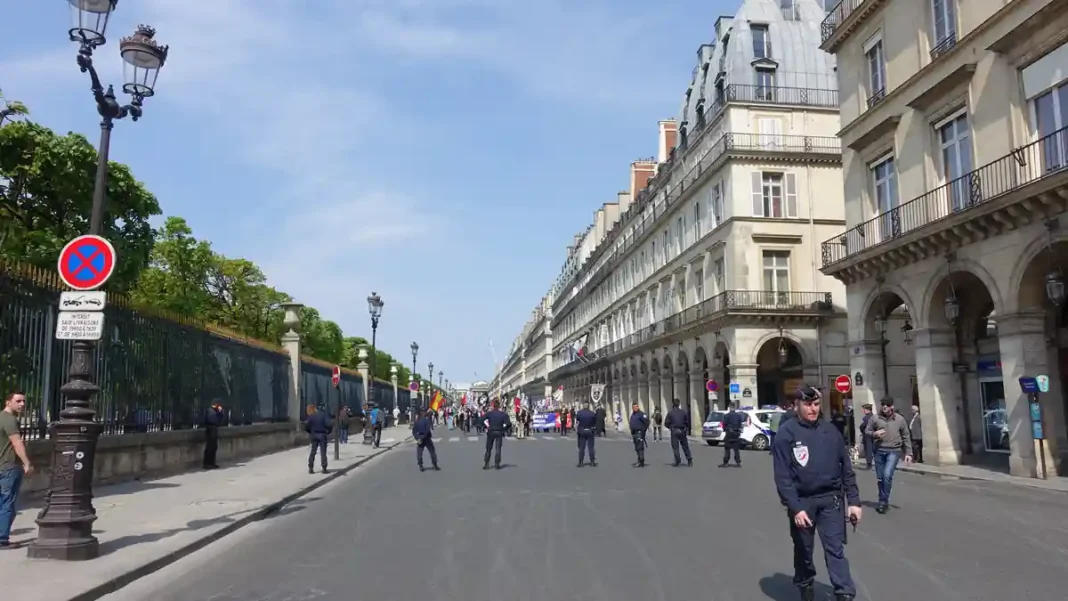
The France student protests police response is facing its most serious reckoning yet. A 14-year-old boy suffered a broken jaw and multiple smashed teeth when a police officer fired a tear gas canister into his face at close range during student demonstrations, one of 24 cases now under investigation by France’s internal police watchdog.
The teenager, identified only as Eden, had been sitting on a wall looking at his phone metres away from the protest in Saint-Ouen-l’Aumone when the confrontation unfolded, according to his family’s lawyer.
France student protests police case: what happened to Eden
According to the local prosecutor, an officer approached Eden and struck him with a baton, prompting the boy to respond with a kick. A second officer then fired a tear gas grenade from a Cougar launcher, hitting him directly in the face.
“(The officer) shot him in the mouth and left him lying on the ground, without even calling the emergency services,” said lawyer Elsa Marcel. The family, which asked for Eden’s second name to be withheld, has filed a complaint for attempted murder.
The officer told investigators he was seeking to protect himself and his colleagues after the student confronted police. He was placed under formal investigation on Tuesday, eight days after the incident, on charges of assault by a public official resulting in permanent disability or disfigurement.
Eden’s mother said he underwent surgery and could neither speak nor eat normally, relying on a straw for liquids.
A pattern of serious injuries
Eden’s case is not isolated. It is one of 24 investigations opened by the IGPN, the police oversight body, into the policing of a wave of student unrest that has run for more than two weeks over conditions in French schools.
In Lens, a 15-year-old lost a hand in an incident involving a police stun grenade, prompting Interior Minister Laurent Nuñez to suspend the use of such grenades during the protest movement. In Tours, prosecutors suspect a police riot-control round partially blinded a 16-year-old.
The demonstrations began in September over teacher shortages, overcrowded classrooms and crumbling school buildings, and have since drawn in parents, teachers, university students and trade unions. More than 250,000 people marched on Tuesday according to the Interior Ministry, with organisers putting the figure at 450,000. Police reported 488 arrests that day.
Prime Minister Sebastien Lecornu has described the demonstrations as the most violent in decades, with clashes involving rioting, vandalism and attacks on officers reported in Paris, Strasbourg, Rennes and Toulouse.
Calls to ban ‘less-lethal’ weapons
The injuries have renewed demands for France to withdraw rubber bullets and grenade launchers, weapons not used by police in many other European countries. Rights groups, including Amnesty International and UN human rights experts, have repeatedly criticised them as dangerous and disproportionate.
Police unions counter that officers need intermediate force options when protests turn violent, blaming the injuries on the intensity of the clashes.
The controversy lands in a country with a long history of fraught protest policing, from the yellow-vest movement to pension reform demonstrations. Each cycle of injuries revives the same unresolved debate over where legitimate crowd control ends and excessive force begins.
France has seen repeated waves of student unrest in recent weeks, with hundreds of schools shut at the peak of the disruptions and violence flaring outside high schools. Earlier protests also saw school buildings torched, a reminder of how quickly the movement has escalated.
With the IGPN investigations ongoing and the stun-grenade suspension in place, the government’s handling of the coming demonstrations will be watched closely, in France and beyond.
Frequently asked questions
What happened to the 14-year-old in Saint-Ouen-l’Aumone?
Eden suffered a broken jaw and smashed teeth when a police officer fired a tear gas canister at his face at close range during student protests. His family has filed an attempted murder complaint.
How many police cases are under investigation?
France’s IGPN police watchdog is investigating 24 cases linked to the policing of the student protest wave, including the Eden case, a teenager who lost a hand in Lens and a student partially blinded in Tours.
Why are French students protesting?
The movement began in September over teacher shortages, overcrowded classrooms and deteriorating school buildings, and has grown into a nationwide protest backed by parents, teachers and unions.
Has France restricted police weapons?
Interior Minister Laurent Nuñez suspended police use of stun grenades during the protest movement after the Lens incident, and rights groups are demanding a wider ban on rubber bullets and grenade launchers.