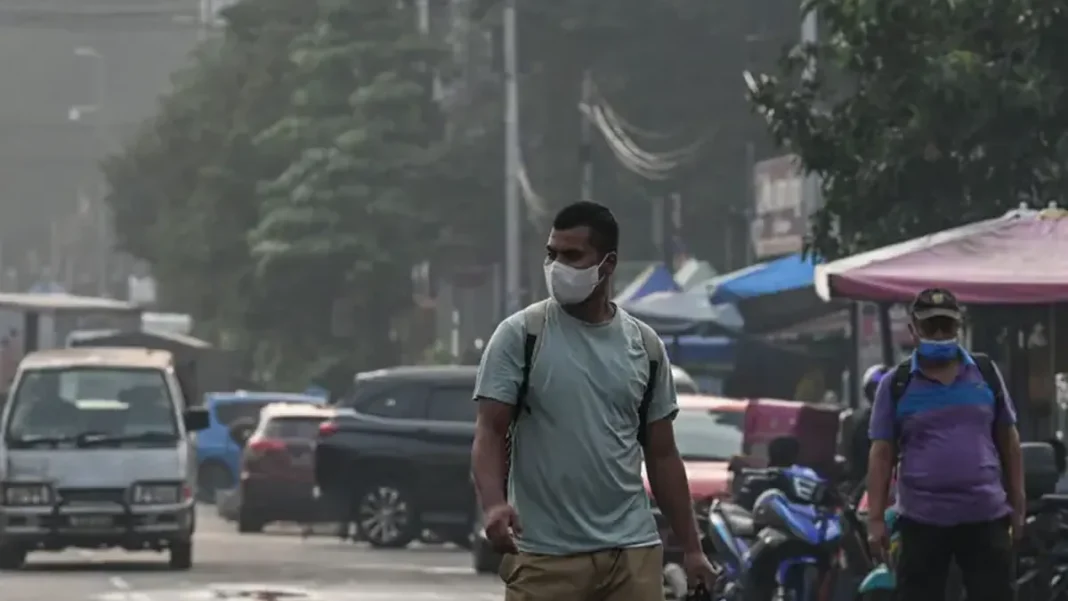
People across Singapore queued at community clubs to collect free N95 masks. As a result, dense smoke haze from fires in Kalimantan had pushed air pollution deep into the unhealthy range. Specifically, the PSI stood at 188 in the west by 5pm on Oct 15. In the central region, it stood at 186. Meanwhile, PM2.5 sat in the high band across the island. Subsequently, the Singapore haze masks distribution began after the People’s Association announced the move. That was on Oct 14, when PM2.5 spiked above 200 in many areas.
Singapore haze masks: queues, not shelters, draw the crowds
For example, at Punggol 21 community club, about 20 people queued from 10am. In addition, about 15 were in line at Jurong Spring at 10.20am. Moreover, small crowds gathered at Kallang and Sengkang points. In addition, several mostly senior residents went to Yuhua community club in Jurong East shortly after 8pm.
Seniors, pregnant women, younger children, and people with medical conditions can collect two free masks each.
Indeed, Tan, a 73-year-old coffee shop stall assistant, collected his to be on the safe side. “I’m spending less time outdoors because of the haze,” he told The Straits Times. He added: “After work, I just go straight home.” He also said the distribution was efficient.
Meanwhile, Elien Chan, a salon worker in her 50s, queued wearing a surgical mask. In fact, she had felt nose sensitivity and a headache during the Oct 14 spike. One N95 mask lasts only three days. “Two pieces are not enough,” she said. She added: “They cannot be washed.”
According to K.C. Tan, a 68-year-old retired aviation officer, several pharmacies he visited were sold out of N95 masks. As a result, he had paused his morning workouts for days with a sore throat. Instead, he relied more on air purifiers and air-conditioning at home. In addition, Joel Tan, a 40-year-old real estate consultant, collected masks for his primary schoolchildren. He noted there was little stock of masks in the market. Consequently, his 11-year-old daughter Chloe had developed a cough, and her school moved recess meals into classrooms. Furthermore, retiree Chew Lai Fong collected masks for herself and her husband. She also offered to get them for neighbours living alone.
In contrast, the haze shelters drew far fewer people. At Yuhua, a room was stocked with drinks, water, and snacks. Specifically, at One Punggol’s shelter, the only person present at 11am on Oct 15 was retired ship captain Sarun. He was waiting for his granddaughter’s childcare pickup.
What the PSI and PM2.5 readings mean
Singapore’s Pollutant Standards Index (PSI) is the official 24-hour measure of air quality. It is calculated from six pollutants. These are PM2.5, PM10, sulphur dioxide, ozone, nitrogen dioxide, and carbon monoxide. In this scale, 0 to 50 is good and 51 to 100 is moderate. For example, 101 to 200 is unhealthy, while 201 to 300 is very unhealthy. Finally, above 300 is hazardous. Indeed, at 188, the west sat firmly in the unhealthy band.
The 1-hour PM2.5 reading measures fine particle concentration over the latest hour. In this scale, 0 to 55 is normal. Meanwhile, 151 to 250 is high, and 251 and above is very high. Specifically, the central region’s 205 fell in the high band. The west read 155, the east 161, and the south 157. Consequently, mask distribution began because PM2.5 had crossed 250 in some areas. At unhealthy levels, people should reduce prolonged or strenuous outdoor exertion. Moreover, smog-hit cities use other measures too. Punjab has asked schools to promote carpooling as Lahore’s AQI nears 200.
Lahore has faced its own air-quality crises, with ozone pollution pushing the city’s readings into dangerous territory. In addition, its AQI has climbed as high as 155 in recent spells.
Why the haze keeps returning
The National Environment Agency spoke on Oct 15 about the haze’s source. Specifically, it said dense smoke haze from fires in Kalimantan kept drifting towards Singapore. South-easterly winds were carrying it, with smoke also seen over Sumatra. Showers were expected on Oct 16. However, southern Sumatra and parts of Kalimantan would likely stay dry. In addition, east-south-easterly winds would keep carrying smoke towards Singapore. The haze was not expected to ease by Oct 18. However, weekend showers and a wind shift could reduce it.
Meanwhile, dry conditions have persisted across parts of the southern ASEAN region. Hotspots and smoke remain in southern and central Sumatra and parts of Kalimantan. On Sept 4, Singapore recorded its first unhealthy PSI episode since October 2023. That day, the central region crossed 101.
Unusual weather patterns are also affecting the region closer to home. In addition, Sindh has recorded a monsoon rainfall deficit this year.
FAQs
What is the difference between PSI and PM2.5?
The PSI is Singapore’s official 24-hour air quality index, based on six pollutants. In contrast, the 1-hour PM2.5 reading covers only the latest hour and shows current conditions faster.
Who can collect free N95 masks in Singapore?
For example, seniors, pregnant women, younger children, and people with medical conditions can collect two masks each. They are available from designated community club distribution points.
When will the Singapore haze clear?
According to the National Environment Agency, the haze was not expected to ease by Oct 18. However, weekend showers and a wind shift could reduce the smoke from Kalimantan.
Sources: Dawn; NEA’s PSI scale explained