


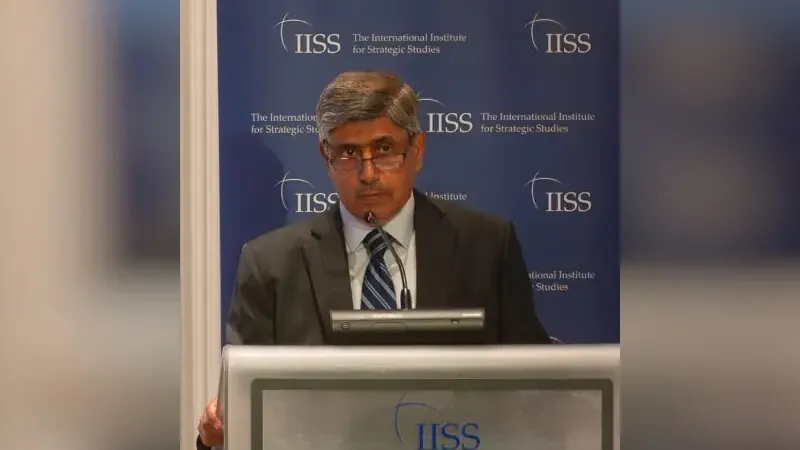
Adviser to the National Command Authority Lt Gen (retd) Mazhar Jamil has warned that Indian military doctrines shaped by a “dangerous ideology” show a poor sense of nuclear realities and endanger South Asia and beyond.
Jamil, a former director general of the Strategic Plans Division, made the remarks in a keynote address at a workshop titled “Nuclear Deterrence and Strategic Stability in South Asia”. The workshop was held last week in London by the International Institute for Strategic Studies, which shared a transcript of his address late on Monday.
Indian military doctrines show “poor strategic sense”, says Jamil
“Indian military thinking is being shaped by a dangerous ideology, which conflates mythology with national power,” Jamil said. “The outcome is very risky and delusional Indian military doctrines with a poor strategic sense of nuclear realities are endangering South Asia and beyond.”
He argued that a strategic stability model for any region must account for the political beliefs and strategic thinking of states, since those shape policy. In South Asia, he said, military adventurism and hegemonic ambitions are “highly risky and unaffordable” in a nuclearised environment.
Jamil said Kashmir remained the core dispute between the two rivals and needed resolution under United Nations Security Council resolutions. He accused India’s political leadership of avoiding conflict resolution because it believes it has no locus standi on Kashmir at multilateral forums, and of managing the dispute through military means instead.
He also pointed to what he called a political transformation led by the Hindutva doctrine, which he said seeks to marginalise non-Hindu citizens, especially Muslims. That shift, he said, has added “an additional layer of complexity to the regional security environment”. India’s domestic politics have drawn scrutiny before; Feature Pakistan earlier explained the controversy over voter-roll deletions in India.
Three lessons for strategic stability
Jamil said India’s leadership seemed “frozen in time and unable to break the shackles of history”, and laid out three lessons he called vital for stability.
First, conflicts outlast military adventurism and wars unless they are resolved politically. The Kashmir conflict therefore needs a political approach and dialogue, he said.
Second, any military misadventure between two nuclear powers can only escalate a crisis to undesirable consequences. India, he said, must understand it “cannot dictate its unjustified and illegal policy objectives through military aggression to another nuclear power”.
Third, citing military scholar Carl von Clausewitz, he warned that “war is the realm of uncertainty and escalation is really a control ladder”. Wars that begin with confidence often end with the realisation that control was illusory, he said, and in nuclearised South Asia “that realisation may come too late to manage safely”.
What the NCA and SPD are
The National Command Authority is Pakistan’s apex nuclear decision-making body, and the Strategic Plans Division acts as its secretariat. Jamil led the SPD before retiring, which gives his remarks weight in strategic circles.
His comments come against a tense backdrop. India holds the Indus Waters Treaty in abeyance, and Jamil accused New Delhi of supporting groups such as the Tehreek-i-Taliban Pakistan and the Balochistan Liberation Army, a charge Pakistan has raised at the United Nations. Foreign Minister Ishaq Dar told the SCO summit in Dushanbe on Tuesday that Pakistan has one expectation from the Taliban regime: Afghan soil must not be used for terrorism.
Jamil also recalled the March 9, 2022 BrahMos missile incident, when it took India 48 hours to inform Pakistan, and the launch of dual-capable BrahMos missiles during the four-day military conflict in May 2025. He also cited India’s fast-growing nuclear and missile programmes and a SIPRI assessment on sea-based deterrence patrols.
“While Pakistan remains committed to peace, strategic stability and responsible nuclear stewardship, it cannot ignore these dangerous escalatory steps,” he said. “Pakistan reserves the right to undertake all appropriate measures to safeguard its national security.”
Who is Mazhar Jamil?
A retired lieutenant general, former director general of the Strategic Plans Division, now serving as an adviser to the National Command Authority.
Where did he make the remarks?
In a keynote at an International Institute for Strategic Studies workshop in London on nuclear deterrence and strategic stability in South Asia.
What are his main warnings?
That Indian military doctrines reflect a mythological and revisionist outlook, show poor understanding of nuclear realities, and risk catastrophic miscalculation.
What did he say about the May 2025 conflict?
That India rushed to blame Pakistan for the Pahalgam attack, launched an offensive aimed at “escalation domination”, and underestimated Pakistan’s resolve, bringing South Asia close to nuclear catastrophe.

 Mazhar Jamil has warned that Indian military doctrines show a poor sense of nuclear realities, endangering South Asia.)