Pakistan Tells UN Israeli Actions in Syria ‘Counterproductive’, Demands Withdrawal
Pakistan condemns Israeli actions in Syria, the country’s envoy told the UN Security Council on Monday, warning that continued Israeli military operations were undermining peace in the region.
Pakistan condemns Israeli actions in Syria at UN briefing
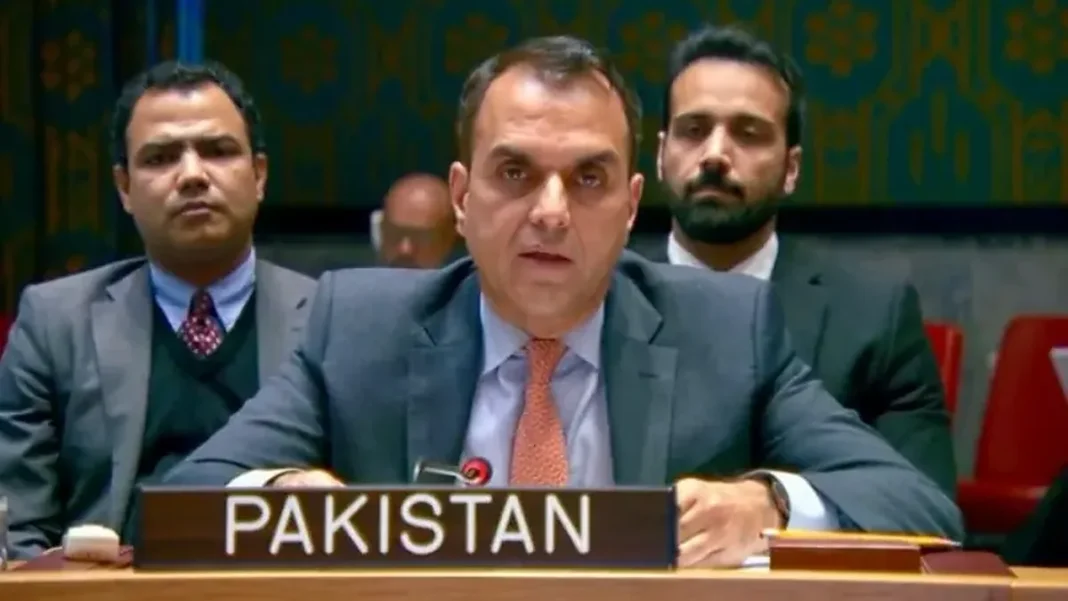
Ambassador Usman Jadoon, Pakistan’s Acting Permanent Representative to the United Nations, addressed a Security Council briefing on the humanitarian and political situation in Syria. He described continued Israeli military actions as “profoundly counterproductive to the prospects for regional peace and stability”, calling them flagrant violations of international law and of Syria’s sovereignty and territorial integrity.
Pakistan reiterated its demand for Israel’s withdrawal from all occupied Syrian territory. It also called for full respect for the 1974 Disengagement of Forces Agreement. The occupied Syrian Golan remains Syrian territory under international law and Security Council resolutions 338 and 497, the ambassador said.
The statement forms part of Pakistan’s sustained engagement at multilateral forums, where Islamabad has repeatedly raised territorial integrity and international law.
Backing for Syria’s political transition
Jadoon welcomed the Syrian government’s efforts toward national reconciliation and political transition. He said Syria’s unity and diversity were mutually reinforcing. Progress in engagement with the SDF, the Kurdish-led Syrian Democratic Forces, also drew Pakistan’s approval. Outstanding challenges, including the situation in Suweida, should be addressed through dialogue with full respect for Syria’s unity, sovereignty and territorial integrity.
This marks a sharp turn from the country’s recent past. Bashar al-Assad was ousted in late 2024 after a popular uprising that ended decades of authoritarian rule. Ahmed al-Sharaa now leads Syria and has moved to engage more closely with the international community. He has promised accountability for past atrocity crimes and begun government reforms. For a country that endured years of civil war, the shift has opened a narrow window for rebuilding.
Reconstruction needs sustained international support
The envoy stressed that Syria’s reconstruction and economic revival deserve sustained international support. The lifting of sanctions by the United States and the European Union, expanding investment and new economic partnerships would give real impetus to recovery. At the same time, sustained humanitarian assistance remains essential for millions of Syrians.
Economic diplomacy of this kind echoes Pakistan’s own dealings with multilateral lenders, where policy choices in Washington and Brussels carry direct consequences for ordinary citizens. Sanctions relief, if it holds, could let Syria’s battered economy breathe again. Relief on paper must still become real trade and finance flows before households feel any difference.
The statement also reflects Pakistan’s wider diplomatic activity across the region, as Islamabad builds partnerships that link economic cooperation with political stability.
Counter-terrorism vigilance and the regional picture
Jadoon warned that the threat from Daesh and other terrorist groups, including foreign terrorist fighters, requires sustained vigilance. Pakistan supports Syria’s counter-terrorism efforts and the strengthening of its national institutions.
The warning lands in an uneasy neighbourhood. Tensions around Iran and the broader Middle East have kept the region on edge, as reflected in recent assessments of shifting alliances. For Syria, stability remains fragile while outside powers continue to strike inside its borders.
He closed by noting that fraternal ties between Pakistan and Syria continue to grow. Leaders of the two countries met on the sidelines of the UN General Assembly High-Level Week, reaffirming their shared commitment to stronger bilateral relations.
Read the full statement as reproduced by WE News English and the APP report carried by Tez Khabar.
What did Pakistan ask Israel to do at the UN?
Pakistan demanded Israel’s withdrawal from all occupied Syrian territory and full respect for the 1974 Disengagement of Forces Agreement, stressing that the occupied Syrian Golan remains Syrian territory under international law and resolutions 338 and 497.
Why does Pakistan support lifting sanctions on Syria?
Ambassador Jadoon argued that US and EU sanctions relief, along with expanding investment and economic partnerships, would give impetus to Syria’s recovery, with sustained humanitarian assistance remaining essential.
Who leads Syria after Bashar al-Assad?
Ahmed al-Sharaa now leads Syria after Bashar al-Assad’s ousting in late 2024. He has engaged more closely with the international community, promised accountability for past atrocity crimes and undertaken reforms.
What is the SDF?
The SDF, or Syrian Democratic Forces, is the Kurdish-led military alliance that controls parts of northeastern Syria. Pakistan welcomed progress in the Syrian government’s engagement with the group as part of the wider reconciliation process.