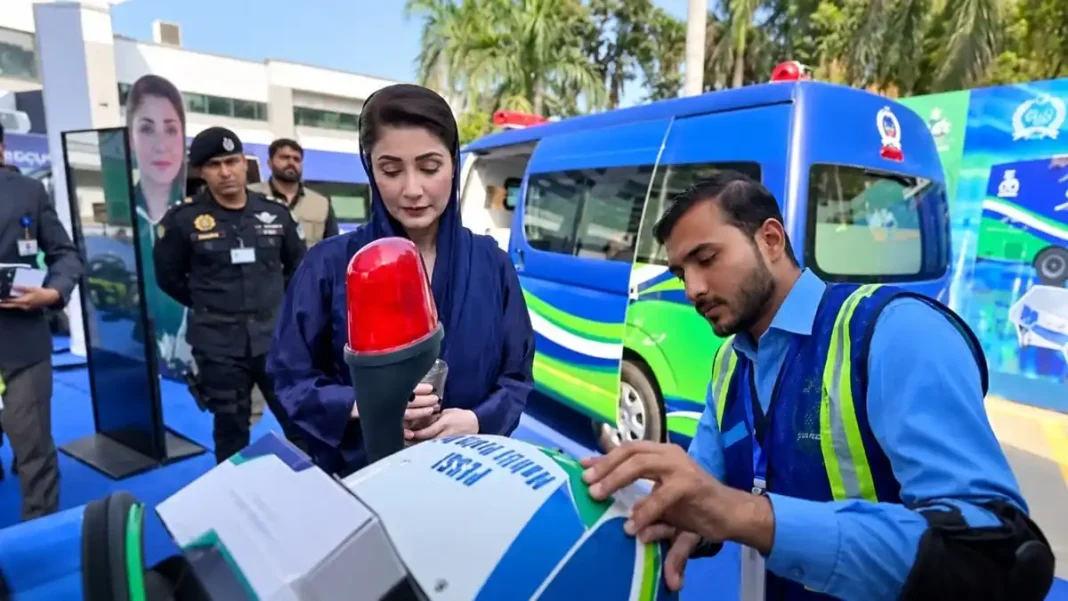
Punjab Chief Minister Maryam Nawaz Sharif launched the Social Security Mobile Health Programme in Lahore on Monday. The Punjab mobile health units will take medical services to more than 4.6 million industrial workers and their families. Care will reach people at their workplaces and at their doorsteps, instead of only inside hospitals.
The first phase covers Lahore, Kasur and Sheikhupura. The programme will then expand to 12 more districts by March 2027. It runs through the Punjab Employees Social Security Institution, known as PESSI.
Punjab mobile health units: what the fleet carries
The fleet fields 10 mobile hospitals and five mobile clinics. A mobile dental hospital and a mobile cardiac unit complete the larger vehicles. Forty motorcycles and 10 scooters support the teams on narrower routes.
Each mobile hospital carries male and female doctors, radiologists, nurses, laboratory technicians and X-ray technicians. The vehicles hold outpatient departments, radiology facilities and pathology laboratories. As a result, a worker can consult a doctor, give a blood sample and get an X-ray in one visit.
The service list is practical. Units will offer medical consultations, basic medicines and first aid. They will also run diagnostic tests, give telemedicine appointments and spread health awareness. The dental hospital adds dental treatment, dental X-rays and intraoral camera checks. The cardiac unit, meanwhile, gives first screenings and consultations for heart problems.
Every unit links back to a digital hub at PESSI headquarters. Officials there can watch each vehicle’s location, route and field work in real time. That tracking should show whether units keep to their schedules across the three districts.
Screening factories and schoolchildren for heart disease
One part of the programme looks beyond daily illness. Mobile screening teams will visit 29,845 factories, industrial units and other workplaces across Lahore, Kasur and Sheikhupura. Their task is the early detection of rheumatic heart disease, a condition that damages heart valves and often starts quietly in younger people.
The teams will also screen 54,000 children who study in workers’ welfare schools across Punjab. The mobile cardiac unit will handle first screenings and follow-up consultations for workers and their families. Early detection matters here, because heart valve damage is far easier to manage when doctors find it early.
That focus fits a wider pattern in public healthcare this year. In Karachi, doctors at the Jinnah Postgraduate Medical Centre recently expanded free radiotherapy for breast cancer patients, another service where cost shuts many families out. Screening drives work on the same logic: our coverage of 44,000 breast cancer cases reported in Pakistan each year showed how late diagnosis, not only treatment, drives poor outcomes.
Why factory-gate care matters for workers
For a daily-wage or factory worker, a hospital trip costs more than the consultation. It can mean a lost shift, travel fares and a full day away from the production line. So minor problems often go unchecked until they turn serious. Bringing a clinic to the factory gate removes that trade-off for registered workers.
Worker welfare has stayed in the headlines this month. The Supreme Court recently dismissed a Sindh government plea in the Baldia factory fire case, a reminder of how weak workplace protection once proved in Pakistan’s factories. At the same time, textile exporters have warned of a steep fall in orders, which puts further pressure on the same workforce this programme serves.
At the launch, the chief minister said the programme would improve access to care for registered workers and their families. She said it would also ensure timely diagnosis and treatment. She added that the government already provides treatment and medicines through 24 social security hospitals. Services will also run through 250 PESSI medical outlets. Mobile services at factories and commercial sites, she said, will reduce the burden on those hospitals.
The test now is delivery. The expansion deadline of March 2027 gives the programme a clear marker. Workers in the first three districts will judge it on simpler things, though: whether the vans arrive on schedule, and whether medicines stay in stock.
What is the Social Security Mobile Health Programme?
It is a Punjab government programme launched by Chief Minister Maryam Nawaz Sharif on October 12, 2026. It uses mobile hospitals, clinics and specialist units to serve more than 4.6 million industrial workers and their families.
Which areas do the Punjab mobile health units cover first?
The first phase covers Lahore, Kasur and Sheikhupura. The programme will expand to 12 additional districts by March 2027.
What services do the mobile units provide?
The units provide medical consultations, basic medicines, first aid, diagnostic tests, telemedicine and health awareness. Specialist units add dental treatment and cardiac screening, including checks for rheumatic heart disease at factories and workers’ welfare schools.