Shehbaz briefs allies on KP governor’s rule, calls it the “most difficult decision”
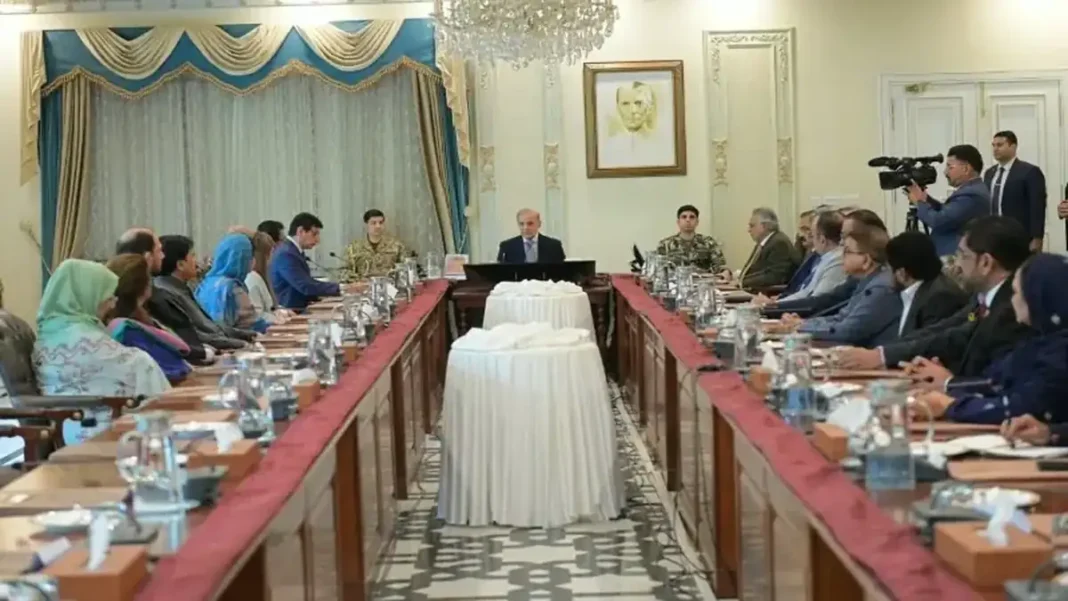
Prime Minister Shehbaz Sharif held back-to-back meetings with allied parties on Monday to explain the KP governor’s rule, telling them the Centre had made every effort to avoid what he called the “most difficult decision” taken in the interest of the province’s people. “We made every effort to avoid taking this extreme step in any way,” the prime minister said.
Shehbaz met an MQM-P delegation led by Education Minister Khalid Maqbool Siddiqui, which included Health Minister Mustafa Kamal, senators Amir Waliuddin Chishti and Khalida Ateeb, and MNA Farooq Sattar. He separately briefed a parliamentary delegation of the PML-Q, BAP, IPP and PML-Zia, including Khalid Magsi, Sadiq Sanjrani and Chaudhry Salik Hussain, and addressed a PML-N parliamentary party meeting.
Ishaq Dar, Khawaja Asif, Azam Nazeer Tarar, Tariq Fazal Chaudhry and Rana Sanaullah attended from the government side. After all the consultations, Shehbaz told his party, it was decided that “this is the moment to save Pakistan.”
Inside the KP governor’s rule briefings
The briefings are the government’s first detailed public account of why it moved against a PTI-run province. The Centre imposed governor’s rule in Khyber Pakhtunkhwa and emergency in 12 districts on Sunday, citing the provincial government’s “deliberate disengagement” from the fight against terrorism.
Shehbaz said attacks targeting civilians and security forces had risen while the province failed to denounce terrorist groups. “Pakistan comes first,” he told the PML-N parliamentary party. “Nothing is more important than the country’s progress and survival.”
He said the step followed consultations with allies and the worsening law-and-order situation, with restoring peace and accelerating development as the top priorities.
The October 3 talks that collapsed
Shehbaz gave the allies his version of the failed dialogue with the opposition. He said the Centre negotiated “with an open heart” but got no positive response, and that the October 3 government-opposition talks collapsed after a consensus draft was already ready.
The PTI team, he said, sought more time to consult the now non-functional KP chief minister Sohail Afridi, and was then ordered to “create another May 9, even go beyond it” — a claim that could not be independently verified.
The talks followed his engagement with JUI-F chief Fazlur Rehman and the October 11 cabinet meeting.
Money, security and the long march
The prime minister told the meetings that the Centre had provided more than Rs800 billion to KP under NFC arrangements for counterterrorism, but the province failed to strengthen its Counter-Terrorism Department or build Safe City projects. He also alleged the province was deprived of health, education and infrastructure development during PTI’s tenure.
He termed the PTI long march a “conspiracy to destroy the country’s improving economy”, criticised Afridi for not condemning terrorists or sympathising with martyrs’ families, and recalled cooperation offers made to former CM Ali Amin Gandapur.
The newly appointed KP Advisory Council, he said, would work under the governor to improve living conditions and safety in the province. In an aside on the economy, the prime minister said IMF Managing Director Kristalina Georgieva had told him “This is a new Pakistan” in praise of the country’s economic reforms.
PTI has rejected the intervention as unconstitutional. Its senators have called the negotiations leading up to it a sham, and the party has vowed to challenge the decision in court. The province has seen tense days since the proclamation: PTI workers clashed with police in Bara, and Afridi’s family has approached the Peshawar High Court over his detention.
What happens next
What follows will depend on two tracks: the courts, where the emergency and governor’s rule face legal challenges, and the streets of KP, where PTI’s protest calls have so far drawn a limited response. The federal government says the new administrative setup must now perform and deliver the peace it promised.
Frequently asked questions
Who did Shehbaz Sharif brief on the KP governor’s rule?
An MQM-P delegation led by Khalid Maqbool Siddiqui, a PML-Q/BAP/IPP/PML-Z parliamentary delegation, and the PML-N parliamentary party.
Why does the government say governor’s rule was necessary?
The province’s “deliberate disengagement” from counterterrorism, rising attacks, and the collapse of the October 3 talks — a move he called the “most difficult decision” for KP’s people.
What did the PM claim about the October 3 talks?
He said a consensus draft was ready but the PTI team sought more time to consult Sohail Afridi, and claimed the PTI side was then ordered to “create another May 9, even go beyond it.”
What economic claims did the prime minister make?
That the Centre gave KP over Rs800 billion under the NFC for counterterrorism, that the PTI long march was a “conspiracy to destroy the country’s improving economy,” and that IMF chief Kristalina Georgieva praised Pakistan’s reforms as “a new Pakistan.”
—
*Source: Dawn*