


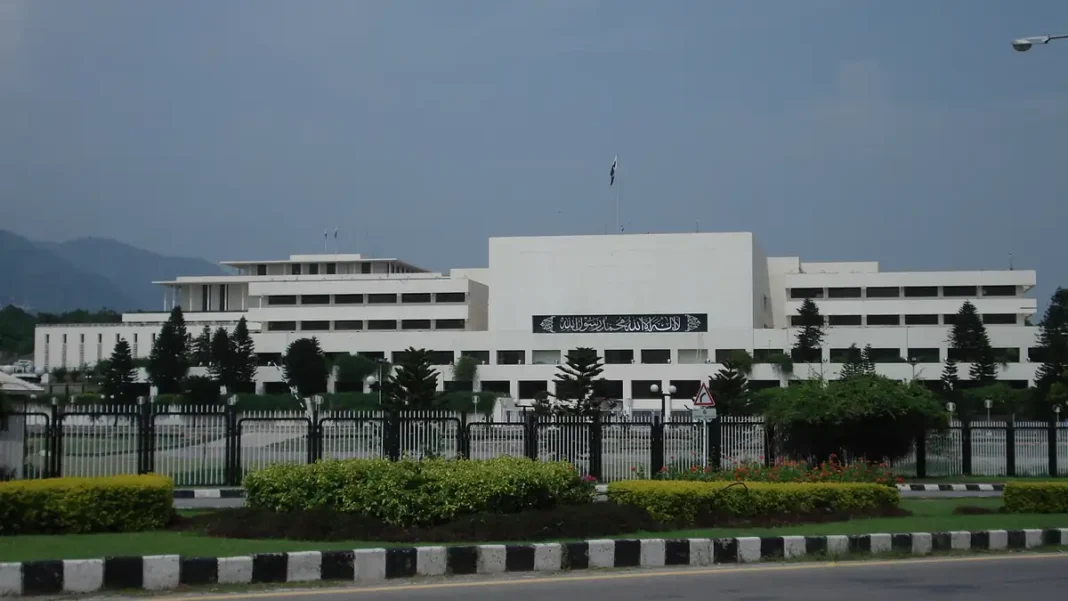
Quick answer: The 13th Amendment (1997) stripped the president of the power to dissolve the National Assembly — the notorious Article 58(2)(b) — restoring full parliamentary supremacy.
In this guide
- Background: The Shadow of the 8th Amendment
- What the 13th Amendment Changed
- 1. Repeal of Article 58(2)(b)
- 2. Governors’ Discretionary Powers Curbed
- 3. Presidential Powers Over Key Appointments Removed
- 4. Parliamentary Supremacy Restored
- The Politics Behind It
- What Happened Next
- The 13th Amendment in Everyday Terms
- Frequently Asked Questions
- What is the 13th Amendment in the Constitution of Pakistan?
- Who passed the 13th Amendment?
- What was Article 58(2)(b)?
- Did the 13th Amendment last?
The 13th Amendment in the Constitution of Pakistan, passed in 1997, was one of the most consequential changes ever made to the country’s basic law. In a single stroke, it stripped the President of the power to dismiss elected governments — the notorious Article 58(2)(b) — and restored full parliamentary supremacy. This guide explains what the amendment changed, why it was passed, and what followed.
Background: The Shadow of the 8th Amendment
To understand the 13th Amendment, you must first understand the 8th Amendment of 1985. Passed under General Zia-ul-Haq, the 8th Amendment inserted Article 58(2)(b) into the Constitution, giving the President discretionary power to dissolve the National Assembly “where, in his opinion, a situation has arisen in which the Government of the Federation cannot be carried on in accordance with the provisions of the Constitution.”
That single clause hung over Pakistani democracy like a sword. Between 1988 and 1996, it was used to dismiss four elected governments:
- 1988 — President Ghulam Ishaq Khan dismissed PM Benazir Bhutto’s government
- 1990 — President Ghulam Ishaq Khan dismissed PM Nawaz Sharif’s first government
- 1993 — President Ghulam Ishaq Khan dismissed PM Benazir Bhutto’s second government
- 1996 — President Farooq Leghari dismissed PM Benazir Bhutto’s government again
Every prime minister of the 1990s governed knowing the President could send them home. The parliamentary system existed in name; in practice, the presidency was the ultimate arbiter.
What the 13th Amendment Changed
After winning a heavy two-thirds mandate in the February 1997 elections, Prime Minister Nawaz Sharif moved to end this era. The Constitution (Thirteenth Amendment) Act, 1997, passed by Parliament in April 1997, made these key changes:
1. Repeal of Article 58(2)(b)
The centrepiece: the President’s power to dissolve the National Assembly at his discretion was deleted. From now on, the Assembly could only be dissolved on the Prime Minister’s advice (Article 58(1)) — the standard parliamentary position.
2. Governors’ Discretionary Powers Curbed
Parallel provincial provisions were amended. Governors lost the discretionary power to dissolve provincial assemblies; dissolution now required the Chief Minister’s advice.
3. Presidential Powers Over Key Appointments Removed
The amendment removed the President’s discretionary authority over the appointment of provincial governors, the chiefs of the armed services, and the judges of the superior courts — these became powers exercised on advice, not at personal discretion.
4. Parliamentary Supremacy Restored
Taken together, the changes returned Pakistan to the parliamentary model the 1973 Constitution’s framers had intended: the Prime Minister as the real chief executive, the President as a largely ceremonial head of state. The 8th Amendment’s presidential tilt was substantially undone.
For the broader constitutional framework, see our complete guide to the Constitution of Pakistan 1973.
The Politics Behind It
Nawaz Sharif’s Pakistan Muslim League (N) had won around two-thirds of the National Assembly in 1997 — the first time since 1977 that a single party held such a commanding majority. That supermajority made constitutional amendment possible (amendments need two-thirds under Article 239).
Sharif’s motivation was widely understood: he had been dismissed under 58(2)(b) himself in 1993, and he had no intention of governing under its shadow again. The amendment passed with broad support — even many who opposed Sharif on other matters agreed the presidential power of dissolution had destabilised democracy.
What Happened Next
The 13th Amendment achieved its immediate goal: no elected government has been dismissed by presidential order since 1997. But the story did not end there:
- The 14th Amendment (1997) followed months later, introducing strict party discipline (defection clause) — strengthening the Prime Minister further, critics said at the cost of MPs’ independence.
- The 17th Amendment (2003), passed under General Pervez Musharraf, partially revived a presidential dissolution power in modified form — showing how hard-won parliamentary gains could be rolled back under military rule.
- The 18th Amendment (2010) then repealed the 17th Amendment’s changes and restored — and deepened — parliamentary supremacy, devolving powers to the provinces.
The lesson of this arc is that constitutional supremacy in Pakistan has been a two-steps-forward, one-step-back struggle, with the 13th Amendment as one of the great forward steps.
The 13th Amendment in Everyday Terms
Three points to remember:
- Before 1997, the President could dismiss the Prime Minister and dissolve the Assembly on his own — and did so four times in eight years.
- The 13th Amendment deleted that power, along with presidential discretion over governors, services chiefs, and judges.
- Since 1997, no Pakistani government has been sent home by presidential order — assemblies now complete their terms unless dissolved on the Prime Minister’s own advice.
Frequently Asked Questions
What is the 13th Amendment in the Constitution of Pakistan?
A 1997 constitutional amendment that repealed Article 58(2)(b) — the President’s power to dissolve the National Assembly — and removed presidential discretion over governors, services chiefs, and judges, restoring parliamentary supremacy.
Who passed the 13th Amendment?
Prime Minister Nawaz Sharif’s government, using its two-thirds majority after the February 1997 elections. Parliament passed it in April 1997.
What was Article 58(2)(b)?
A clause inserted by the 8th Amendment (1985) letting the President dissolve the National Assembly if, in his opinion, the federal government could not be run constitutionally. It was used to dismiss four governments between 1988 and 1996.
Did the 13th Amendment last?
Its core achievement — ending presidential dismissals — has lasted. The 17th Amendment (2003) partially revived dissolution powers under Musharraf, but the 18th Amendment (2010) removed them again.
Related Constitution Guides
 stripped the President’s power to dissolve assemblies. Learn what changed and why.)