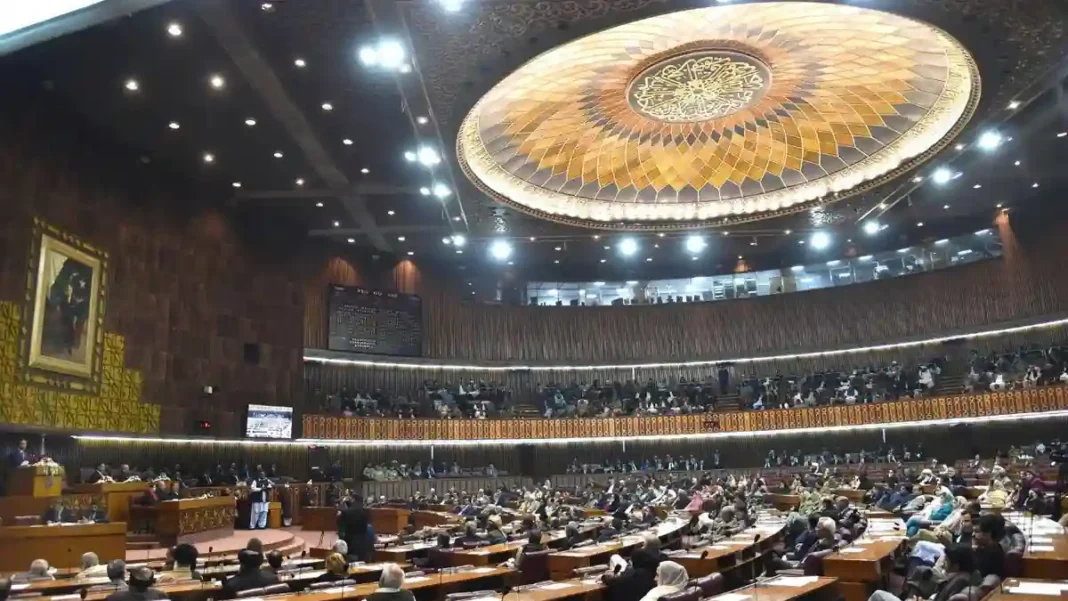
Constitutions must be stable enough to anchor a state and flexible enough to survive it. The Constitution of Pakistan 1973 strikes that balance through Article 239, which lays down the procedure for amending the Constitution itself. Every one of the 27 amendments Pakistan has passed — from the 1st to the 27th — travelled through this article.
Quick answer: Article 239 sets the amendment rule: a two-thirds majority in both the National Assembly and the Senate, plus presidential assent — used 27 times so far, most recently in November 2025.
In this guide
- The amendment procedure
- Why the bar is so high
- 27 amendments and counting
- Limits on the amending power
- Article 239 and democratic stability
- Frequently asked questions
- What is Article 239 of the Constitution of Pakistan?
- Can the President veto a constitutional amendment?
- How many amendments has the Constitution of Pakistan had?
- What majority is needed to amend the Constitution?
The amendment procedure
Article 239 sets a deliberately demanding process. A bill to amend the Constitution must be passed by each House of Majlis-e-Shoora (Parliament) — the National Assembly and the Senate separately — by the votes of not less than two-thirds of the total membership of that House. This is a far heavier requirement than the simple majority needed for ordinary legislation, and it applies in each House independently: a two-thirds majority in one House cannot compensate for a shortfall in the other.
Once passed, the bill is presented to the President for assent. Here Article 239 contains a striking provision: the President cannot withhold assent. Unlike ordinary bills, over which the President has limited delaying powers, a constitutional amendment bill must receive assent — there is no presidential veto over constitutional change. The amendment becomes part of the Constitution on receiving that assent.
Why the bar is so high
The two-thirds requirement in each House serves a clear purpose: the Constitution should not be rewritten by a narrow or temporary majority. Amending the basic law demands a broad national consensus, cutting across party lines and, in practice, across provinces — since the Senate gives every province equal weight. This rigidity is a feature, not a flaw. It protects the Constitution’s core bargains — federalism, fundamental rights, the Islamic provisions — from being undone by whichever government happens to hold a simple majority.
27 amendments and counting
The procedure of Article 239 has been used 27 times, and the amendments trace Pakistan’s political history:
- Early amendments adjusted the new Constitution’s machinery in the 1970s.
- The 8th Amendment (1985) entrenched presidential powers, including the power to dissolve the National Assembly — later undone by the 13th Amendment (1997).
- The 18th Amendment (2010) devolved sweeping powers to the provinces and is widely regarded as the most far-reaching amendment of all.
- The 21st Amendment (2015) created military courts in the wake of the Army Public School tragedy.
- The 26th Amendment (2024) changed the procedure for appointing the Chief Justice and the composition of the Judicial Commission of Pakistan, reshaping judicial appointments.
- The 27th Amendment (November 2025), the most recent, established the Federal Constitutional Court — a new apex forum whose working, including bench formation under the Chief Justice, is now taking shape.
Each of these passed through the same Article 239 doorway: two-thirds in each House, then the President’s non-discretionary assent.
Limits on the amending power
An old question in constitutional law is whether even a properly passed amendment can do anything — or whether some features of a constitution are unamendable. Pakistan’s courts have wrestled with this, and the debate continues among jurists. What is settled is the procedure: whatever the substantive limits may be, no change to the constitutional text counts unless it clears the Article 239 thresholds. An amendment passed by a simple majority, or by one House alone, is simply not an amendment at all.
Article 239 and democratic stability
There is a paradox at the heart of Article 239. The same procedure that protects the Constitution can also be used to alter its character — the 8th Amendment showed how. The safeguard is political rather than textual: because two-thirds of each House is needed, no single party acting alone has ever commanded the numbers to amend the Constitution unilaterally in Pakistan’s parliamentary history. Amendments have required negotiation, coalition-building and compromise — which is exactly what the framers intended the procedure to force.
Frequently asked questions
What is Article 239 of the Constitution of Pakistan?
Article 239 is the constitutional amendment procedure. An amendment bill must be passed by each House of Parliament by not less than two-thirds of its total membership, and then receives the President’s assent, which cannot be withheld.
Can the President veto a constitutional amendment?
No. Article 239 expressly provides that the President cannot withhold assent to a duly passed constitutional amendment bill. There is no presidential veto over constitutional change.
How many amendments has the Constitution of Pakistan had?
27 amendments have been passed under the Article 239 procedure. The most recent is the 27th Amendment of November 2025, which established the Federal Constitutional Court.
What majority is needed to amend the Constitution?
Not less than two-thirds of the total membership of each House — the National Assembly and the Senate separately. An ordinary simple majority is not enough.