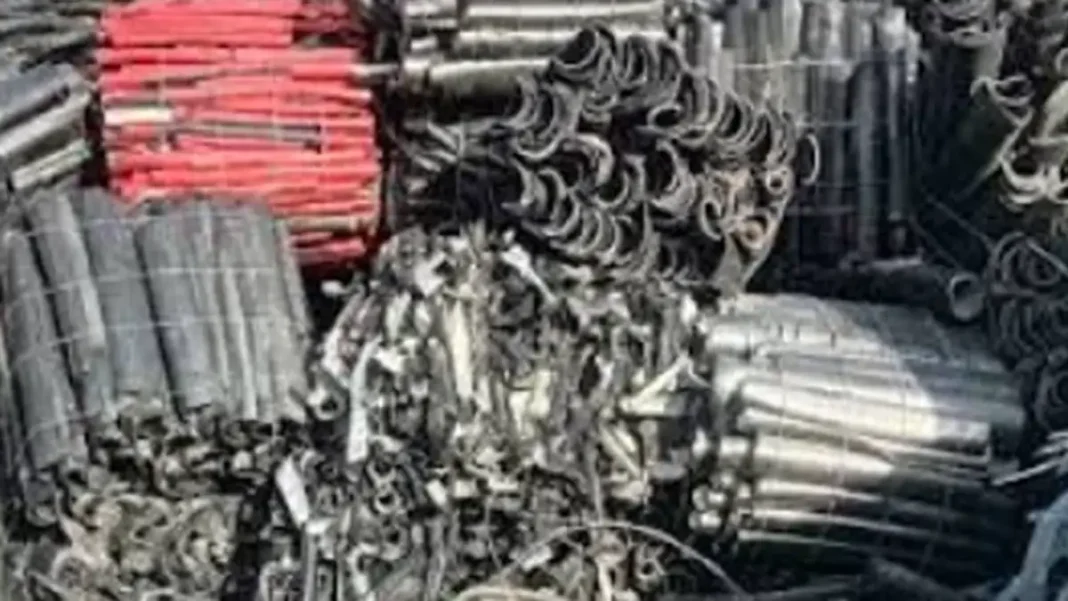
As new industrial equipment gets dearer, one of Karachi’s oldest markets has become the lifeline of the city’s factories: Shershah kabari market supplies affordable machinery and spare parts to industrial units across Karachi, keeping production lines moving.
Currency depreciation, import restrictions and steep tariffs have pushed up the cost of new equipment. For small plant operators, the market now means the difference between running production lines and costly downtime.
Scrap from Gadani
Crucial to this supply line, Tribune reports, is the market’s direct link with the country’s ship-breaking industry. Salvaged machinery from decommissioned vessels at Gadani provides heavy-duty marine refrigeration compressors, industrial cooling units, generators and high-capacity valves, which Shershah’s workshops re-engineer for cold storage, food processing, textile and plastics plants.
Gadani, on the Balochistan coast, has long been Pakistan’s ship-breaking hub. The director-general of the International Labour Organization visited the yard to inspect working conditions there, and Gadani beach is known to most Pakistanis as a picnic spot, though its working waterfront feeds Shershah’s trade.
Shershah kabari market: cheaper than new imports
“If an industrial unit in Karachi’s industrial areas needs a brand-new imported cold storage compressor or a 50-horsepower motor today, it can cost millions of rupees and take weeks to clear customs,” says Waleed Shaikh, manager at a food manufacturing factory.
Shershah trades in motors, pumps, generators, compressors and machinery for cold storage, blast-freezing and textile units. Some buyers purchase complete machines, while smaller units source specific parts to repair existing equipment.
“Even a small component can stop a production line if it is unavailable when needed. Keeping essential spares helps us resume work without waiting for a replacement,” said Karim Memon of a home textile industry.
The workshops behind the trade
Dealers in Shershah do more than sell scrap: they test, repair and rebuild the equipment that comes through their shops.
“In our shop, we source high-grade used units often salvaged from ship-breakers or overseas industrial lots, rewind the copper coils, replace the seals and bearings, and deliver them fully tested at a fraction of the cost. We are not just dealing in scrap. We are keeping essential industrial and cooling plants operational when new imports are out of reach,” dealer Waheed Khan said.
The skills are learned on the job. Self-taught lathe operators, copper winders and machinists work without formal engineering credentials, yet they have diagnostic and machining skills built over decades of work.
“You cannot learn this trade from a textbook,” notes master machinist Asghar. “Every piece of heavy refrigeration equipment or motor that arrives from a decommissioned ship or a closed factory has unique wear and mechanical faults.”
“Depending on the fault, we may need a complete machine or just a small part. Our technicians decide what needs replacement, and the market provides a range of options,” said Jameel Hussain, who runs a lace-embroidery unit.
Costs are rising for traders too
Despite steady demand, workshop operators face their own cost pressures. Raw material, imported scrap metal, ship-breaking salvage and decommissioned plant machinery all swing sharply in price with haulage charges and local duties.
“When duties on iron scrap rise or local transport rates jump, acquiring heavy compressor blocks and machinery lots becomes expensive immediately. We have to absorb these cost increases because our customers operate on limited budgets,” explains a scrap trader who also works as an agent.
A shock absorber for industry
Industry insiders describe Shershah as a critical shock absorber for Pakistan’s commercial sector. By recirculating heavy industrial equipment and providing low-cost, reconditioned alternatives, it prevents widespread halts across manufacturing and cold-chain supply networks.
The city is adding new industrial space, including Karachi Marble City, a 300-acre stone park, and a task force seeking export proposals. But until formal credit and capital equipment imports become viable for small and medium enterprises, Karachi’s factories will keep depending on the used machinery and spare parts passing through Shershah.
Frequently asked questions
What is Shershah’s kabari market?
It is a Karachi market trading in used industrial machinery and spare parts, much of it salvaged at Gadani and from decommissioned factories.
What kind of equipment does the market supply?
Motors, pumps, generators, compressors and machinery for cold storage, blast-freezing and textile units, plus spare parts.
Why do factories buy used machinery?
New imported equipment can cost millions of rupees and take weeks to clear customs. Reconditioned units cost a fraction of that.
Where does the machinery come from?
Much of it is salvaged from decommissioned vessels at Gadani, Pakistan’s ship-breaking hub, or from overseas industrial lots and closed factories.
Who works in the market?
Self-taught lathe operators, copper winders, machinists and dealers, many with decades of experience rebuilding heavy refrigeration equipment.