Pakistan Food Diplomacy UN Call to Protect Supplies
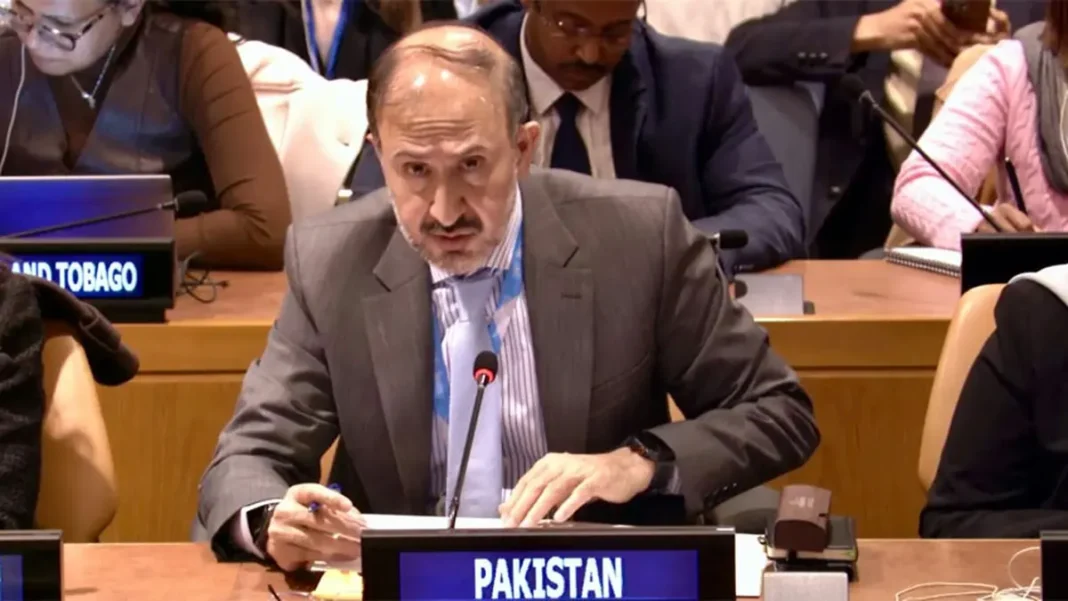
Pakistan food diplomacy UN efforts were on show as Pakistan told the United Nations Security Council that food crises now reach far beyond war zones, hitting developing countries that depend on food and energy imports.
The message came from Ambassador Syed Haider Shah, Pakistan’s Permanent Representative to the UN, at an informal Council meeting on food diplomacy and conflict-driven food insecurity. The Pakistan food diplomacy UN intervention urged practical steps to keep food and fertiliser supplies steady, alongside climate-resilient farming.
The meeting was convened by Greece under the Arria-Formula format, named after former Venezuelan ambassador Diego Arria. These informal sessions let Council members exchange views frankly with other states, experts, aid agencies, academics and the private sector.
A two-way link between hunger and conflict
Ambassador Shah described a dangerous feedback loop. Armed conflicts, including foreign occupation, drive mass hunger, while hunger and economic desperation in turn raise the risk of renewed or protracted conflict.
“The challenge before us is therefore not merely to respond to food crises, but to prevent them, and to address the underlying conditions that give rise to them,” he said.
He argued that food insecurity extends well beyond active conflict zones and hits developing countries, especially those reliant on food and energy imports, the hardest.
“The suffering in Gaza, Sudan, Yemen, South Sudan and other conflict-affected regions is a stark reminder of the human cost of this failure,” he said.
The debate built on Security Council Resolution 2417, adopted in 2018, which treats the denial of food as a weapon of war. Delegates discussed treating food systems as strategic assets, using early-warning data, working across sectors and protecting humanitarian access and the infrastructure civilians depend on to survive.
Pakistan food diplomacy UN: what the envoy asked for
Ambassador Shah called for stronger cooperation to keep food and fertiliser supplies reliable, prevent trade disruptions and ensure fair access to farm inputs. He said food diplomacy should be judged by tangible results, not by creating new mechanisms, and should build on the expertise of the UN, the Food and Agriculture Organization and the World Food Programme.
He said lasting food security required joint action by governments, the UN, international financial institutions and other stakeholders. He also pressed all parties in conflicts to allow rapid and unimpeded humanitarian assistance, in line with international humanitarian law.
“All parties in conflicts must allow and facilitate rapid and unimpeded humanitarian assistance, consistent with international humanitarian law,” he said.
Citing Pakistan’s own experience with climate-driven floods, he stressed building climate-resilient agriculture, protecting smallholder farmers and backing those efforts with financing, technology transfer and capacity building.
He closed with a caution: “While food diplomacy can help foster cooperation, it cannot substitute for the actual resolution of conflicts.” Lasting food security, he said, required peaceful settlement of disputes under the UN Charter and international law.
Why the warning matters at home
Pakistan is itself an import-dependent country for food. It buys wheat, edible oil and fertiliser from abroad, so a disruption in shipping or a spike in world prices reaches Pakistani markets fast. Wheat sowing in Vehari has already been hit by seed and fertiliser shortages this season, showing how thin the margin is between a normal harvest and a shortfall.
The hunger picture at home is already stark. A recent report warned of a hunger crisis in Pakistan, and the poverty rate stands at 28.9 per cent. When food prices rise, the poorest households feel it first, and there is little room to absorb the shock.
Pakistan has also been building farm partnerships to steady supplies. A delegation is heading to Brazil to deepen agriculture cooperation, covering technology transfer, livestock and market access. Food exports surged in the July to September quarter, showing the farm sector can earn as well as feed, when inputs and markets hold steady.
The envoy’s warning also connects to Pakistan’s wider UN work. The country has pressed the Council on Gulf shipping and food security in the same month, arguing that threats to sea lanes endanger food and energy supplies for developing economies. The food diplomacy meeting extends that argument from shipping lanes to the whole food system.
Frequently asked questions
What did Pakistan tell the UN Security Council?
Pakistan said food crises hit import-dependent developing countries hardest, and urged steady food and fertiliser supplies, climate-resilient farming and unimpeded humanitarian access.
Who delivered Pakistan’s message?
Ambassador Syed Haider Shah, Pakistan’s Permanent Representative to the United Nations.
What is an Arria-Formula meeting?
It is an informal Security Council meeting, named after former Venezuelan ambassador Diego Arria, that allows frank, private exchanges between Council members, other states and experts.
What is Resolution 2417?
It is a 2018 Security Council resolution that condemns the starving of civilians as a method of warfare and calls for the protection of food systems and humanitarian access.
Why does food diplomacy matter for Pakistan?
Pakistan imports wheat, edible oil and fertiliser, so trade disruptions and price spikes reach its markets quickly, while climate floods and sowing shortages already strain domestic supply.