Pakistan Navy Capabilities Enhanced, Says Admiral Ashraf
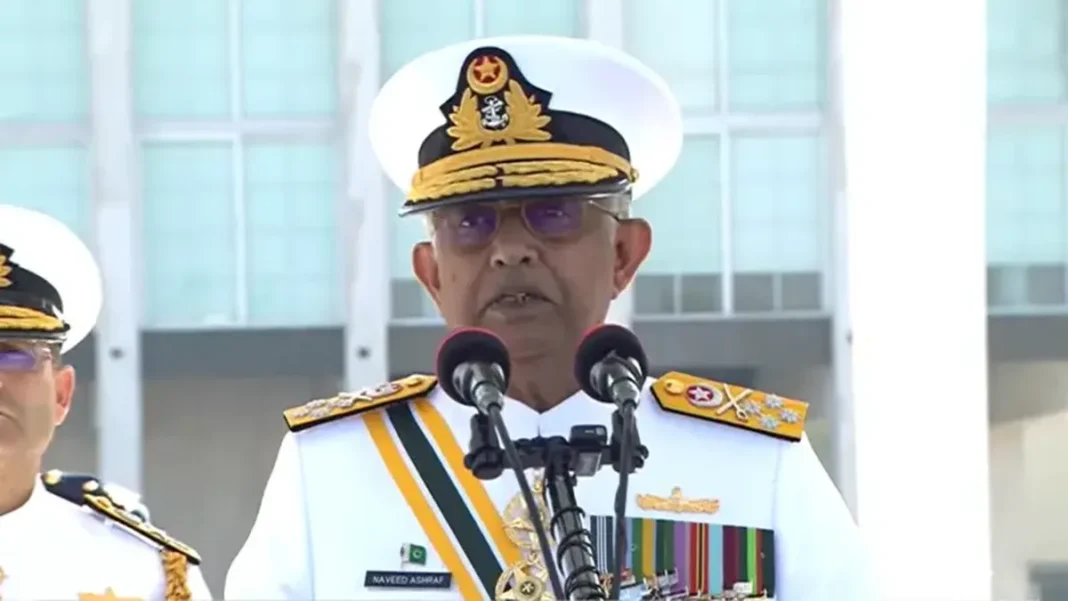
Pakistan Navy capabilities have grown across every operational domain, Chief of the Naval Staff Admiral Naveed Ashraf said on Thursday, as he addressed the graduation parade at the Pakistan Air Force Academy Asghar Khan in Risalpur.
Admiral Ashraf was the chief guest at the parade in Nowshera district. Chief of the Air Staff Air Chief Marshal Zaheer Ahmed Baber Sidhu also attended, and the ceremony ended with a fly-past.
The naval chief told the graduating cadets that the Pakistan Navy was making strong headway towards modernising its fleet. He said the armed forces were fully aware of how warfare was changing and had prepared for it.
How Pakistan Navy capabilities have changed
Admiral Ashraf pointed to new warships, submarines, weapons and unmanned systems as proof of the change.
“The induction of state-of-the-art warships, Hangor-class submarines, indigenously developed long-range weapons, unmanned systems, and the establishment of Pakistan Maritime Science and Technology Park are some of the important developments taking place,” he said.
The navy will induct eight Hangor-class submarines. The first arrived at Karachi Port in June and fired a live weapon in the Arabian Sea in September.
In April, the navy fired a locally developed anti-ship ballistic missile at an extended range, then tested the indigenously developed Taimoor anti-ship weapon days later. In November last year, it tested a ship-launched anti-ship ballistic missile.
The navy has been testing new weapons at a steady pace: Pakistan tested the Fatah-3 supersonic cruise missile this week. It also concluded its SeaSpark 2026 exercise last month.
Admiral Ashraf said the navy’s combat capabilities had “recently undergone significant enhancement and transformation across all operational domains aligned with contemporary and future warfare demands”.
Warfare is changing, the naval chief said
The admiral told the parade that the character of modern warfare had altered dramatically and was evolving at an unprecedented pace, driven by new technology.
He said conflicts were no longer restricted to traditional battlefields. They now spanned the electronic warfare, cyber, space and cognitive domains, while autonomous systems, artificial intelligence and information warfare had reshaped how battles were fought and won. The strategic environment had become more complex, particularly against the backdrop of heightened tensions in the Middle East, and the armed forces were fully aware of the change and had prepared for it.
Operation Muhafizul Bahr and the May 2025 conflict
Admiral Ashraf said Operation Muhafizul Bahr, which began in March this year when the Middle East conflict flared, was still “continuing successfully”.
He also recalled the May 2025 conflict with India. The army has named the period from the April 22 Pahalgam attack to the May 10 conclusion of Operation Bunyanum Marsoos as Marka-i-Haq.
“I am sure our adversary has learned the lesson, and it would be unwise to need a second,” he said, praising the air force’s “extraordinary performance” in the conflict.
He said the Pakistan Air Force had conducted multi-domain operations chiefly using indigenous capabilities, above all a home-grown kill chain.
Narrating the navy’s part, Admiral Ashraf said the Pakistan Navy “successfully deterred the Indian Navy from any hostilities at sea and it remained at bay throughout the conflict”.
He described the air force and navy as “brothers in arms”, with the “maritime domain as our shared operational space”. He said Pakistan was a peace-loving nation that prioritised restraint, dialogue and diplomacy, but added: “We know how to defend our motherland.”
India’s air power has changed since that conflict. FlightGlobal now lists 32 Indian Rafale jets, down from 36 before the fighting.
Admiral Ashraf also thanked Turkiye’s air force chief, General Rafet Dalkiran, for attending, and praised the “time-tested friendship” between the two countries. Pakistan’s armed forces also serve abroad: 183 Pakistani peacekeepers have lost their lives on United Nations missions.
Frequently asked questions
What did Admiral Ashraf say about the navy?
He said the navy had enhanced its combat capabilities across all domains, with new warships, Hangor-class submarines, long-range weapons and unmanned systems.
How many Hangor-class submarines will Pakistan get?
The navy is set to induct eight Hangor-class submarines. The first arrived at Karachi Port in June and fired a live weapon in the Arabian Sea in September.
What is Operation Muhafizul Bahr?
It is a naval operation that began in March this year when the Middle East conflict flared. Admiral Ashraf said it was still continuing successfully.
What did the naval chief say about the May 2025 conflict?
He said the Pakistan Navy deterred the Indian Navy from any hostilities at sea. He praised the air force’s multi-domain operations and its home-grown kill chain.
Who attended the parade at Risalpur?
Air Chief Marshal Zaheer Ahmed Baber Sidhu attended, along with Turkiye’s air force chief, General Rafet Dalkiran. The parade marked the graduation of a new batch of air force cadets.