Gilgit-Baltistan Tax Exemption System Goes Online
Gilgit-Baltistan has launched an online system for the Gilgit-Baltistan tax exemption on goods imported from China, in a move aimed at ending disputes over who gets the relief.
Chief Minister Amjad Hussain Azar formally launched the Gilgit-Baltistan Traders’ Registration and Tax Exemption System (GB-TERS) at a ceremony in Gilgit on Friday. The platform will register traders and process their exemption claims online.
The Gilgit-Baltistan tax exemption covers goods brought in through the Sost Dry Port for local use in the region. Eligible imports are free of sales tax, income tax and federal excise duty, within an annual ceiling of Rs4 billion.
The chief minister said the exemptions had been secured from the federal government and would benefit traders and the wider public. He said the online system would make access fair, simplify registration and prevent discrimination.
Gilgit-Baltistan tax exemption: what traders get
The relief follows an agreement reached in September 2025, after traders staged a 68-day protest at the Sost Dry Port that blocked the Karakoram Highway and disrupted trade between Pakistan and China through the Khunjerab Pass.
Under the deal, the federal government approved a tax relief package for the region, and the Federal Board of Revenue issued a notification under the Customs Act 1969, the Sales Tax Act 1990, the Federal Excise Act 2005 and the Income Tax Ordinance 2001.
Only goods imported through the Silk Route Dry Port at Sost, and falling under specified Pakistan Customs Tariff codes, qualify. Each consignment needs online authorisation from the notified Gilgit-Baltistan authority, and the importing firm must be wholly owned by people holding a domicile of the region.
The exemption works on a first-come, first-served basis. Once the annual Rs4 billion limit is used up, later imports become taxable. Goods brought in under the scheme must also be consumed within Gilgit-Baltistan.
Applicants must run a registered firm or partnership to qualify, the chief minister said.
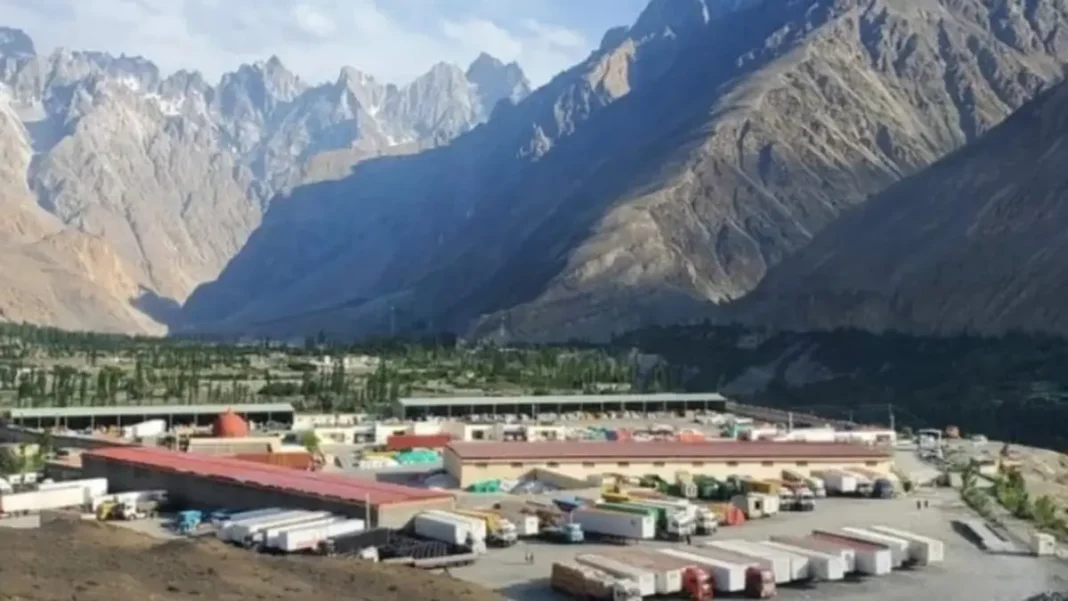
The Sost Dry Port sits at the Pakistani end of the Karakoram Highway near the Khunjerab Pass, the only land crossing between Pakistan and China, and handles the bulk of overland trade between the two countries. That is why the exemption system matters beyond Gilgit-Baltistan itself.
A trade-free zone next for Gilgit
The chief minister also directed the provincial secretary for minerals and industries to prepare proposals at once for a trade-free zone in Gilgit, to serve local and international traders. He said the provincial government would build the zone from its own resources.
The zone would add to the region’s growing role as a trade gateway. Pakistan and China already run a green channel for cargo through Sost and the Khunjerab Pass, which speeds up clearance for goods moving across the border.
The shift to online registration also fits a wider push to digitise trade. Pakistan has rolled out a single-window system for digital trade payments, as government departments move their payments and clearances online.
For traders in Gilgit-Baltistan, the test now is whether the online system works in practice, and whether the Rs4 billion ceiling lasts the year or runs out early, as demand from importers is high.
What is the GB-TERS system?
GB-TERS is the Gilgit-Baltistan Traders’ Registration and Tax Exemption System, an online platform that registers local traders and processes their claims for tax exemptions on goods imported from China.
Which goods qualify for the tax exemption?
Only goods imported through the Silk Route Dry Port at Sost, falling under specified Pakistan Customs Tariff codes, and meant for local consumption in Gilgit-Baltistan qualify. Each consignment needs online authorisation, and the importing firm must be wholly owned by people holding a Gilgit-Baltistan domicile.
What is the annual exemption limit?
The exemptions are subject to an annual ceiling of Rs4 billion. The relief is granted on a first-come, first-served basis, and imports become taxable once the limit is exhausted.
Why did traders protest at Sost in 2025?
Traders staged a 68-day protest at the Sost Dry Port in 2025, blocking the Karakoram Highway, to press for tax exemptions on goods imported from China. The protest ended with an agreement with the federal government in September 2025.