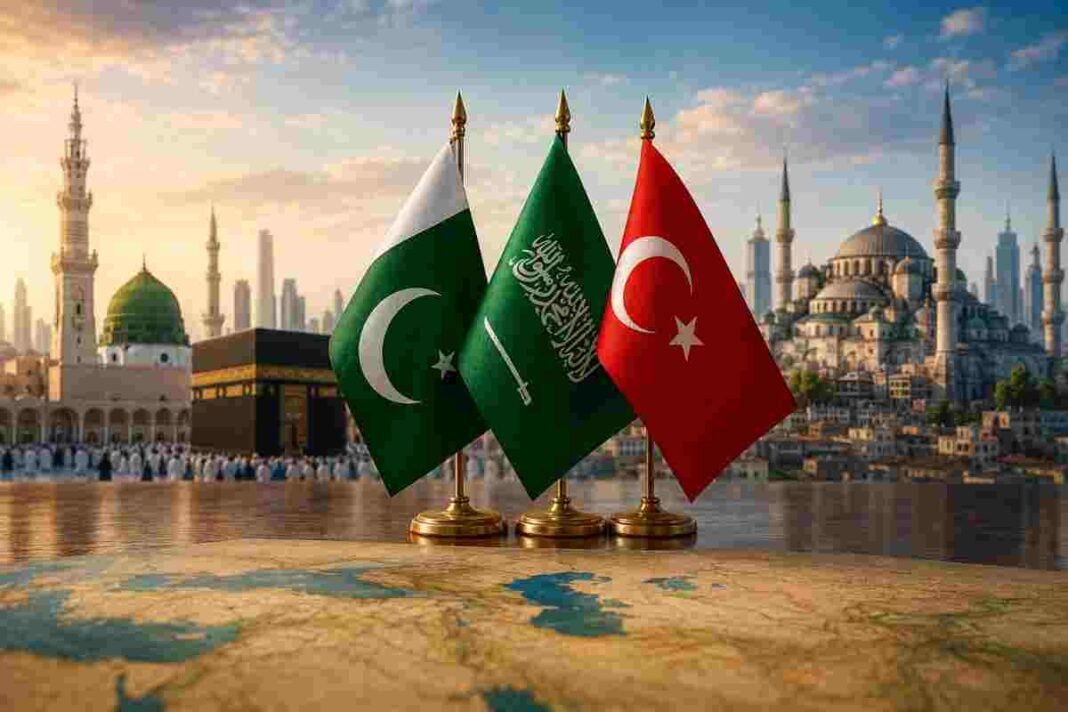
Turkish Foreign Minister Hakan Fidan said an agreement has been reached to rename the Makkah Joint Defense Agreement the “Makkah Pact.”
Speaking at a press conference after the first meeting held in Istanbul, the Turkish foreign minister described the Makkah Joint Defense Agreement as a historic initiative that does not target any alliance or country. He said the agreement aims to promote regional peace and cooperation.
Fidan said Türkiye has always stood with its brothers during difficult times and will continue to support them. He added that Türkiye has never stepped back from helping its partners.
According to the Turkish foreign minister, regional countries need to work together to establish lasting peace and stability. He also said practical steps have already been taken to develop an operational security structure for the region.
Fidan stressed that regional countries must jointly develop a roadmap to strengthen peace and security. He described the Makkah defense alliance as an arrangement based solely on defense.
He said other countries could join the Makkah defense alliance if they accept its terms. The doors remain open to all brotherly countries that wish to join the alliance.
“We have started establishing the structure of the alliance,” Fidan said.
He further clarified that the alliance does not target any specific state. According to Fidan, the partnership between Pakistan, Saudi Arabia and Türkiye rests on international law.
He added that the countries involved are working on a roadmap that would allow other states to join the agreement.
Writing
Turkish Foreign Minister Hakan Fidan has announced a major development involving the regional security arrangement led by Pakistan, Saudi Arabia and Türkiye. The countries have agreed to rename the Makkah Joint Defense Agreement as the “Makkah Pact.”
Fidan announced this in Istanbul after the participating countries’ first meeting. He described the agreement as a historic step toward stronger regional security and cooperation.
The Turkish minister stressed that the Makkah Defense Pact does not target any particular country. Instead, the arrangement seeks to encourage peace, stability and closer cooperation among regional states.
Fidan said Türkiye will continue to stand alongside its partners during difficult times. He noted that Ankara has consistently supported friendly countries and intends to maintain that approach.
At the same time, he called for greater cooperation among countries across the region. In his view, regional states can address security challenges more effectively by coordinating their policies and actions.
The first meeting also produced practical progress on the security framework. Fidan said the participating countries have already taken steps to establish an operational structure for regional security.
That development could give the new alliance a more organized framework. It may also help the member states coordinate their response to future security challenges.
Fidan said the participating nations now need to develop a joint plan for maintaining peace. He emphasized that regional countries should take greater responsibility for security in their own neighborhood.
The Makkah Defense Pact will focus on defense rather than confrontation. Fidan made it clear that the alliance does not seek conflict with other states or regional blocs.
He also indicated that the arrangement could expand in the future. Other countries can join if they agree with the alliance’s principles and conditions.
According to Fidan, the participating states want to keep the door open to other friendly nations. This approach could allow the security framework to grow beyond its current membership.
The Turkish foreign minister said the countries have already begun building the alliance’s structure. Their next steps will focus on creating a clear system for cooperation and coordination.
Pakistan, Saudi Arabia and Türkiye form the core of the current arrangement. Fidan said their cooperation follows international law.
That point remains important as the alliance develops. The participating countries want the agreement to strengthen regional security without creating a confrontation with another state.
Fidan also confirmed that officials are working on a roadmap for wider participation. The roadmap could define how additional countries can join and cooperate within the new framework.
The proposed name change also gives the agreement a shorter and more recognizable identity. The term “Makkah Pact” reflects the agreement’s connection with Makkah while presenting it as a broader regional initiative.
For Pakistan, the development could carry wider strategic significance. Islamabad already maintains close defense and diplomatic ties with both Türkiye and Saudi Arabia.
The new framework could therefore create another channel for cooperation between the three countries. It may also encourage discussions on regional security, joint planning and strategic coordination.
Saudi Arabia brings significant regional influence to the partnership. Türkiye contributes military capabilities and diplomatic reach, while Pakistan has extensive defense experience and strong ties across the Muslim world.
Together, the three countries could create a distinct regional security platform. However, its future impact will depend on how quickly the members turn the announced framework into practical cooperation.
Fidan’s comments suggest that the alliance has moved beyond a basic political understanding. The participating countries have started discussing the operational structure needed to support their security commitments.
The Makkah Defense Pact could therefore evolve into a more organized mechanism over time. Its development will likely attract attention from other regional countries that are assessing new security partnerships.
The emphasis on defense may also help the alliance present itself as a stabilizing initiative. Fidan repeatedly stressed that the partnership does not target a specific country or existing alliance.
Instead, the participating states want to build stronger cooperation around shared security interests. They also aim to encourage regional countries to work together rather than depend entirely on external security arrangements.
The next phase will focus on the alliance’s structure and expansion plans. Officials will need to establish clear procedures for cooperation, membership, and joint security activities.
If the participating countries maintain their current momentum, the Makkah Defense Pact could become an important feature of regional diplomacy. Its success, however, will depend on sustained political commitment and practical coordination among its members.
For now, the agreement signals a deeper security partnership between Pakistan, Saudi Arabia and Türkiye. The planned name change to the Makkah Pact also marks a new stage in efforts to create a broader regional framework based on defense, cooperation and international law.