Netanyahu Eisenkot Coalition Talks Resume in Israel
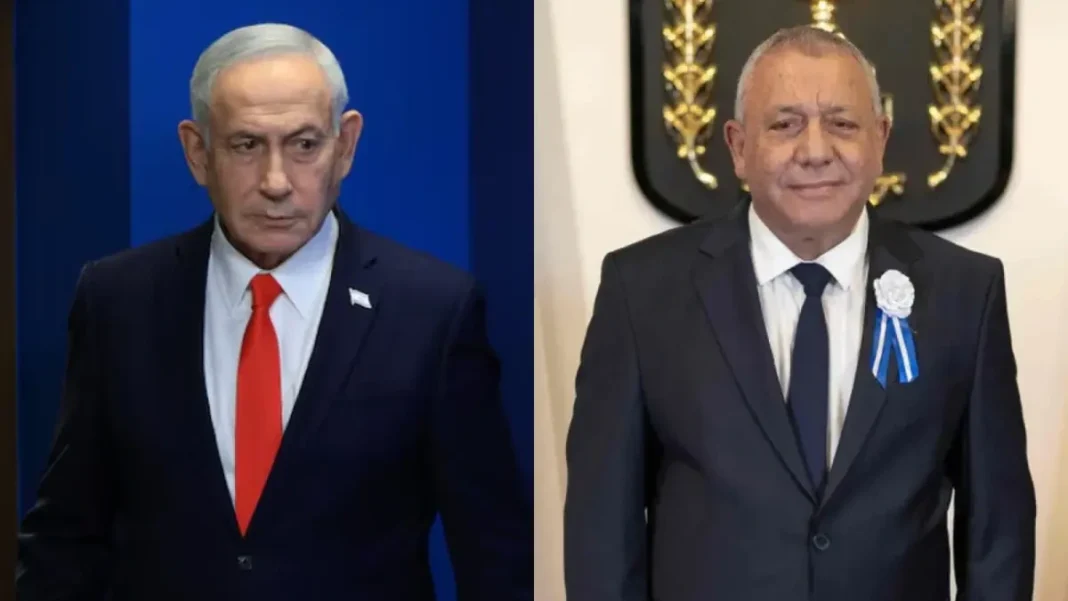
Netanyahu Eisenkot coalition talks resumed on Sunday in Herzliya, as the two rivals opened a second round of negotiations over a government neither side can form alone. Delegations from Benjamin Netanyahu’s Likud party and Gadi Eisenkot’s Yashar party met at a hotel in the coastal city near Tel Aviv, a week after their first round, Dawn reported.
Neither bloc won an outright majority in the October elections, so both men now need partners they would rather avoid.
The deadline Eisenkot faces
Eisenkot, a former army chief of staff, has until December 6 to form a government, with a possible 14-day extension. His bloc holds 48 seats in the 120-member Knesset, so he needs 13 more lawmakers to reach the 61-seat majority a government requires.
That arithmetic shapes every choice he makes. His bloc stays split over three paths: an alliance with ultra-Orthodox parties, a working arrangement with Arab parties, or a national unity government with Likud.
If he misses the deadline, the mandate to form a government goes back to the president. The president can then ask another member of the Knesset to try, or the Knesset can vote to dissolve itself and send voters back to the polls.
What the Netanyahu Eisenkot coalition talks must settle
Likud set out its terms before the talks began. The party called for an end to what it described as personal attacks and incitement against the outgoing prime minister and his government. It also said a unity government should bring together parties that support Israel as the nation-state of the Jewish people, with no Arab parties taking part.
The policy demands run deeper. Likud wants agreement to reject the creation of a Palestinian state and to keep Israeli control over territory in Syria, Lebanon and the Gaza Strip. It also wants a compromise on conscription of ultra-Orthodox Jews, an issue that has split Israeli politics for years.
Gaza sits at the centre of those demands. A recent Board of Peace report on the Gaza war faulted both sides, and Likud’s position would keep Israeli forces in place.
The Arab parties won a record 19 seats in the October vote, and they oppose Netanyahu staying in power. Their strength makes them hard to ignore, yet Likud has ruled out their participation in any government it joins.
Why a unity government stays unlikely
Netanyahu is pressing for a national unity government, which could include a rotation of the premiership between the two men. Israel tried that formula in 2020, when Netanyahu and Benny Gantz shared power under a rotation deal. A similar arrangement now could let Netanyahu keep political protection against the corruption charges he faces, and keep blocking an independent inquiry into the security failures before the Hamas raid of October 7, 2023.
But the idea runs into a wall. Eisenkot built his campaign around opposition to Netanyahu, and he refuses to serve in a cabinet led by him. His ally Naftali Bennett, a former prime minister, repeated that refusal on Saturday. Bennett said he would not join a coalition with Netanyahu or his bloc under any circumstances.
On Saturday, Yashar called the return to talks a genuine commitment to forming the broadest possible government. Likud answered at once with its list of conditions, which suggests the two sides still stand far apart.
Eisenkot’s emergency plan
Eisenkot warned on Friday that he would not let the talks drag on. He said he was ready to put an emergency national government before parliament, a signal that he may move without waiting for Likud to agree.
His remarks point to a two-stage plan: first form a minority government built on the core opposition parties, then widen it once it holds office. It could draw support from the 19 Arab party lawmakers, even if they do not join the cabinet.
That route has its own obstacle. Eisenkot’s right-wing ally Avigdor Liberman rejects working with the Arab parties and instead favours an alliance with ultra-Orthodox Jewish parties. The two men sit in the same bloc yet pull in opposite directions.
What happens if no government forms
The December 6 deadline sets the pace for the next two weeks. If Eisenkot cannot put together 61 seats by then, he can ask for 14 more days. After that, the mandate returns to the president, who may give another lawmaker a chance to build a coalition.
If no one succeeds, Israel faces fresh elections, with Netanyahu staying on as caretaker prime minister for months longer.
Pressure from outside Israel adds another layer. Trump weighs fresh strikes on Iran as Israel presses its case, while Pakistan and Saudi Arabia reviewed regional tensions in recent talks. The arrest of a journalist in the West Bank has also drawn attention from media groups around the world.
Frequently asked questions
Why did Netanyahu Eisenkot coalition talks resume?
The two parties met again in Herzliya on Sunday, a week after their first round, because neither camp won a majority in the October elections. Eisenkot must form a government by December 6, and a unity deal with Likud is one of the few paths to 61 seats.
What is the deadline for forming a government in Israel?
Eisenkot has until December 6, with the possibility of a 14-day extension. If he fails, the mandate returns to the president, who can ask another lawmaker to try or see the Knesset dissolve for fresh elections.
Why does Eisenkot need 61 seats?
The Knesset has 120 members, so 61 seats give a government its majority. Eisenkot’s bloc holds 48 seats, which leaves him 13 short of the number he needs to govern.
What conditions has Likud set for a unity government?
Likud wants an end to personal attacks on Netanyahu, no Arab parties in the government, rejection of a Palestinian state, continued Israeli control in Syria, Lebanon and Gaza, and a compromise on ultra-Orthodox conscription.
What happens if Eisenkot fails to form a government?
The mandate goes back to the president, who may hand it to another member of the Knesset. If no one can build a coalition, the Knesset can dissolve itself and Israel will hold fresh elections, with Netanyahu staying on as caretaker prime minister in the meantime.