

“Nigran Wazir-e-Azam” — the phrase appears in every Pakistani election cycle, and every time, millions of people ask the same question: what does “nigran” actually mean? This guide explains the term, the office behind it, and why Pakistan’s Constitution insists on a nigran prime minister between governments.
Quick answer: “Nigran” (نگران) means caretaker. The nigran prime minister is the neutral, unelected head of government appointed after the National Assembly dissolves, who runs the country until general elections. The most recent was Anwaar-ul-Haq Kakar (14 Aug 2023 – 4 Mar 2024); as of October 2026 the office is vacant because Pakistan has an elected government.
In this guide
The Word “Nigran”
In Urdu, nigran (نگران) describes someone entrusted with looking after something — a supervisor, guardian or caretaker. Applied to the prime ministership, it signals exactly what the office is: not a government with a mandate, but a stewardship. The nigran wazir-e-azam keeps the state functioning while the country chooses its next real government. English-language Pakistani media use “caretaker prime minister” and “nigran prime minister” interchangeably — they are the same office.
Why Pakistan Needs a Caretaker
The logic is about fair elections. When the National Assembly is dissolved — whether it completes its five-year term or is dissolved early — general elections must follow within 90 days. During that campaign, the state must be neutral: police, administration and state resources cannot be wielded by a prime minister who is also contesting the election. So the outgoing PM steps aside, and a mutually agreed neutral figure takes over. The system is written into Articles 224 and 224-A of the Constitution — Pakistan is one of the few countries to constitutionalise the caretaker concept rather than leaving it to convention.
The appointment itself is a consensus exercise: the outgoing prime minister and the Leader of the Opposition agree on a name, the President appoints them, and if the two leaders deadlock, a parliamentary committee — then the Election Commission — decides. See our full caretaker PM explainer for the step-by-step mechanism and the powers of the office.
A Short History: 1990 to Today
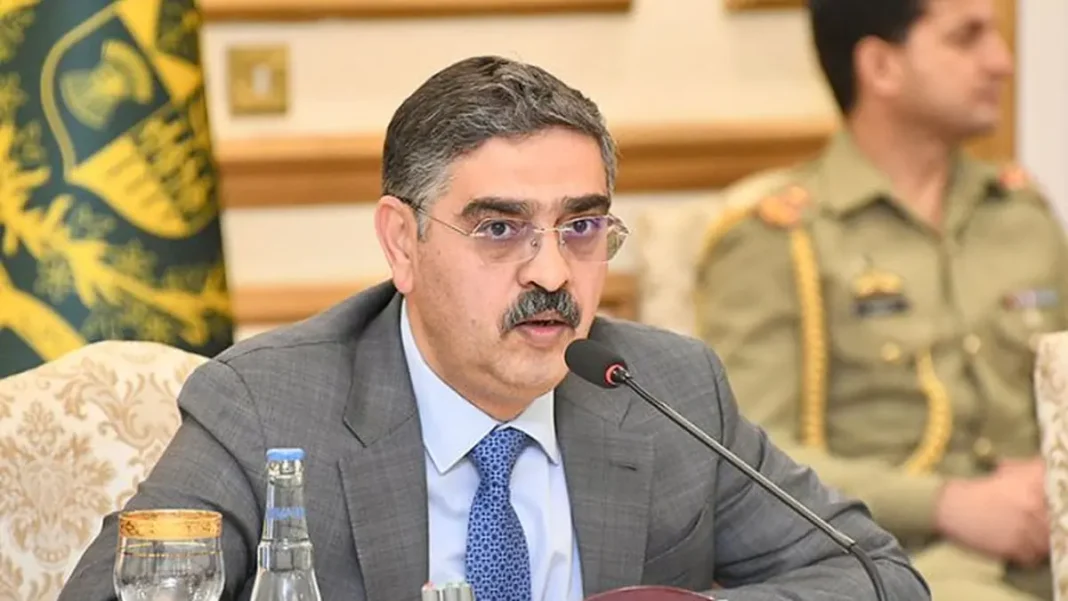
The system has been used eight times. Ghulam Mustafa Jatoi became the first caretaker PM in 1990. The roll call since — Balakh Sher Mazari and Moeenuddin Ahmad Qureshi in 1993, Malik Meraj Khalid in 1996–97, Muhammad Mian Soomro in 2007–08, Mir Hazar Khan Khoso in 2013, Nasirul Mulk in 2018 — reads as a shadow history of Pakistan’s democratic transitions. The eighth and most recent, Anwaar-ul-Haq Kakar, served from 14 August 2023 to 4 March 2024: at 203 days, the longest caretaker tenure ever, stretched by the delayed 8 February 2024 elections. He handed power to Shehbaz Sharif, who remains the elected prime minister as of October 2026 — which is why there is currently no caretaker prime minister.
Frequently asked questions
What is the nigran prime minister in Urdu?
نگران وزیر اعظم — literally “caretaker prime minister”: the neutral acting head of government between the dissolution of the Assembly and the next elections.
Is the nigran prime minister elected?
No. The office is appointive by design — chosen by consensus between the outgoing PM and the Opposition Leader (or by committee/ECP), precisely to keep it above electoral contest.
How is “nigran” different from “acting” prime minister?
An acting PM temporarily fills in for an absent premier within a sitting government. A nigran PM heads a full caretaker government during the interregnum between elected governments — a constitutionally distinct role.