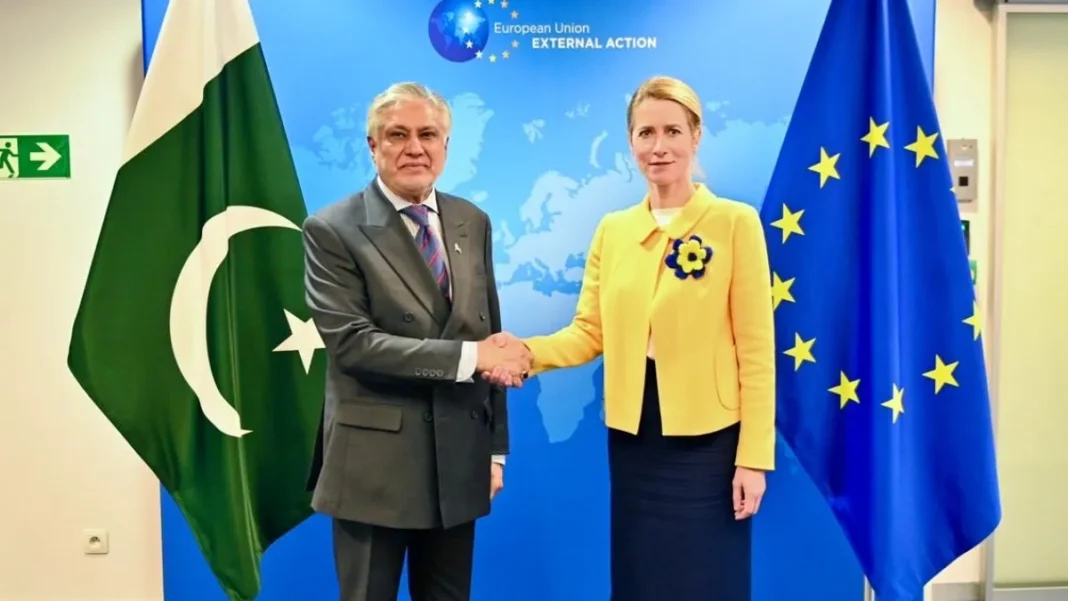
KARACHI: The European Union has urged Pakistan to demonstrate stronger implementation of its human rights and rule of law commitments to secure trade benefits under the next phase of the Generalised Scheme of Preferences Plus (GSP+) arrangement, as exporters warn that the looming EU-India trade deal could sharpen competition for them.
EU Ambassador to Pakistan Raimundas Karoblis met leaders of the Pakistan Textile Council (PTC) in Karachi on Wednesday, laying out what Brussels expects ahead of the next GSP+ assessment. The meeting covered Pakistan’s recent performance, the upcoming review cycle, and the outlook for textile and apparel exports to the bloc.
What the EU told Pakistan
Karoblis referred to the EU’s assessment of Pakistan covering 2023 to 2025, published on July 16, 2026. Improvements in human rights and the rule of law would be essential for the new GSP+ scheme, he said. The EU is not introducing new standards, but expects Pakistan to implement the UN conventions it has already committed to.
The European Commission will engage more closely with the government in Islamabad, prioritising demonstrable short-term improvements before a credible action plan with measures, timelines and measurable indicators is drawn up. Brussels will emphasise effective implementation rather than merely ratifying conventions or passing laws.
Why GSP+ matters for textile exporters
Textiles account for roughly 70 to 76 per cent of Pakistan’s exports to the EU, making the scheme the single most important trade preference for the country’s largest export industry.
PTC Chairman Fawad Anwar said continued GSP+ access remained vital for value-added textile and apparel exporters, supporting employment, tax revenue and the wider business ecosystem. Anwar, who sits on the government’s GSP+ reapplication committee, said the council would take the findings to the Prime Minister’s Office, the Foreign Ministry and the Commerce Ministry, and offered technical assistance including a dedicated senior focal point.
PTC Vice Chairman Anees Khawaja noted that the EU assessment had recognised progress across human rights, labour, environment and governance, and invited the ambassador to Multan to see how GSP+ trade had supported livelihoods in smaller cities beyond Karachi.
Gul Ahmed chief executive Zaki Bashir asked for textile and apparel export sector conditions to be assessed separately from national-level findings. The council also pointed to certified industrial facilities, female workforce participation exceeding 70 per cent at certain sites, and established worker committees as evidence of compliance on the ground.
The India factor
The meeting also weighed the competitive threat from the EU-India free trade agreement now under negotiation. Anwar warned that the deal could increase competitive pressure on Pakistani exporters even if Pakistan retains its preferential access, giving Indian rivals improved or duty-free entry into the same European markets.
Export-led growth is now official policy: the prime minister recently told exporters to lift performance, after earlier criticism of sluggish shipments. Any erosion of Pakistan’s tariff advantage in Europe would make that target harder to reach, given how heavily the country’s textile exporters depend on the EU market, a dependence on display again at this year’s Pakistan stalls at the Paris textile expo.
Emerging EU rules add a second front
PTC chief executive Muhammad Hasan Shafqaat said exporters needed clarity on emerging EU rules, including the Digital Product Passport and supply chain due diligence requirements, which could extend traceability obligations across the value chain back to farm level. The council is separately preparing an assessment of the EU-India FTA’s potential economic impact on Pakistan’s exports at the Foreign Ministry’s request.
What happens next
The message from Brussels is that the next GSP+ phase rewards delivery, not paperwork. With the India deal advancing, Pakistan’s exporters face a two-front test: proving that human rights and rule of law commitments are being implemented in practice, and staying competitive against a rival whose own trade doors to Europe may soon open wider.
FAQ
What is GSP+?
GSP+ is the EU’s Generalised Scheme of Preferences Plus, a trade arrangement that gives eligible developing countries duty-free or reduced-duty access to European markets, on condition that they implement UN conventions on human rights, labour, the environment and governance.
What did the EU ambassador tell Pakistan’s textile exporters?
EU Ambassador Raimundas Karoblis told PTC leaders in Karachi that Pakistan must show stronger implementation of its human rights and rule of law commitments, with demonstrable short-term improvements and a credible action plan ahead of the next GSP+ phase.
How could the EU-India free trade deal affect Pakistani exporters?
If the EU-India FTA removes or cuts tariffs on Indian goods, Indian exporters would gain cheaper access to the same European markets where Pakistani exporters compete, eroding Pakistan’s edge even if its own GSP+ access continues.