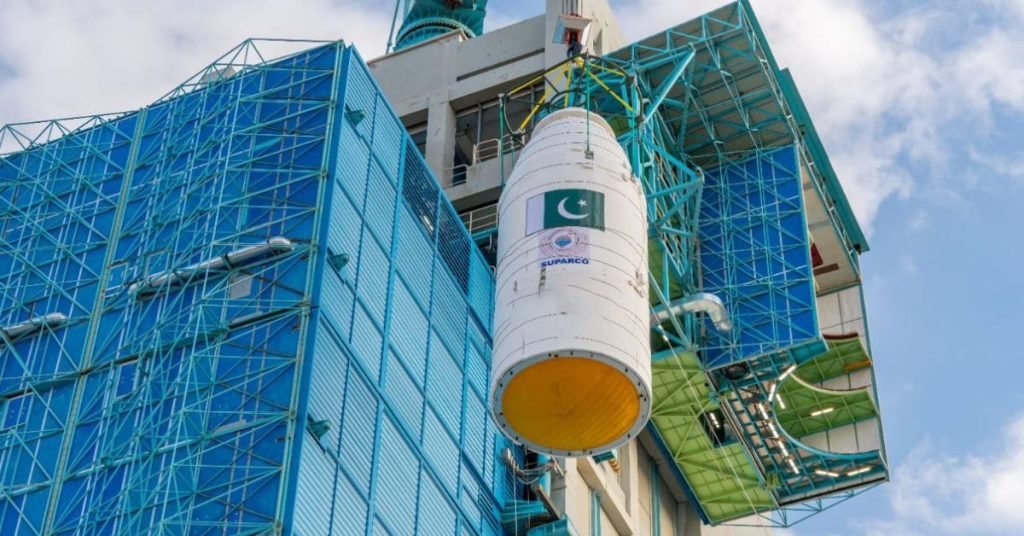
Pakistan Aims to Land Jinnah-1 Lunar Rover on the Moon in 2028
Pakistan Aims to Land Jinnah-1 Lunar Rover on the Moon in 2028
Pakistan plans to land the Jinnah-1 lunar rover on the Moon in 2028, SUPARCO Chairman Yusuf Khan has announced. The mission would take the national space programme beyond its current focus on Earth observation and satellite services.
Khan made the announcement at an event marking World Space Week. He said Pakistan has made significant progress in its space activities and highlighted the country’s growing use of its own satellites.
From Borrowed Capacity to Home-Grown Fleet
Pakistan previously relied on European and Chinese satellites for several space-based services. That picture is changing. The EO-1 satellite went up in January 2025, followed by two more satellites in July and October the same year. Pakistan now operates six Earth-observation satellites serving different sectors.
Those satellites support agriculture, urban planning and natural disaster management. Satellite technology is also expanding internet and television coverage across the country, a growing part of the wider space programme.
The Jinnah-1 Lunar Rover Mission
The Jinnah-1 lunar rover mission will take Pakistan beyond Earth observation into deep-space exploration. If the 2028 mission succeeds, it will stand as an important milestone for the country’s space programme, which has until now concentrated on satellites serving practical needs on the ground.
A lunar rover explores the Moon’s surface and relays its findings back to mission teams on Earth. For Pakistan, the mission would build directly on the satellite expertise SUPARCO has developed in recent years.
Why the Mission Matters
Until now, Pakistan’s space activity has stayed close to home. The six Earth-observation satellites currently in orbit watch crops, cities and rivers, and support television and internet links. A Moon mission changes the scale of ambition entirely.
It also fits a pattern in the region, where space programmes have moved from satellites to lunar exploration. For Pakistan, Jinnah-1 would be the programme’s first deep-space project, testing how far its engineering capacity can reach.
Khan also pointed to World Space Week as a way to introduce young people to space technology. The event, he said, helps raise awareness about space science and its practical uses.
What Comes Next
The 2028 target gives SUPARCO roughly two years for development, assembly and testing before a launch campaign. None of those details have been made public yet, and the agency has not said which launcher would carry the mission.
The announcement itself is the starting signal. Expect mission details, technical specifications and the launch plan to emerge as the 2028 window approaches.
Frequently Asked Questions
What is Jinnah-1?
Jinnah-1 is Pakistan’s first planned lunar rover, announced by SUPARCO Chairman Yusuf Khan. It is expected to reach the Moon in 2028.
When will Pakistan’s lunar rover reach the Moon?
SUPARCO has targeted 2028 for the Jinnah-1 lunar rover to reach the Moon.
How does Jinnah-1 fit into Pakistan’s space programme?
The rover builds on Pakistan’s recent satellite work. EO-1 launched in January 2025, two more satellites followed in July and October that year, and the country now operates six Earth-observation satellites.