Pakistan Map Colour Guide: What Each Colour-Coded Region Means
Colour political maps of Pakistan give every province and territory its own shade — but few explain what you are actually looking at. This guide decodes the standard colour scheme: which colour is which region, where the capitals sit, and how the colours relate to Pakistan’s real administrative divisions.
Quick answer: On a colour map of Pakistan, the four provinces (Punjab, Sindh, Khyber Pakhtunkhwa, Balochistan) each get a distinct colour, with separate shades for Azad Jammu and Kashmir, Gilgit-Baltistan and the Islamabad Capital Territory. Exact hues vary by publisher — the regions, not the shades, are the standard.
In this guide
The Standard Colour Scheme
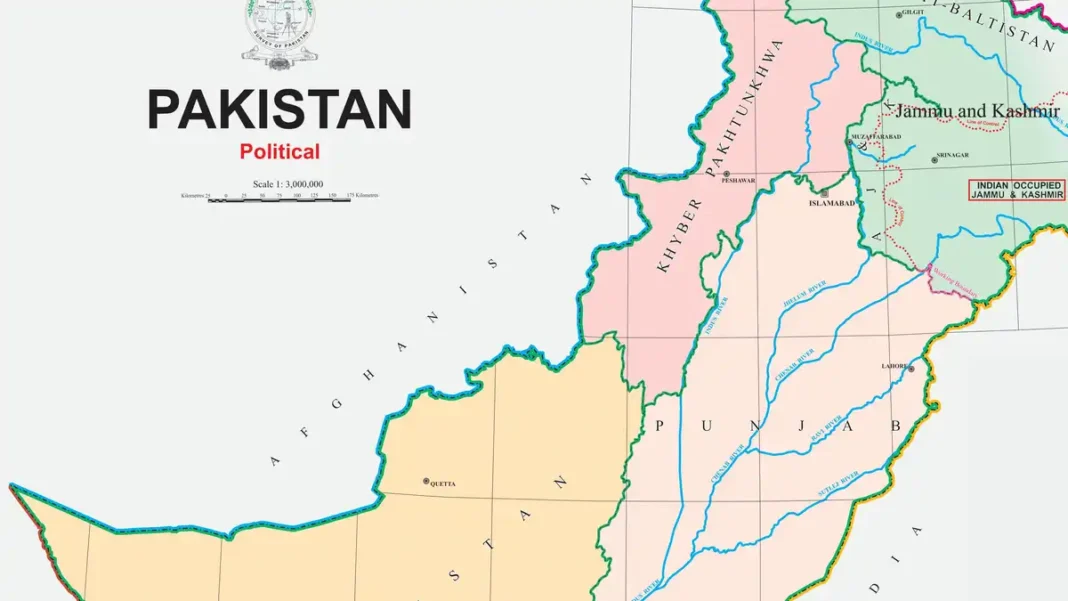
There is no single official colour palette — cartographers choose their own hues. What is standard is the set of regions shown in distinct colours:
- Four provinces: Punjab, Sindh, Khyber Pakhtunkhwa, Balochistan
- Two autonomous territories: Azad Jammu and Kashmir, Gilgit-Baltistan
- One federal territory: Islamabad Capital Territory
A well-made colour map also marks the national capital (Islamabad) with a star and provincial capitals with dots, draws international borders in a heavier line than internal boundaries, and shades disputed areas according to the publisher’s editorial policy.
The Four Provinces
Punjab
Pakistan’s most populous province — over 110 million people — occupying the eastern block of the map. Capital: Lahore. On most colour maps it is the large region east of the Indus, bordering India.
Sindh
The south-eastern block running down to the Arabian Sea. Capital: Karachi, Pakistan’s largest city and main port. Sindh’s coastline gives Pakistan its sea access.
Khyber Pakhtunkhwa
The north-western block along the Afghan border. Capital: Peshawar. Since the 2018 merger, the former tribal areas (FATA) are part of KP — maps printed before 2018 show them separately, so check the map’s date.
Balochistan
The giant western block — about 44% of Pakistan’s land area but the smallest population. Capital: Quetta. It borders both Afghanistan and Iran.
Territories & the Capital
- Azad Jammu and Kashmir (capital Muzaffarabad) — the north-eastern block, shown in its own colour on Pakistani maps.
- Gilgit-Baltistan (capital Gilgit) — the high northern block bordering China, home to K2 and the Karakoram.
- Islamabad Capital Territory — the small enclave around Islamabad; easy to miss on small maps, usually marked with a star.
How to Read the Map
- Check the legend first. Colours are arbitrary; the legend maps each shade to a region.
- Check the date. Pre-2018 maps show FATA separately; pre-2020 maps use the old Kashmir depiction. The current standard is the August 2020 official political map.
- Check the publisher. Pakistani, Indian and international atlases draw the Kashmir boundary differently — know whose map you are reading.
- Look for the scale and projection. Web maps often stretch the north; printed school atlases are the most reliable for study.
Frequently Asked Questions
What do the colours on a Pakistan map mean?
Each colour marks one administrative region — the four provinces, two autonomous territories and the federal capital territory. The colours themselves are the cartographer’s choice; the regions are the standard.
Which is the biggest province of Pakistan by area?
Balochistan, covering roughly 44% of the country’s land area, with its capital at Quetta.
Why is FATA missing from new Pakistan maps?
The Federally Administered Tribal Areas were merged into Khyber Pakhtunkhwa in 2018, so current maps show them as part of KP rather than separately.
Where can I download a colour Pakistan map?
See our map download guide — including the public-domain official 2020 map, free for printing and reuse.