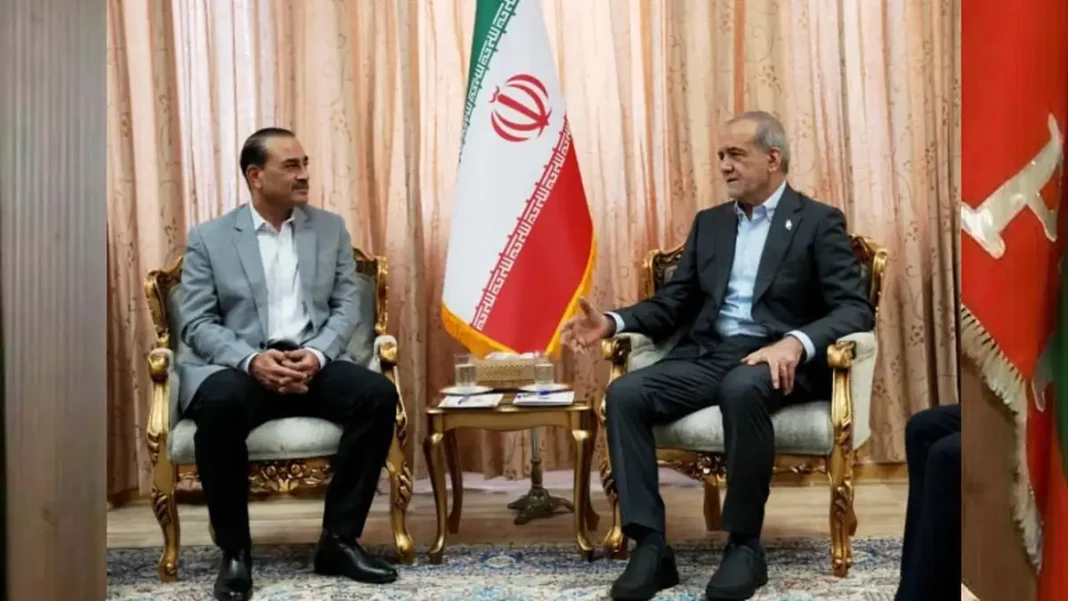
TEHRAN: Iranian President Masoud Pezeshkian discussed mediation efforts and regional developments with Pakistan’s Chief of Defence Forces, Field Marshal Asim Munir, in Tehran on Tuesday, as Pakistan pressed ahead with its attempt to bridge the gap between Iran and the United States.
The Pezeshkian Munir meeting was reported by Iran’s Nour News outlet. Interior Minister Mohsin Naqvi accompanied the field marshal to the Iranian capital, according to Iranian media. No official statement from Pakistan on the talks had been issued by late evening.
Pezeshkian Munir meeting covers seven conditions
In a separate meeting with the visiting Pakistani military chief, Iran’s Parliament Speaker Mohammad Bagher Ghalibaf said Washington could not win Tehran’s trust unless it implemented Iran’s seven conditions. The conditions centre on reopening the Strait of Hormuz and include lifting the blockade on Iranian ports, ending sanctions on Iran’s oil exports, and halting hostilities on all regional fronts.
Ghalibaf added that Iran had “no new message” for the United States, according to the semi-official ISNA news agency.
Iran’s security chief Mohsen Rezaei, secretary of the Supreme National Security Council, told Munir that Tehran would not allow nuclear material to leave the country. “Not even a tiny bit of enriched nuclear material will leave Iran,” he said, describing the material as a national asset. He added that there would be no negotiations until Washington took steps to build trust, starting with the fulfilment of Iran’s conditions.
Iranian Foreign Ministry spokesman Esmaeil Baqaei said earlier that the talks would relate to negotiations but focus mainly on bilateral relations and stronger cooperation between the two countries.
Fifth visit since the interim deal
The trip is Munir’s fifth to Tehran since Pakistan brokered an interim peace agreement between Iran and the US in June. That deal, often called the Islamabad Memorandum, faltered within weeks, and fighting resumed in July. His previous visit was in September, when he met Pezeshkian, Rezaei, Ghalibaf, Foreign Minister Abbas Araghchi and Interior Minister Eskandar Momeni.
Our earlier report on the field marshal’s departure for Tehran noted that the visit was aimed at following up on regional developments and the stalled Iran-US negotiations.
A day earlier, Araghchi blamed Washington for insecurity in the Strait of Hormuz, the narrow waterway through which much of the world’s oil and gas shipments pass. Iran has sought to blockade the strait during the war that began when the US and Israel launched joint strikes on Iranian targets on February 28.
Why the visit matters for Pakistan
Pakistan has positioned itself as the main channel between Tehran and Washington this year. Prime Minister Shehbaz Sharif, Foreign Minister Ishaq Dar and Naqvi have all engaged Iranian leaders alongside the military chief in the effort to broker a lasting settlement.
The stakes for Islamabad go beyond diplomacy. The conflict has already reshaped the region’s security map: Turkiye has moved the Makkah Joint Defence Agreement with Pakistan and Saudi Arabia toward ratification, and Britain has deployed Typhoon jets to help defend Saudi cities against Houthi aerial attacks.
Brent crude traded near $111 a barrel on Tuesday, keeping fuel costs high across importing countries, including Pakistan. Any credible path back to negotiations would ease pressure on oil markets and on Pakistan’s own import bill.
For now, Tehran’s message is unchanged: trust must be rebuilt through concrete steps, and the seven conditions remain the price of reopening the Strait of Hormuz.
What did Pezeshkian and Munir discuss?
They discussed mediation efforts between Iran and the United States and regional developments, according to Iran’s Nour News outlet. Details of any decisions were not immediately released.
What are Iran’s seven conditions?
They include lifting the blockade on Iranian ports, ending US sanctions on Iran’s oil exports, and halting hostilities on all regional fronts, as a basis for reopening the Strait of Hormuz.
How many times has Munir visited Tehran this year?
This is his fifth visit since Pakistan brokered the interim Iran-US peace agreement in June. His previous trip was in September.