Study: Saudi Missile Plant Expansion Signals Bigger Missiles
Satellite images show Saudi Arabia is expanding a ballistic missile factory west of Riyadh, according to researchers who studied the site over 17 months. The Saudi missile plant expansion at al-Duwadimi appears designed for larger solid-fuel missiles that could fly farther or carry heavier payloads.
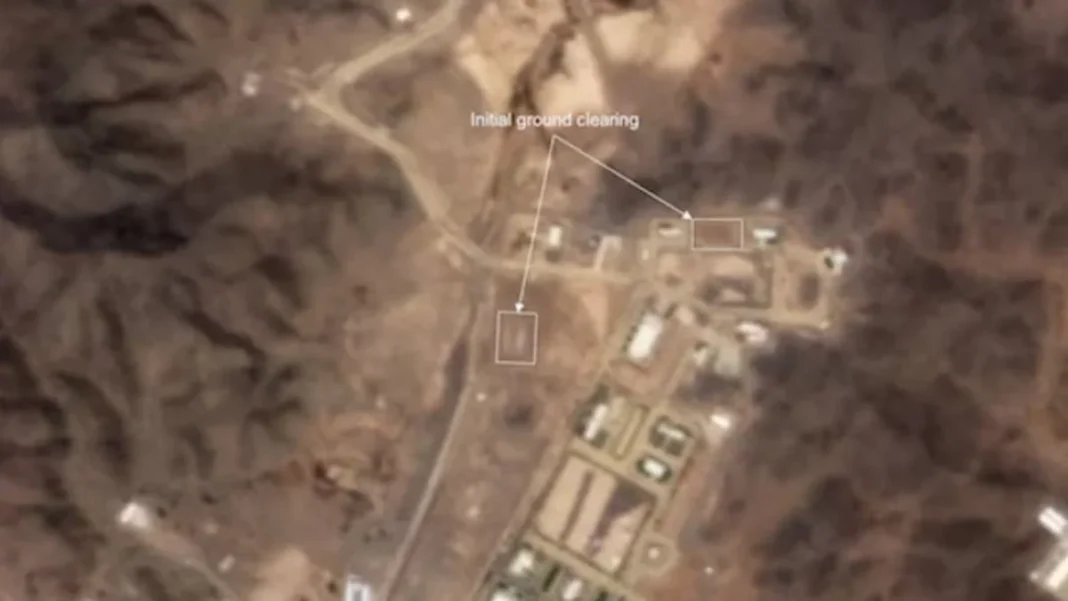
The assessment comes from Sam Lair and Michael Duitsman of the Foreign Policy Research Institute, a non-partisan research organisation based in Philadelphia. They examined images of the al-Duwadimi complex, about 200 kilometres west of Riyadh, taken by the United States satellite company Planet Labs between April 2025 and September 2026.
What the Saudi missile plant expansion shows
The images show a new building that houses casting pits, the wells in which a mixture of fuel ingredients is poured into missile motor casings and left to harden. The building is flanked by walls that appear designed to shield nearby structures from accidental blasts, and it is at least twice as large as the building believed to hold the plant’s existing casting pits.
A second new building at the site could store fuel ingredients or finished missile parts. The researchers concluded Saudi Arabia is enlarging the complex’s infrastructure, likely to produce larger missiles. Militaries prefer solid-fuel missiles because they can be stored for long periods and fired far more quickly than liquid-fuel systems.
Chinese technology links and an older arsenal
Lair and Duitsman, along with experts from the London-based International Institute for Strategic Studies and the CNA research organisation, told Reuters that the makeup of Saudi Arabia’s missile force suggests the al-Duwadimi complex relies on Chinese technology. Its features also resemble Chinese missile plants.
The history runs back decades. Saudi Arabia secretly bought about 40 liquid-fuel DF-3 ballistic missiles from China in 1987, according to a declassified United States Central Intelligence Agency estimate dated 1991, and displayed two of them at a military parade in April 2014. More recently, the research institute’s team identified what it assessed to be wreckage in Yemen of a Saudi-fired, Chinese-designed DF-15 missile, using videos and photographs posted on social media.
Lair said the kingdom may now be producing the solid-fuel DF-15, and that the al-Duwadimi expansion is likely aimed at producing the longer-range DF-21 or a similar missile. Riyadh turned to Beijing, the researchers noted, because Washington has long restricted exports of longer-range missile systems. The Saudi embassy and Information Ministry did not respond to requests for comment, nor did the Chinese embassy and defence ministry. The CIA declined to comment, and the White House did not respond.
Why the expansion matters for the region
More capable missiles could help Saudi Arabia deter attacks by Iran and make its armed forces more self-reliant, while strengthening its hand in the conflict with Yemen’s Tehran-backed Houthi fighters. The risks run the other way too: larger Saudi missiles could fuel a regional missile race, and they could deepen opposition in the United States Congress to a civilian nuclear agreement with Saudi Arabia, which has already raised proliferation concerns.
Sascha Bruchmann, a research fellow at the International Institute for Strategic Studies who reviewed the assessment at Reuters’ request, agreed that the expansion could be for more powerful solid-fuel missiles. He said longer-range missiles would let Saudi Arabia strike Iran without risking its United States-supplied F-15 fighter jets against Iranian air defences, and that they could narrow the capability gap with Iran, whose missiles and drones can already strike Saudi targets at will.
Why it matters for Pakistan
The findings land at a sensitive moment for Pakistan. Pakistan and Saudi Arabia completed ratification of the Makkah defence pact this month, tying Pakistan’s security more closely to the kingdom. A shift in Saudi missile capability therefore matters in Islamabad as well as in Riyadh, since Gulf security affects oil shipping, regional trade and the large Pakistani workforce in Saudi Arabia.
Pakistan has watched the Gulf missile exchanges closely. A Saudi-led coalition has intercepted Houthi missiles aimed at Riyadh in recent weeks, and European and regional powers warned in Istanbul against any new attack on Iran. The al-Duwadimi expansion is a longer-term development than those incidents, but it points in the same direction: the Gulf’s missile competition is growing, not shrinking.
What remains unconfirmed matters as much as what the images show. The assessment is an open-source reading of satellite pictures, not an official Saudi statement. Riyadh has not confirmed what the new buildings are for, and the researchers’ conclusions about missile types remain assessments, not verified facts.