DRAFT — Tariq Fazal Rejects Claims K-P Governor’s Rule Is About Minerals
- Suggested slug: tariq-fazal-kp-governors-rule-minerals-claim
- Category: National News
- Focus keyphrase: K-P governor’s rule
- SEO title: Tariq Fazal: K-P Governor’s Rule Not About Minerals
- Meta description: Tariq Fazal rejected claims linking the K-P governor’s rule to mineral extraction, calling it a “peace game, not a power game” on Capital Talk.
- Tags: Tariq Fazal Chaudhry, K-P, governor’s rule, minerals, PTI, parliament, Faisal Karim Kundi, counterterrorism
- Original element: follow-up to Feature Pakistan’s prior coverage of the governor’s-rule saga (PML-N’s defence of the move and Governor Kundi’s Oct 17 minerals statement), with internal links; places the minister’s TV appearance in the timeline of the saga.
- Source: https://tribune.com.pk/story/2635746/tariq-fazal-rubbishes-linking-governors-rule-in-k-p-to-mineral-extraction (Tribune, published 19 Oct 2026)
- Story date: 19 October 2026
- Image file: hourly-2232-tariq-fazal-kp-governor-rule-minerals.webp
- Image title: K-P minerals mining governor’s rule debate
- Image alt: Mining operations in Khyber-Pakhtunkhwa amid the K-P governor’s rule minerals debate
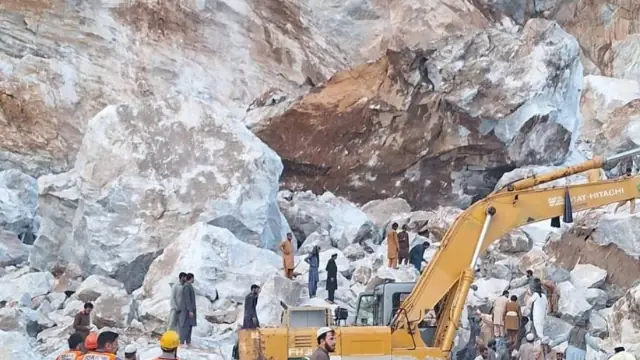
- Image caption: Mining operations in Mardan, Khyber-Pakhtunkhwa. The minister rejected claims the governor’s rule is linked to mineral extraction. Image: Express
- Image credit: Image: Express
- Note on image: photo is from the original Tribune article, captioned there “PHOTO: EXPRESS”
—
Tariq Fazal Rejects Claims K-P Governor’s Rule Is About Minerals
Parliamentary Affairs Minister Tariq Fazal Chaudhry has rejected claims that the K-P governor’s rule and emergency are linked to the province’s mineral wealth, saying in a Tribune report the move is about terrorism, not resources.
Speaking on the private television programme Capital Talk on Monday, the minister said political parties were linking the emergency to the minerals debate because they saw it as part of a “power game”. He dismissed that reading outright.
“It’s not a power game but a peace game, because of which an emergency has been imposed,” he said, adding that it was unfortunate that attempts were being made to link the emergency in K-P with anything other than terrorism.
How the K-P governor’s rule minerals row began
The emergency and governor’s rule were declared on October 11, after talks between the government and the opposition broke down. The collapse of negotiations followed a PTI long march towards Islamabad that began on October 4.
Last week, a joint session of parliament adopted two resolutions ratifying the presidential proclamations imposing a state of emergency and governor’s rule in K-P for two months, drawing opposition protests. Earlier, both houses had separately approved the emergency by majority vote under Clause 1 of Article 232 of the Constitution.
The opposition has described the move as an attempt to encroach on the province’s mineral wealth and vowed to resist what it calls the forcible occupation of Pakhtun lands and the appropriation of their natural resources. The PML-N leadership has publicly defended the governor’s rule as a constitutional necessity.
Minister points to terrorism, not mining
Chaudhry underlined that the emergency had been imposed in extraordinary circumstances and that a constitutional option had been used. He said there were differences of opinion between the former provincial government and the federal government on counterterrorism, adding that the former chief minister was not even willing to condemn terrorism and the TTP.
On the security situation, he said Dera Ismail Khan was among the 12 districts where operations would be conducted in the first phase. “There is no writ of the government there in DI Khan,” he said, adding that he could name parliamentarians who paid protection money to travel home safely.
The minister also conceded that some parties, including people in his own party, had wanted a share of authority in the new setup, but said the advisory council members were selected on merit as experts in their fields.
Minerals debate continues despite denial
The minister’s denial came just two days after K-P Governor Faisal Karim Kundi said the province’s minerals would be extracted and sold to promote economic prosperity. On October 17, the governor urged domestic and foreign companies to invest in the sector through joint ventures to generate employment and support local businesses.
Chaudhry also addressed recent remarks by US Chargé d’Affaires Natalie Baker, who claimed Pakistan possessed mineral wealth worth seven trillion dollars. He said Pakistan’s partnership with the US was old, and noted that she had named both Balochistan and K-P.
“Mines and minerals that have been buried for the past 80 years, should they not be extracted to pay off Pakistan’s loans?” he asked. The federal government has stressed that people from K-P and Balochistan will have the first right to their provinces’ mineral wealth, and that the money will be spent on provincial development. The minister said figures on federal funds given to K-P, and how much was actually spent, would be made public, with numbers for Balochistan to follow.
Pakistan’s mineral reserves are estimated at around $8 trillion over 600,000 square kilometres, according to the Institute of Cost and Management Accountants, though mining has historically contributed less than 3 per cent of GDP.
Frequently asked questions
What did Tariq Fazal Chaudhry say about the K-P governor’s rule?
The parliamentary affairs minister rejected opposition claims that the emergency and governor’s rule in K-P are linked to mineral extraction. He said the move is a “peace game, not a power game” aimed at terrorism, not resources.
When was the emergency imposed in K-P?
The emergency and governor’s rule were declared on October 11, after government-opposition talks failed. Parliament later ratified both proclamations for two months under Clause 1 of Article 232 of the Constitution.
Why does the opposition link the move to minerals?
Opposition parties argue the real motive is control over the province’s vast mineral reserves, calling it an encroachment on Pakhtun lands and natural resources. The government insists the move is a constitutional response to the security situation.