Slug: task-force-local-governments-funding-direct-polls
Category: National
Focus keyphrase: local government reforms Pakistan task force
SEO title: Task Force Demands Funding, Direct Polls for Local Govts
Meta description: A task force has urged constitutionally guaranteed funding for local governments, directly elected mayors, and an end to lawmakers’ development funds.
Tags: local government, devolution, task force, direct polls, Article 140-A, development funds, mayors, Punjab
Original element: own data point — our own local-government election coverage (the Punjab three-phase April proposal, the ECP’s rejection, and the PPP’s preparations, all linked) provides the electoral backdrop the task force report is responding to.
Task Force Seeks Guaranteed Funding, Direct Polls for Local Governments
KARACHI: A task force on local governance on Wednesday called for constitutionally guaranteed funding, directly elected mayors and stronger safeguards for local councils, warning that provincial political and bureaucratic control has undermined devolution in Pakistan.
Prepared by the Task Force on Reforms in Local Governance in Pakistan — convened by the BNU Centre for Policy Research with the Sanober Institute, deliberating between January and June — the report recommends a protected share of public resources for local governments, greater control over revenue, and abolishing or repurposing development funds run by national and provincial lawmakers.
Article 140-A ‘never fulfilled’
The report said no province had consistently fulfilled Article 140-A’s constitutional requirement to devolve political, administrative and financial authority to elected local governments, as legislators and provincial administrations were reluctant to surrender control over development spending, personnel and public services.
It attributed the weakness of local government to a “zero-sum mentality”, with parallel administrative structures, delayed elections and appointed administrators preventing elected councils from developing institutional continuity.
Guaranteed funding and local revenue
The task force proposed a constitutionally protected allocation of 30 to 40 per cent of “the divisible pool” — though the report does not clearly specify the pool — to be released as a single grant at the start of each financial year.
Citing a World Bank report, it said local governments’ share of total spending had fallen from around 10 per cent in 2005 to about 4.7 per cent in 2024. In Punjab, officials reportedly said salaries consumed some 80 per cent of funds received, leaving little for development.
The report called for transparent Provincial Finance Commissions allocating by population, revenue generation and need, and for letting local governments assess, collect and retain property tax, capital gains tax on urban land, agricultural cess and user charges.
It also proposed ending separate development-fund channels run by MNAs and MPAs. “These funds should either be abolished or strictly repurposed to strengthen local governments,” it said.
Punjab law draws criticism
The report criticised the Punjab Local Government Act 2025 for retaining provincial executive control, arguing that rejecting secret ballots for councils above the union council tier conflicted with Article 226, and opposing indirect mayoral elections and the absence of guaranteed fiscal allocations. Sections 21 and 76 were identified as reinforcing provincial control, alongside more than 50 provincially controlled companies performing urban functions.
In Sindh, it flagged provincial appointees’ effective veto over councillors’ plans; in Khyber-Pakhtunkhwa, the reversal of a commitment to channel development spending locally; and in Balochistan, geographic dispersion, limited capacity and a narrow revenue base.
Direct elections and control over services
The task force recommended directly elected mayors and chairpersons, with clear rules and judicial review for suspending elected councils. Major cities would get metropolitan corporations under directly elected mayors; rural districts would have elected chairpersons.
Local governments should primarily oversee education up to matriculation, primary and secondary healthcare, water supply, sewerage, solid waste management, local roads and community welfare, while provinces retain tertiary healthcare, higher education, inter-district infrastructure and policy coordination.
The report stressed that transferring functions without staff and budgets would render devolution ineffective, proposing that civil servants in Grade 16 and below in devolved departments be placed under local government control, with their salaries.
Constitutional safeguards and next steps
The report proposed expanding Article 140-A through a constitutional schedule defining local government responsibilities, amending Article 160 to put Provincial Finance Commissions on a National Finance Commission-like timetable, and reviewing Articles 7 and 226 to strengthen the enforceability of local elections. A Council of Common Interests framework should set minimum standards.
It also called for merit-based recruitment, training for officials and elected representatives, and online publication of budgets and performance indicators — with constitutional and fiscal changes immediately, legislative reforms within two years, and revenue and civil service measures over two to four years.
On demands for new provinces, the report argued that smaller units and stronger local governments were compatible, but local reform should take precedence. Its comparison of the United States, Germany, India, Brazil and China identified predictable financing, control over local revenue and sustained accountability as the essentials.
The task force was chaired by BNU Vice Chancellor Dr Moeed Wasim Yusuf, with Sanober Institute Chairman Aizaz Ahmad Chaudhry as co-chair. Members included former federal ministers Khurram Dastagir Khan and Shafqat Mehmood, plus legal experts, researchers and civil society representatives.
The electoral backdrop
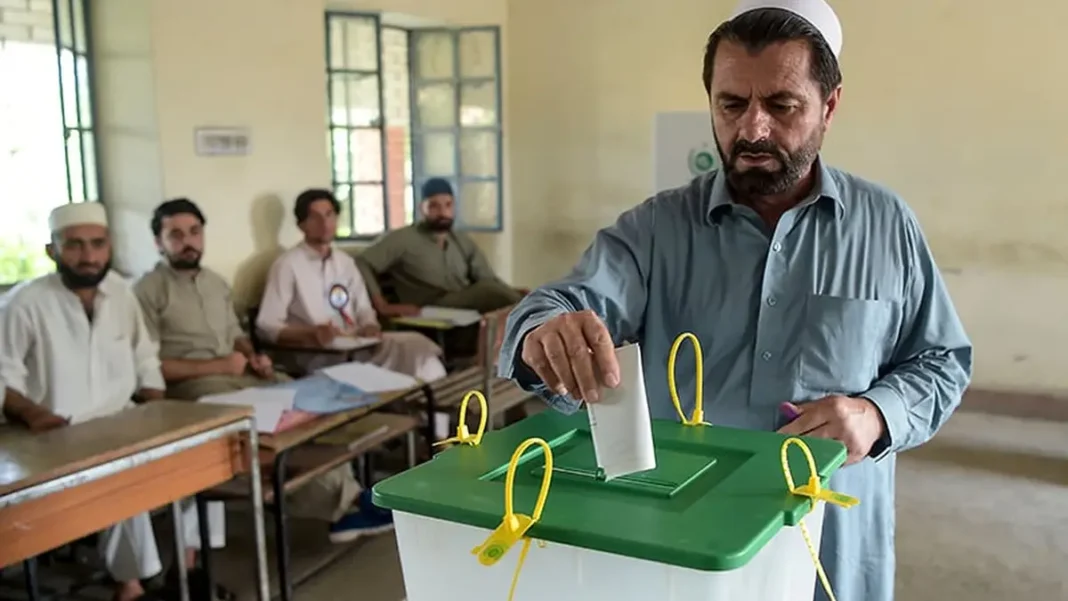
The report lands as local-government elections take shape. Punjab has proposed holding the polls in three phases in April, though the Election Commission has rejected that April 2027 plan, while the PPP has stepped up its preparations across the province. In the federal capital, Islamabad’s 130 union councils have just been finalised after delimitation objections were dismissed.
The task force concluded that meaningful devolution required municipal institutions capable of delivering everyday services — functioning schools, staffed hospitals, timely road repairs. The Express Tribune reported the task force’s findings on Wednesday night.