IRGC Says Three Tankers Hit Mines in Strait of Hormuz
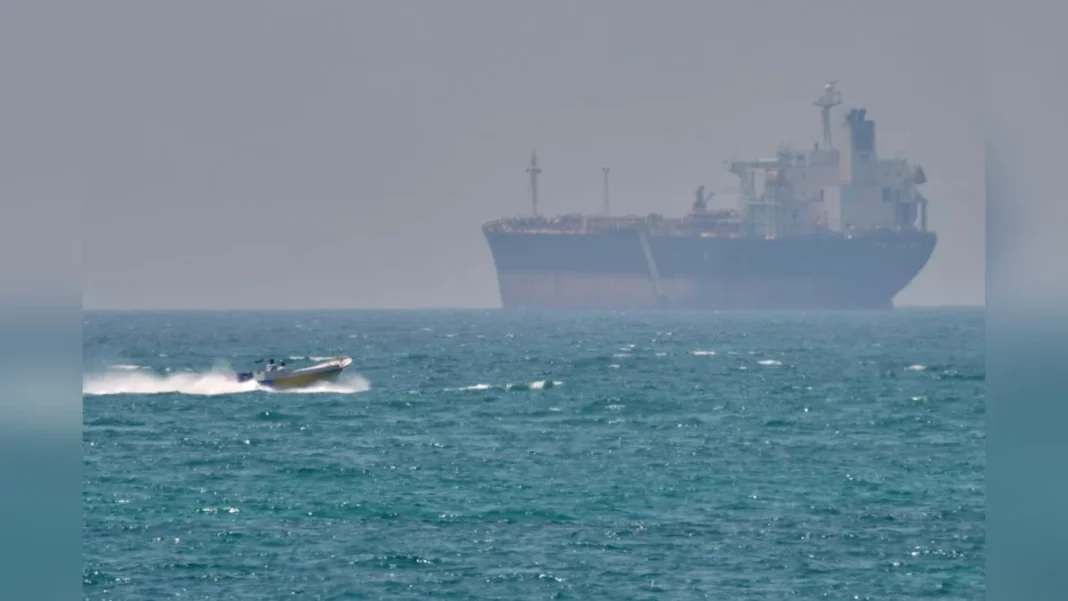
Iran’s Islamic Revolutionary Guard Corps Navy said three oil tankers struck naval mines in the Strait of Hormuz late on Monday, setting off explosions and fires aboard all three vessels.
The IRGC Navy said two of the tankers hit mines in the eastern part of the strait and one near its southern coast. It said all three were sailing under extensive US military air cover and escort, and claimed American protection had failed to prevent the incidents.
The claims could not be independently verified. US Central Command has not responded, and the IRGC has not named the tankers, their owners or flag states, or given details of casualties or damage.
The claim was carried by Iranian state media, including the Mehr News Agency, which said the tankers exploded and caught fire after striking the mines. The Express Tribune reported the IRGC statement and the speaker’s remarks on Tuesday.
Warning to shipping
The IRGC Navy said it would release footage of the explosions and fires. It warned vessel owners, commanders and shipping companies that US military cover would not exempt them from maritime regulations and the directives of its traffic control centre.
It also warned vessels against taking unauthorised routes or ignoring maritime warnings in the strait.
The United Nations’ International Maritime Organization recorded 136 security incidents involving vessels in the Strait of Hormuz and the wider Middle East between March 1 and November 11, including 35 in October alone.
Similar claims have surfaced repeatedly in recent weeks. Iran said on November 17 that two tankers had struck mines in the southern part of the strait and that a third had caught fire after striking a mine east of it. The United Kingdom Maritime Trade Operations agency separately reported two tanker attacks in the strait on the same day, and it was unclear whether they were connected to the mine strikes Iran claimed.
Speaker warns of stalemate
Iranian Parliament Speaker Mohammed Bagher Ghalibaf said on Monday that the US wants to impose a “no war, no peace” stalemate on Iran. He argued that “sustainable deterrence” alongside or instead of negotiations is the way to end the threat of conflict.
“Sustainable deterrence means strengthening the country,” Ghalibaf said in remarks carried by Iran’s semi-official Tasnim news agency. He added that diplomacy and war are both instruments for achieving deterrence.
The “neither war nor peace” situation cannot continue and “must be resolved”, he said. “The question now is how, by whom, and with what actions should we resolve this situation,” he added.
Why the Strait of Hormuz matters
The Strait of Hormuz is a major shipping route for global oil and liquefied natural gas supplies. Oil shipped from the Gulf passes through the strait, so disruption there can feed into fuel prices in importing countries, including Pakistan.
Pakistan has been building energy ties in the region. Feature Pakistan reported that the Pakistan-Oman oil deal has grown into a long-term partnership. At home, Pakistan’s own gas sector is in flux, with Feature Pakistan reporting that the Sui gas companies split plan has landed on the prime minister’s table.
The United States has also moved against Iran’s finances. Feature Pakistan reported that US sanctions target Iran’s shadow banking networks. Turkiye’s foreign minister has warned that the world economy would suffer if no peace deal is reached with Iran, as Feature Pakistan reported.
How the standoff reached this point
Regional tensions have escalated since the US and Israel launched a war against Iran in February. Tehran responded by attacking Israel and US military facilities across the region.
The US and Iran signed a framework agreement in June to end hostilities and began negotiations, which later stalled over how to ensure safe and free navigation through the Strait of Hormuz.
Fighting between the parties has flared intermittently since July. Iran announced on July 12 that it had closed the strait after the US resumed military strikes, and Tehran has warned it would target vessels using routes other than those designated by Iranian authorities or attempting to transit the waterway without permission.
Frequently asked questions
What happened in the Strait of Hormuz?
Iran’s Revolutionary Guard Corps Navy said three oil tankers struck naval mines late on Monday, causing explosions and fires aboard all three vessels, one near the southern coast and two in the eastern part of the strait.
Have the claims been verified?
No. The claims could not be independently verified. US Central Command has not responded, and the IRGC has not named the tankers, their owners or flag states, or given details of casualties or damage.
What did Iran’s parliament speaker say?
Mohammed Bagher Ghalibaf said the US wants to impose a “no war, no peace” stalemate on Iran and that “sustainable deterrence” is the way to end the threat of conflict.
Why does the Strait of Hormuz matter?
It is a major shipping route for global oil and liquefied natural gas supplies. Oil shipped from the Gulf passes through the strait, so disruption there can affect fuel prices in importing countries, including Pakistan.
How long has the standoff lasted?
The US and Israel launched a war against Iran in February. The two sides signed a framework agreement in June, but negotiations later stalled and fighting has flared intermittently since July.