KSE-100 Falls 4,045 Points in Fifth Weekly Drop
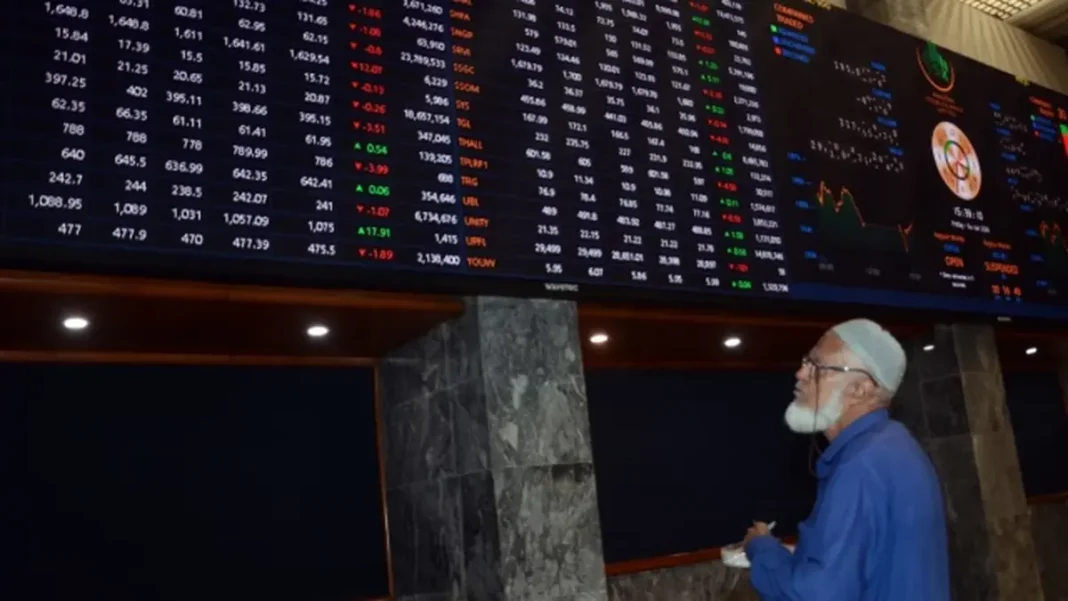
The KSE-100 index fell 4,045 points during the outgoing week to close at 162,375, its fifth consecutive weekly decline, as escalating geopolitical tensions, rising oil prices and domestic economic uncertainty weighed on investor sentiment. The benchmark slipped below the key levels of 166,000, 164,000 and 163,000 in a week of broad-based selling.
Arif Habib Limited put the weekly decline at 2.4 per cent, and JS Research confirmed the fifth straight weekly fall, with both pointing to persistent geopolitical uncertainty.
How the KSE-100 fell through the week
The week opened with a lacklustre session, as the KSE-100 declined 454 points, or 0.27 per cent, to close at 165,966 and slip below the 166,000 mark. On Tuesday, rising oil prices weighed on the market again, and the index lost 814 points, or 0.49 per cent, to end at 165,152.
Wednesday brought a brief recovery, with the benchmark gaining 779 points, or 0.47 per cent, to close at 165,931 on support around 165,000. On the second last session, as geopolitical risks escalated, the index dived 2,007 points, or 1.21 per cent, to 163,924.
Geopolitical headwinds pushed the market below 163,000 on the final trading day on Friday, when it fell 1,550 points, or 0.95 per cent, to close the week at 162,375.
What analysts blamed for the fall
JS Research head Muhammad Waqas Ghani said average volumes dropped 13 per cent to 393 million shares, while traded value rose 7 per cent week on week to 69.7 million dollars, and Brent crude closed above 114 dollars a barrel, against last week’s average of 106 dollars.
Arif Habib Limited linked the decline primarily to persistent geopolitical uncertainty, with dearer oil and domestic economic uncertainty adding to the pressure. The combination kept sellers in control through most of the week, despite Wednesday’s brief rebound.
The wider economic picture
Pakistan’s trade deficit widened 21.1 per cent to 9.33 billion dollars in the first quarter of fiscal year 2026-27, as imports grew nearly twice as fast as exports, while large-scale manufacturing grew just 0.67 per cent in August, signalling an industrial slowdown.
GDP growth for fiscal year 2025-26 was revised down to 3.65 per cent from 3.70 per cent, and for 2024-25 to 3.11 per cent from 3.18 per cent, with quarterly growth of 3.89, 4.31, 4.42 and 2.0 per cent. Agriculture, industry and services grew 3.50, 3.34 and 3.81 per cent, the economy’s size reached Rs126.4 trillion, or 450.4 billion dollars, and per capita income stood at 1,896 dollars.
Power generation in September rose 5 per cent year on year to 13,217 gigawatt hours on higher hydel, local coal, imported coal and wind output, while generation cost rose 32 per cent to Rs9.35 per kilowatt-hour and distribution companies sought a fuel cost adjustment of Rs2.56 per kilowatt-hour for September.
A committee reviewing the Automotive and Auto Parts Manufacturing Policy 2026-31 proposed reforms to boost exports and accelerate new energy vehicle adoption, including lower sales tax on such vehicles, reduced import tariffs, mandatory export targets for original equipment manufacturers, localisation requirements and incentives for incremental exports. Prime Minister Shehbaz Sharif also approved a 1 per cent sales tax on electric vehicles and major import tax cuts under a five-year auto policy, subject to IMF and cabinet approval.
Cotton arrivals rose 8 per cent year on year to 4,081,000 bales as of October 15, 2026, with Sindh up 7 per cent to 2,443,000 bales and Punjab up 8 per cent to 1,638,000 bales. Sowing reached 1.79 million hectares, 82.8 per cent of the 2.16-million-hectare target, against a fiscal year 2026-27 production target of 9.64 million bales, compared with 7.05 million in 2025-26.
Petroleum prices recorded a 3.2 per cent week-on-week decline in motor spirit to Rs377.71 per litre, and a 1.3 per cent decline in high-speed diesel to Rs391.75 per litre, driven by lower ex-refinery prices, while the levy and margins remained unchanged. National Savings profit rates rose by an average of around 24 to 40 basis points across major schemes, and State Bank reserves remained stable at 21.5 billion dollars.
Related coverage: PSX 1,332-Point Selloff, KSE-100 Falls 1,964 Points on October 12, Refineries Make Over 1000% Higher Profit After Difficult Decision, and 31,000 Consumers Denied Petrol Subsidy.
Frequently asked questions
How far did the KSE-100 fall this week?
The benchmark index fell 4,045 points, or 2.4 per cent, to close the week at 162,375.
Why did the market fall?
Arif Habib Limited and JS Research both pointed to persistent geopolitical uncertainty, with rising oil prices and domestic economic uncertainty adding to the selling pressure.