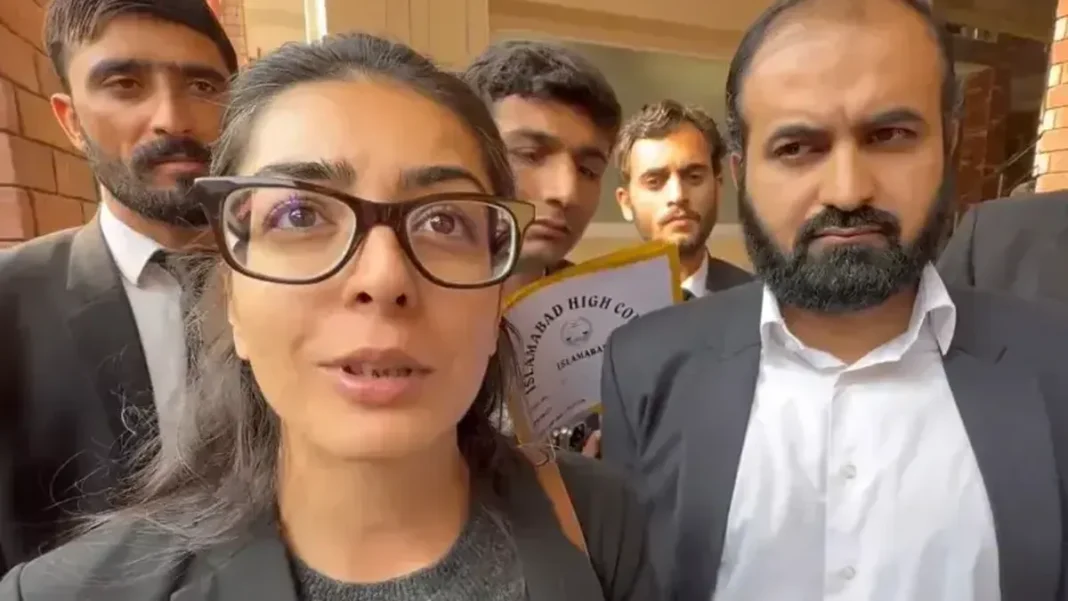
The Supreme Court has directed the inspectors general of police of Sindh, Balochistan, Khyber Pakhtunkhwa and Islamabad to submit comprehensive reports within 10 days on all pending cases against PTI lawmaker Jamshed Dasti. The Dasti Supreme Court hearing also extended his interim bail and adjourned the matter until November 4.
The two-member bench, headed by Justice Malik Shahzad Ahmad Khan, heard Dasti’s petition challenging his seven-year sentence in a 2013 fake degree case. During the hearing, the judges questioned the string of cases registered against the lawmaker across the country, including an allegation of stealing a mobile phone.
Judges question multiple cases over one offence
Justice Abbasi criticised the practice of registering multiple cases over the same alleged offence in different parts of the country. He observed that the burden ultimately fell on the courts.
“Cases under the Maintenance of Public Order (MPO) may be understandable, but there is even an allegation of stealing a Nokia mobile phone,” Justice Abbasi remarked. “In the past, cases of buffalo theft were registered against prominent people. Nokia phones came later.”
He added that if 100 cases were registered against one person, it could take a lifetime to get them all resolved. The judge observed that the courts were left helpless, and that the public was turning the judicial system into a subject of ridicule.
“You say the judiciary ranks 136th in the world, but these are your achievements; the judiciary gets the blame,” he remarked.
Justice Shahzad observed that all members of parliament were respectable in the eyes of the court. He questioned the political commitment to judicial independence, saying politicians tended to remember such principles only after moving into opposition.
“When you move into opposition, you suddenly remember everything, including the independence of the judiciary,” Justice Shahzad remarked. He added that politicians should play their role when they were in power, rather than turning to the courts only when they themselves faced legal action.
Dasti Supreme Court hearing: 47 cases in Punjab alone
Additional Prosecutor General Punjab Tariq Siddiqui informed the court that a report on cases registered against Dasti in Punjab had been submitted. According to the report, 47 cases had been registered against the lawmaker in the province. Of these, 35 had been disposed of, while 12 remained pending.
The bench also questioned Election Commission of Pakistan (ECP) officials about their appearance in the proceedings. ECP Director General Law Muhammad Arshad Khan informed the court that the commission was appearing as the complainant in the matter in response to a court notice.
The ECP law director further informed the court that the National Assembly speaker had referred a matter to the commission, which had issued a decision. The Lahore High Court, however, had suspended the operation of that decision through a stay order.
The ECP’s role in election disputes has drawn attention before, as covered in our report on the ECP’s AI election rules. In Dasti’s case, the commission appears as complainant, while its own decision stands suspended by the high court.
Dasti’s own account
Dasti told the bench that he had waged a struggle against corrupt elements and had also spoken against political party leaders. Justice Shahzad responded that it appeared Dasti had spent his entire life engaged in this struggle.
Justice Abbasi remarked that Dasti spoke courageously, adding that whether his position was right or wrong was a separate matter.
The exchange captured the tone of the hearing. The bench pressed the state on the number and spread of the cases, while also pressing Dasti’s side on the legal questions that will decide the petition.
Detention and house arrest of political figures have become a wider theme in recent weeks, as covered in our report on the house arrests confirmed by Governor Kundi and our report on the HRCP demand on detentions. The courts have also been asked to set the pace in other politically charged cases, as covered in our report on special courts for narcotics cases in Karachi.