KARACHI: For four days, the halls of the Arts Council of Pakistan Karachi never really went quiet.
Panels argued about the future of art in the morning. Drums and dancing filled the workshops by afternoon. And by night, the stages belonged to clowns, detectives, flamenco dancers and a lone pianist merging Sufi music with Western classical themes.
This was days five to eight of the World Culture Festival Karachi 2026, the 25-day festival that opened on 30 October at the Arts Council of Pakistan Karachi.
Theatre, music, dance, film, exhibitions and talks ran side by side. Artists had arrived from more than a dozen countries. Karachi’s audiences, from schoolchildren to the chief secretary of Sindh, filled the seats to watch them.
Day Five: Five Artists, One Question — What Is Art For?
The fifth day of the World Culture Festival Karachi 2026 began with a conversation.
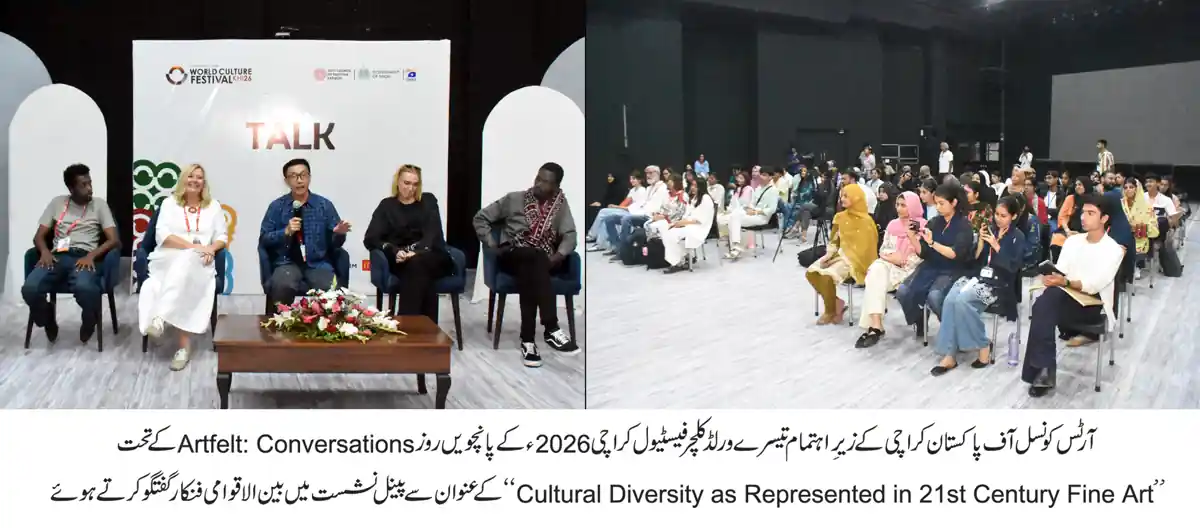
Five visual artists from four continents shared one stage for “Cultural Diversity as Represented in 21st Century Fine Art”, part of the festival’s Artfelt: Conversations series.
Kaleab Alemayehu came from Ethiopia. Petra Kaltenbach came from Germany. Yip Yew Chong came from Singapore, Domi Forest from Sweden and Nelson Ijaka from Kenya.
Each had carried a different artistic journey into the room. Together, they asked how culture shows itself in today’s fine art, and what new tools, above all artificial intelligence, are doing to the artists who use them.
Alemayehu spoke first in spirit: art, he said, offers a glimpse of a world beyond politics.
It is one of the strongest ways people connect, he argued, because every art form lets a person express who they are, and still promotes peace. On artificial intelligence, he was clear. He is not opposed to it. But it must be used thoughtfully and responsibly.
Kaltenbach picked up the thread of change. Dialogue and artistic expression, she said, can bring positive change to a society. And transforming yourself, she added, is how you begin to understand others.
Yip spoke about Pakistan itself. He had made new friends here, he said. Photographs of his work had travelled around the world, and through them, his friends were discovering the true beauty of this country.
Forest looked at the world outside the hall. While parts of it face destruction, he said, a festival like this is a chance to celebrate life. To spread love. To care for one another.
Ijaka brought the hardest experience to the table. He spoke about corruption, and about how difficult it is to rebuild a country.
Art, for him, is how a people shapes its own narrative. It is how a culture learns to take pride in itself. He praised the standard of art in Pakistan, its audiences, and the warmth with which all five guests had been received.
Then the talking stopped, and the day turned physical.
Japanese guitarist Juna Serita led a workshop with a title that is also an argument: “Beyond the Bassline”.
In most bands, the bass guitar stays in the background, holding the rhythm. Serita plays it as a lead instrument. She demonstrated the technique in performance first, so the room could hear what she meant.
Then came the improvisation session. Young musicians joined in, learning directly from her, testing the techniques themselves, and applauding her performance as the session built.
Across the venue, the drums were already going.
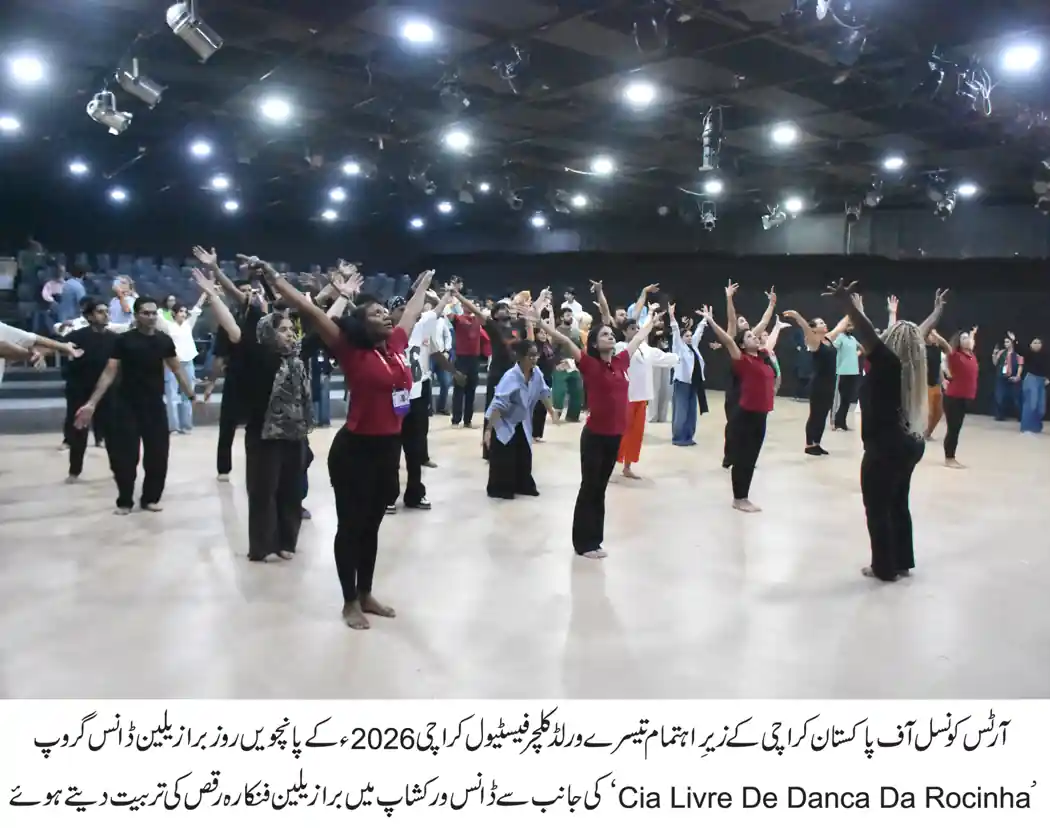
Brazil’s Cia Livre De Danca Da Rocinha was teaching samba. Not as a lecture, but step by step: the coordinated movement of hands, shoulders and feet, locked to the rhythm of the drums, until students and fellow artists were moving together.
Arts Council President Muhammad Ahmed Shah watched the workshop. Then he did something the group had not planned for. He invited the Brazilian dancers to return to Karachi after the festival, for a full two weeks of training.
Film lovers had their own room on day five: the Arab and North African Shorts.
Eight short films unspooled, and between them they carried the weight of a region: Palestinian identity, displacement, memory, family struggles, social injustice, psychological conflict, and the uneasy line between truth and illusion.
The selection was Al-Adham, directed by Eman Hatem; Casting, by Youssef Sanheji; Passport Wedding, by Abdallah Al-Ziyadi; and Red Like Blood, by Yara Saliba Shehadeh.
It continued with Rehab, by Nabeel Sabah Joy; Salopette, by Feryel Ben Boubaker; The Last Minutes, by Houssam Skaff; and The Last Miracle, by Abdelwahab Shawky.
Nearby, an open mic gave the festival back to Karachi itself. Young singers stepped up and performed, adding their own voices to a day dominated by guests.
Theatre closed the night, with two productions that could not have been more different.
First, Italy’s Tom Corradini performed Shaolin Clown. For 50 minutes, he used almost no dialogue at all.
The story is told through movement and expression: a Shaolin monk, deep in his Zen practice, rediscovers the playful, clownish side of his own nature. The piece is inspired by Bernhard Moestl’s book “Shaolin: You Do Not Have to Fight to Win”, and it finds the meaning of life in humour and in everyday moments.
Then Pakistan answered with laughter of its own.
Taleem-e-Balighan, written and directed by Farhan Alam Siddiqui, runs for 60 minutes inside an adult education centre ruled by a strict cleric. His students have clashing personalities and stubborn attitudes. The classroom descends into chaos.
Underneath the comedy sits the satire: a society drifting into decline, and growing distant from its own principles and values. Both productions left the stage to an enthusiastic response.
Day Six: Flamenco Heels and a Puppet’s Warning
On the sixth day, the headline sound was heels on a stage.
Spain’s Flamenco Blanco Flamenco performed “The Grace of Movement”. Traditional flamenco works through three elements at once, and all three were on display.
The hands carry the emotion, expressive and precise. The feet strike the floor in intricate, rapid footwork that builds the rhythm. Live music binds them together.
The hall answered the way flamenco audiences have answered for generations: with sustained, enthusiastic applause. For Karachi, it was a full-evening encounter with one of Europe’s oldest dance traditions.
Earlier that day, the festival belonged to its youngest audience.
Poland’s Miniatura City Theatre staged Little Red Riding Hood, but nobody in the hall saw the picture-book version they expected.
Conceived, directed and designed by Chile-born artist David Zawalla, this puppet production moves the story into the future. Its heroine is the last human girl on a devastated Earth.
The world she crosses is scarred by pollution. Strange creatures emerge from waste. A story every child knows by heart becomes, gently, a warning about the planet those children will inherit.
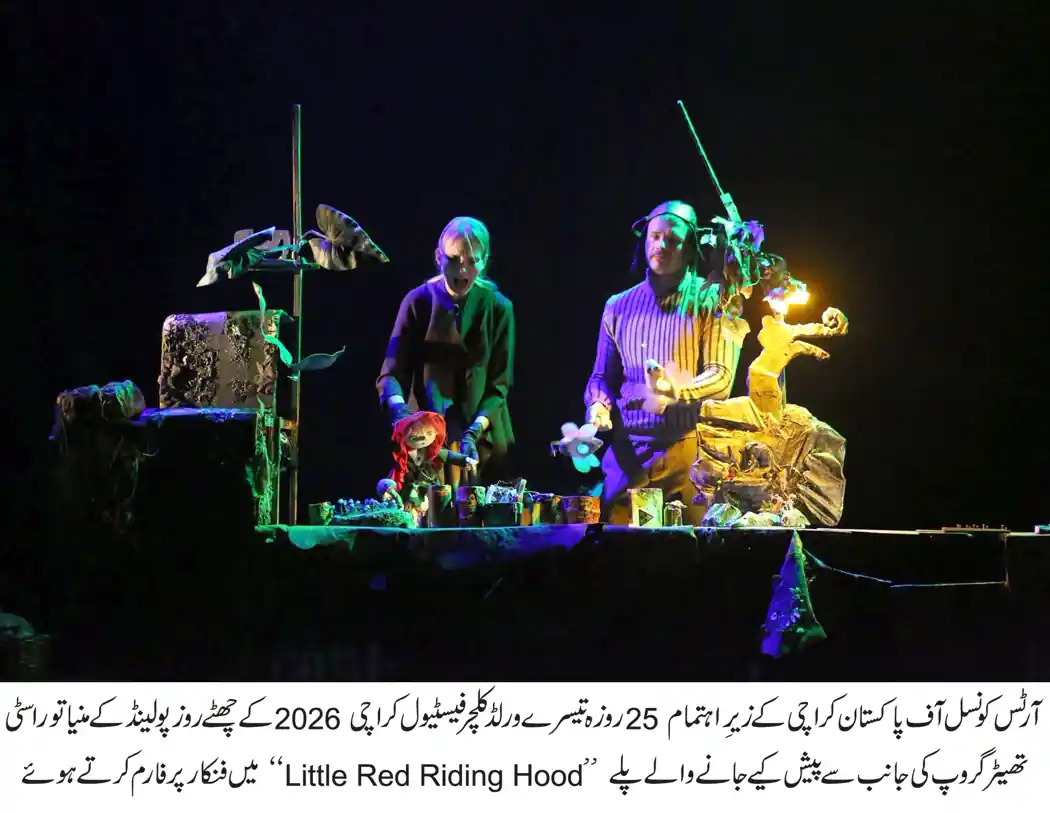
Norway’s Erler Teaterkompani took the opposite approach: pure adventure.
In Gangster Hunting with Daisy Detective, the case cannot be solved from the seats. Children from the audience joined the detective’s hunt for clues, and the line between the cast and the crowd disappeared.
Music filled the middle of the day. Serbian guitarist Aleksandar Lipovan led “Jam and Improvisation”, a workshop built on live jamming and modern guitar technique, with young musicians playing alongside him rather than watching.
The Polish Featurette then screened four short films from Poland: Blue Bird, Momo & Lulu, Dream Up the Title and The Town That Drove Away.
Four films, and the same questions returning in different forms: loneliness and acceptance, relationships, dreams, identity, and the pull between migration and roots.
The evening ended in a classroom. English Only, directed by Awab Bin Farhat, follows four students in an English-language classroom in Karachi.
Through comedy and drama, the Urdu-English play asks what English means in Pakistan. It is opportunity and ambition. It is also identity, friendship and roots, negotiated one lesson at a time. Feature Pakistan covered the day in its day six report.
Day Seven: A Clown Teaches, an Anthem Unites, a Piano Closes
The seventh day opened with noise of the best kind: schoolchildren, back in the hall in large numbers.
Erler Teaterkompani staged Gangster Hunting With Daisy Detective for them once more. The young audience followed the investigation clue by clue, inside a story built for them to join.
Then the performer of day five became the teacher of day seven.
Tom Corradini returned with a workshop on physical comedy and clowning. Young actors, artists and members of the public filled the session, and this time he took his own craft apart in front of them.
How does the body move? How does a facial expression carry a joke? How is comic timing built, beat by beat? The answers came through practical exercises, not lectures.
Physical theatre, Corradini told them, is beautiful to watch. Cartoons are one of its finest examples. And at its heart, it is an art made of movement and gesture, not words.
The next workshop worked on a different instrument: the voice itself.
French artist Zakaria Haffar led “Vocal”, a session on vocal technique, musical notes, pitch and rhythm. He praised Pakistani culture and music, and then chose his teaching text.
It was Pakistan’s national anthem.
Haffar explained the anthem’s finer nuances, its pitch and its rhythm, line by line. Then the room did not just listen. The participants joined him and sang it, together, in one of the day’s most warmly received moments.
The film programme on day seven screened four productions from Türkiye and France. Their subjects moved between rural traditions and family relationships, social challenges and the lives of migrant children.
Evening brought the festival’s most uncomfortable audition.
In The Interview, presented by American artist Gillian Rhodes, a woman auditions for a position called “The One”. It is a post that comes once in a century.
But this audition does not run on qualifications. It does not run on professional experience either.
Instead, she is compelled to reveal the darkest, most deeply suppressed sides of her own personality. Jealousy. Ambition. The desire for power. Narcissism.
As she exposes each one, the play keeps asking its question: what does success cost the person who wins it?
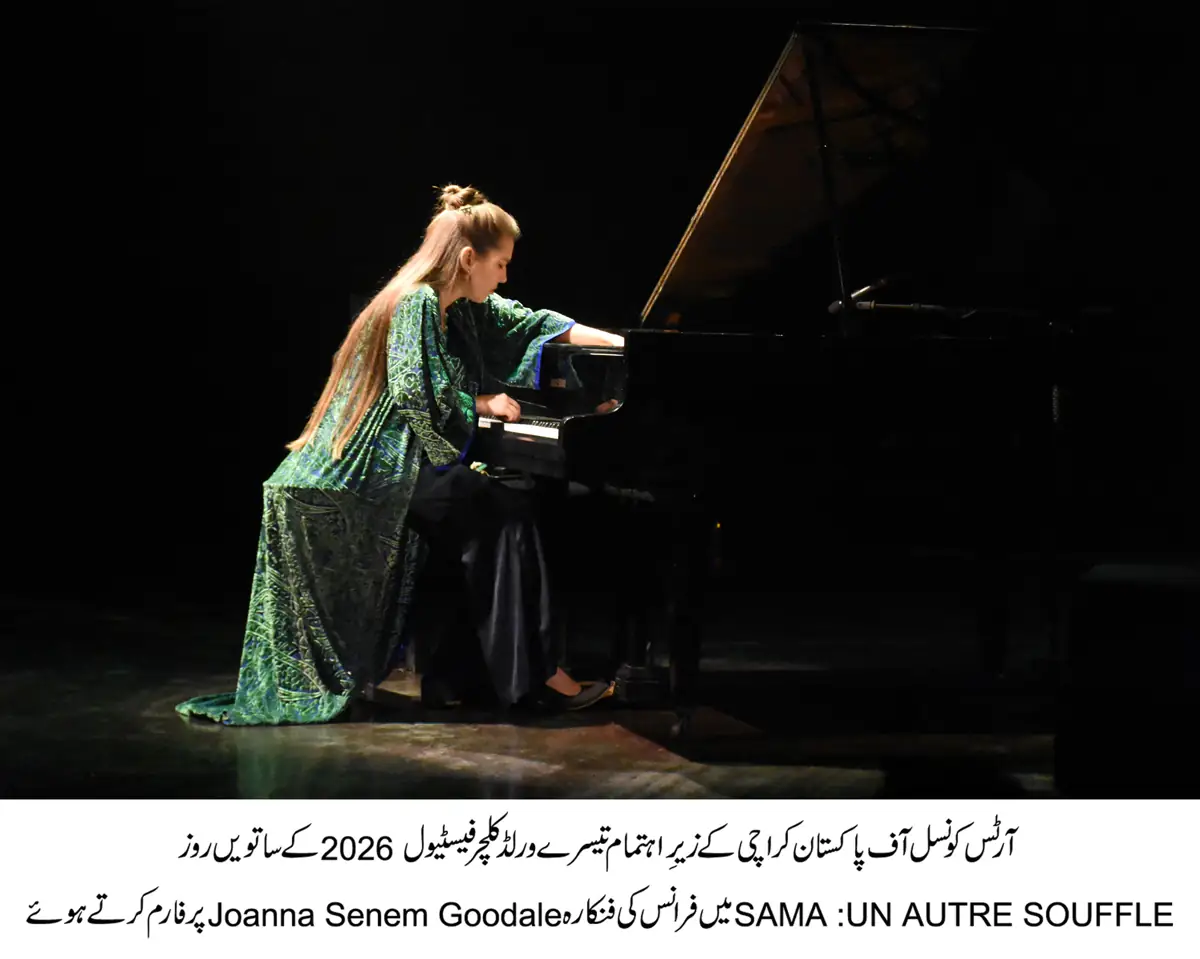
The seventh day ended quietly, at a piano.
French artist Joanna Senem Goodale performed SAMA: UN AUTRE SOUFFLE. On one side, the spiritual depth of Sufi music. On the other, the structure and richness of Western classical music.
Goodale brought the two together in a single performance, a fusion of Eastern and Western traditions. It was the festival’s own argument, made in music: that art is a universal language, and it speaks to everyone in the room.
Day Eight at World Culture Festival Karachi 2026: an Exhibition, and Karachi Painted on a Wall
The eighth day began, like day seven, with children.
TROY! Stowaways in the Trojan Horse retells one of the oldest stories in the world from inside the horse. Written by German playwright Henner Kallmeyer and directed by Uzma Sabeen in collaboration with the Goethe-Institut, the production follows the children who secretly hide inside the wooden horse to enter the city of Troy.
Lively performances, humour and suspense held the young audience from start to finish.
Film ran in two strands through the day. The Italian Evening screened The Reach, Il Paese, The Village and Until Time Forgets Us.
The Türkiye & France programme paired two Turkish films, Aboveground-Underground and Platform 1, with two French productions, About My Mom and La Petite École.
On the dance floor, UK-based artists Josh Middleton and Rebecca Solomon led an Afro-Brazilian Jazz workshop. Participants worked through African and Brazilian dance styles, movements and techniques, feeling two traditions meet in a single rhythm.
And in a quieter corner, Singaporean artist Yip Yew Chong was painting live.
Scenes of traditional culture and everyday life took shape on his canvas in his distinctive style. Between strokes, he shared a fact that surprised many participants: he has never received formal art education. Everything he does was learned by himself, through years of continuous practice.
By evening, the festival put on its most formal occasion.
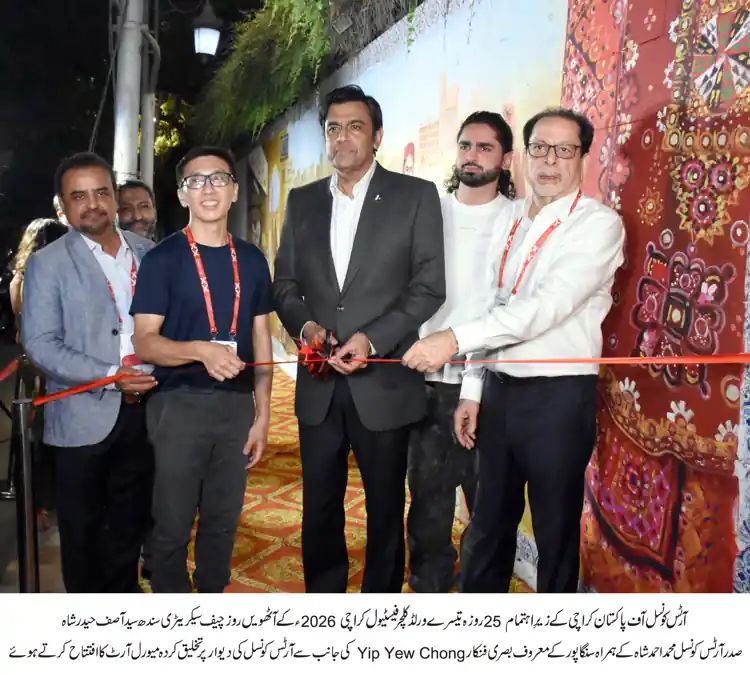
Sindh Chief Secretary Syed Asif Haider Shah inaugurated CONSTELLATIONS, the second International Art Exhibition of the World Culture Festival Karachi 2026. Arts Council President Muhammad Ahmed Shah and international artists stood with him, and awards and bouquets were presented to the participating artists.
The chief secretary’s message was simple. Art knows no boundaries, he said. It travels across continents, and imagination extends even beyond galaxies.
Its true beauty, he said, lies in connecting artists with one another, across cultures and across geographical borders.
He welcomed students and guests from Karachi and across Pakistan. And he pointed to what hung on the walls around them: artworks by artists from Balochistan, Gilgit-Baltistan, Punjab, various regions of Sindh, Karachi and Islamabad, sharing one exhibition.
The credit, he insisted, belonged elsewhere. Ahmed Shah, he said, is the principal visionary and driving force behind the World Culture Festival. The festival has grown into a fully-fledged international cultural event, recognised in Pakistan and around the world.
His support, he promised, would continue. For the Arts Council and the artistic community, he said, he remains just a phone call or a message away.
Ahmed Shah answered with the festival’s own origin story.
The idea, he recalled, was first proposed at a meeting with the chief secretary at his residence. At the time, the chief secretary raised concerns about the law and order situation, and asked for a week to consider the proposal.
That week changed Karachi’s cultural calendar. Since then, the festival has received extensive support from 54 departments and ministries of the Sindh government, with the chief secretary playing a significant role in making it happen.
He described the chief secretary as a passionate admirer of art and culture, a believer in an inclusive and multicultural society without discrimination. And he framed the festival as a shared commitment: a peaceful, progressive and prosperous Pakistan.
He also thanked the people the audience rarely sees, the young festival team, noting that several of its senior members first walked into the Arts Council as volunteers.
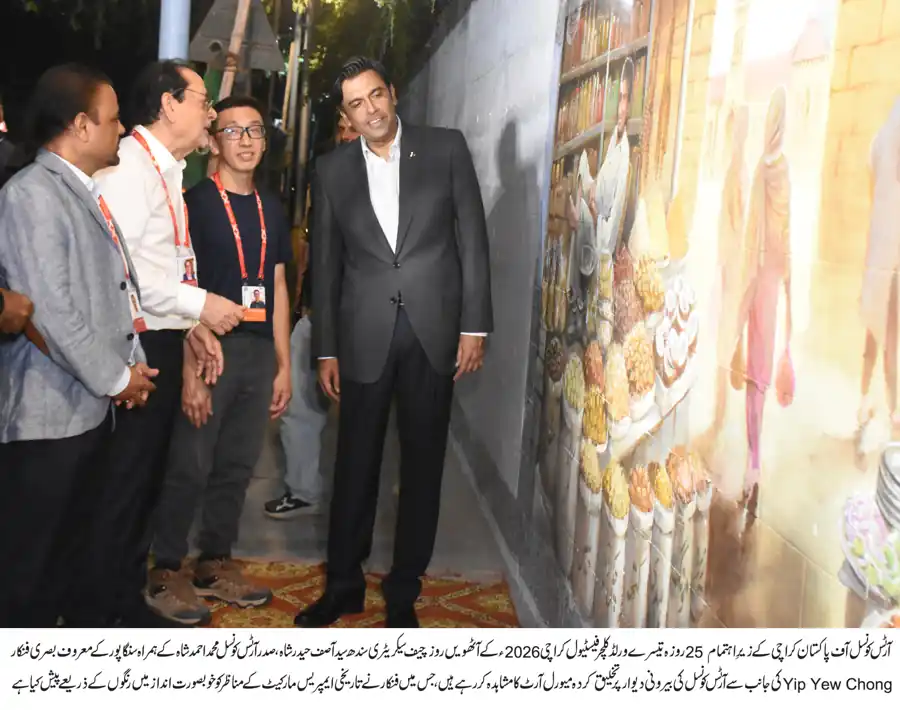
Then everyone went outside.
On the exterior wall of the Arts Council, Yip Yew Chong’s mural “Mera Karachi” was unveiled: the city he had been painting and praising all week, now painted by him, at the scale of a building.
Karachi looks back at you from that wall. Its historic streets and neighbourhoods. Its traditional markets. Sindhi culture, woven through the scene.
Its iconic architectural landmarks are there, and so is the Arts Council building itself. And there is the renowned Empress Market, the city’s old landmark, holding its place in the portrait.
One city, gathered into a single continuous scene, by an artist who arrived as a guest and left a piece of Karachi on its own wall.
The eighth day ended the way this four-day stretch of theatre had begun: with Taleem-e-Balighan.
Farhan Alam Siddiqui’s satire returned to Auditorium I. This time, there was no room left. The hall was packed to capacity, and the strict cleric’s chaotic classroom brought the run of days five to eight to a close.
The World Culture Festival Karachi 2026 continues at the Arts Council of Pakistan Karachi. Twenty-five days of theatre, music, dance, film, exhibitions and workshops are still unspooling, and Karachi is still walking through the doors.
Frequently Asked Questions
What is the World Culture Festival Karachi 2026?
It is the third edition of the Arts Council of Pakistan Karachi’s international culture festival: 25 days of theatre, music, dance, film, exhibitions, workshops and talks in Karachi, with artists from around the world.
What happened on day five of the festival?
Five artists from Ethiopia, Germany, Singapore, Sweden and Kenya debated cultural diversity and artificial intelligence in fine art. Juna Serita led her Beyond the Bassline workshop, Brazil’s dancers taught samba, eight Arab and North African short films screened, and Shaolin Clown and Taleem-e-Balighan played on stage.
What was the headline performance on day six?
Spain’s Flamenco Blanco Flamenco headlined with “The Grace of Movement”. The day also brought Polish puppet theatre, Norway’s Daisy Detective, a Serbian guitar workshop, four Polish short films and the play English Only.
What stood out on day seven?
Tom Corradini taught clowning, Zakaria Haffar built his vocal workshop around Pakistan’s national anthem, Gillian Rhodes staged the psychological play The Interview, and Joanna Senem Goodale closed the day with her Sufi-classical performance, SAMA: UN AUTRE SOUFFLE.
What happened on the eighth day of the festival?
Sindh Chief Secretary Syed Asif Haider Shah opened the CONSTELLATIONS exhibition and unveiled Yip Yew Chong’s “Mera Karachi” mural. Children watched TROY!, Italian and Turkish-French films screened, a UK duo taught Afro-Brazilian jazz dance, and Taleem-e-Balighan played to a packed hall.
Who organises the World Culture Festival Karachi?
The Arts Council of Pakistan Karachi organises the festival, led by its president, Muhammad Ahmed Shah, with support from 54 Sindh government departments and ministries.