Lahore Smog: EPA Links Diwali Air to Punjab Spike
Lahore smog worsened sharply after Diwali, and the Punjab Environment Protection Agency now says pollution-laden air from India travelled deep into the province, affecting around half of Punjab in a single day.
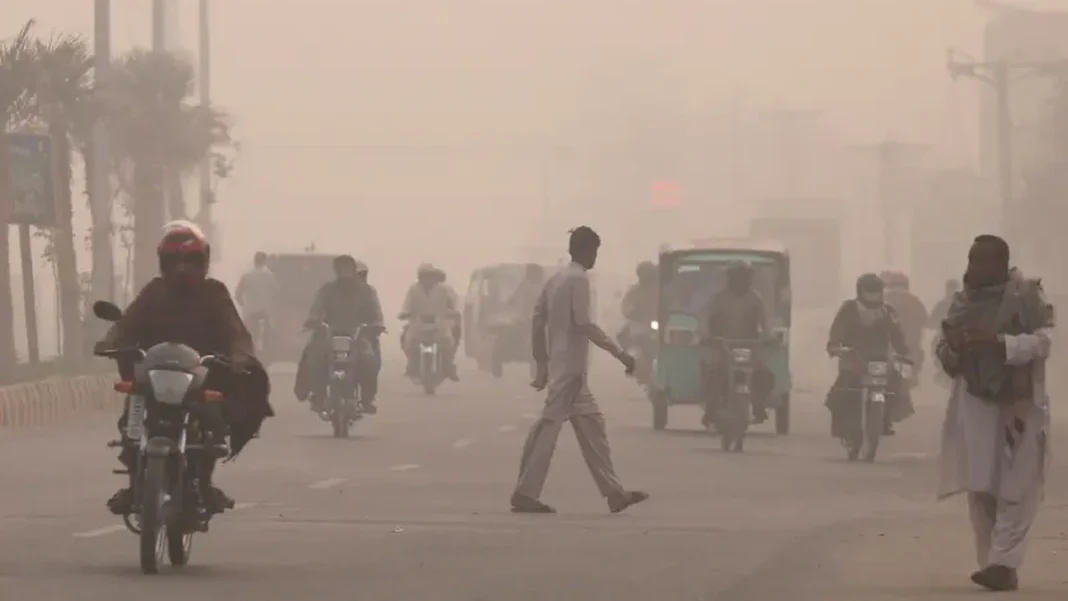
Lahore remained on top of the global ranking of major polluted cities on Wednesday night, recording an air quality index (AQI) reading of 358. In second-placed New Delhi, the AQI stood at 248, but the city’s monitors were so overwhelmed that they stopped recording the full extent of the smog for hours.
Lahore smog covered half of Punjab in a day
The Punjab Environment Protection Agency, in its assessment for the Diwali period, found that pollution-laden air from India travelled deep into Punjab and pushed up particulate matter (PM) concentrations across the province.
According to the agency, around 50 per cent of Punjab was affected by the air originating in India during the preceding 24 hours. Forward-trajectory modelling showed that air released across the border on Diwali night could reach Lahore from Amritsar in about two hours, Faisalabad in 12 hours and Multan in around 11 hours.
Readings showed a sharp east-to-west divide across Lahore. The Wagah Border station recorded a 275 per cent increase in PM2.5 concentrations, reaching its peak between 3am and 4am. Safari Park, on the western side of the city, recorded an increase of only 15 per cent.
The EPA said the pattern matched the movement of pollution carried by easterly winds from across the border. During this time, Lahore’s overall AQI rose from 366 on November 8 to 440 on November 9, reaching its highest recorded value at 9am.
The findings suggest cross-border pollution contributed significantly, but do not establish it as the sole source, since local emissions and weather also shape air quality.
Delhi monitors failed at the peak
In India, smog concentrations reached 66 times the World Health Organisation’s recommended daily maximum for PM2.5, the fine particles small enough to enter deep into the lungs and linked to cancer, and monitors could not capture them.
Analysers installed when the National Air Quality Index was introduced in 2015 were calibrated to measure up to 1,000 micrograms per cubic metre, against a WHO daily maximum of 15 for PM2.5.
Official data therefore missed the full extent of the smog for several hours overnight from Sunday into Monday, as pollution surged with Diwali fireworks. Opposition politicians accused the BJP-led government of deliberately deactivating monitoring around Diwali to hide the full extent of the problem.
The Central Pollution Control Board rejected the accusations of deliberate under-reporting. It said its automated data validation system treats hourly readings beyond the calibrated range as outside range, and such readings are not used in the computation.
The scale only became clear when monitors resumed reporting, around eight hours after the fireworks peaked. Readings then hit 879 micrograms per cubic metre in the Mandir Marg locality, according to monitoring organisation IQAir, which cited data from a city government station. That is more than 58 times the WHO daily limit.
Punjab government defends its record
Senior minister Marriyum Aurangzeb told a press conference on Wednesday that smog should not be treated as a political issue.
“Smog is not a political issue. It is a scientific, environmental and public health challenge,” she said, even as Lahore, Multan and other major cities remained blanketed under a thick layer of smog.
She said that before 2024, Punjab had no integrated system for smog mitigation, monitoring and enforcement. Under Chief Minister Maryam Nawaz, she said, the province had built an evidence-based system that tracks pollution sources, predicts conditions and ensures immediate enforcement.
On November 11, 2024, Lahore’s AQI had exceeded 2,000 and reached about 2,400. On November 11, 2026, it was below 450.
“This significant improvement reflects the impact of scientific planning, sustained mitigation measures, modern monitoring systems and strict enforcement,” she claimed.
She said Punjab’s forecasting system can now predict pollution trends five to seven days ahead, and air pollution indicators had improved by 23 to 64 per cent.
The smog also forced motorway closures. On Tuesday evening, the Shamkot to Abdul Hakeem section was closed to all traffic, and heavy traffic on the Sher Shah-Multan section towards Khanewal was suspended, a motorway police spokesperson told Dawn.
What the numbers mean for Lahore
The EPA assessment shows why the air turned so bad so fast. A large share arrived on easterly winds in a matter of hours, and the monitors nearest the border recorded the sharpest rises.
Feature Pakistan reported that Lahore police challaned 11,871 smoke-emitting vehicles in the latest enforcement drive. Lahore topped the list of the world’s most polluted cities again in October, and a Copernicus report ranked it among the world’s worst cities for ozone pollution.
Frequently asked questions
What did the Punjab EPA find about Diwali smog?
Its assessment found that pollution-laden air from India travelled deep into Punjab, affecting around 50 per cent of the province in 24 hours. Air released on Diwali night could reach Lahore from Amritsar in about two hours.
What was Lahore’s AQI during the smog?
Lahore recorded an AQI of 358 on Wednesday night and remained on top of the global ranking of major polluted cities. Its AQI had risen from 366 on November 8 to 440 on November 9.
Why did Delhi’s monitors fail to record the pollution?
Concentrations exceeded the upper measurement limits of analysers calibrated to 1,000 micrograms per cubic metre. The automated system treated readings beyond that range as outside range, so official data missed the peak for several hours.
How bad was the pollution compared with WHO limits?
Delhi’s smog reached 66 times the WHO recommended daily maximum for PM2.5. Readings later hit 879 micrograms per cubic metre in Mandir Marg, more than 58 times the WHO daily limit of 15.
What is the Punjab government doing about smog?
Senior minister Marriyum Aurangzeb said Punjab now runs 24/7 monitoring, scientific forecasting up to seven days ahead and rapid enforcement across industries, transport, agriculture and brick kilns. She said air quality indicators had improved by 23 to 64 per cent.