
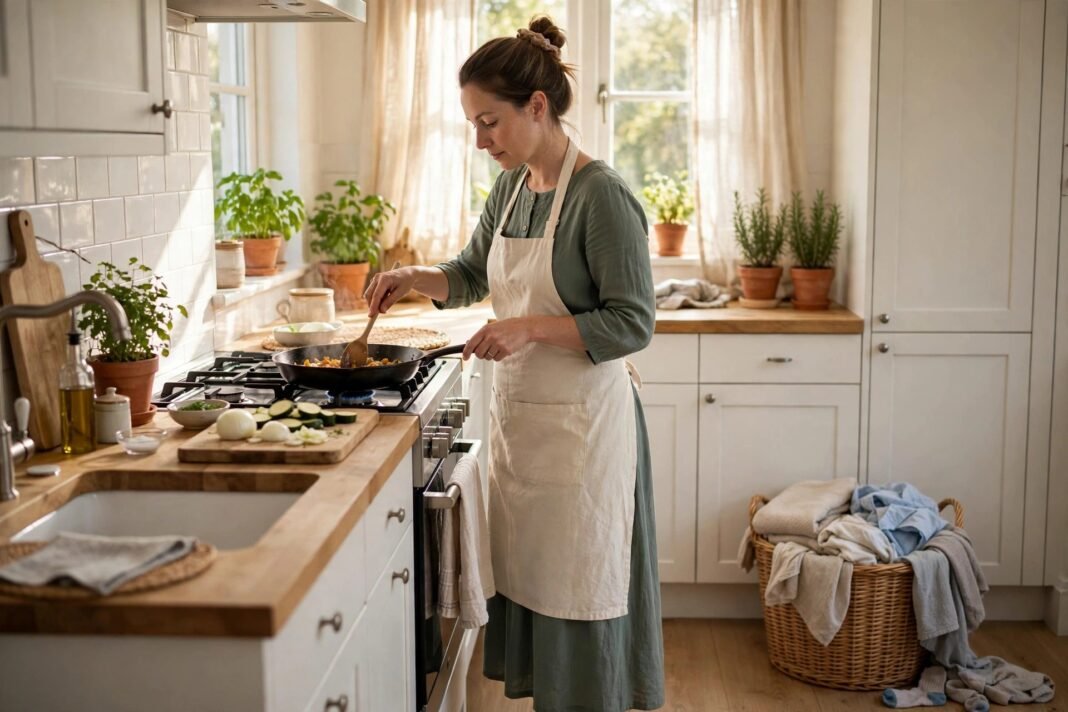
She wakes before everyone else. By sunrise, she has already cooked breakfast and started the laundry. She cleans, shops, and cares for children and older relatives, often until late at night. Her work has no salary, no days off, and no pension. This is the unpaid labour of housewives, and it keeps every home — and every economy — running.
A housewife is a woman whose full-time work is her home. She does not have a paid job outside it. In fact, her day is often longer than any office shift. This article looks at what the unpaid labour of housewives is worth, what it costs her, and what should change.
What the Unpaid Labour of Housewives Really Includes
The unpaid labour of housewives covers far more than cooking and cleaning. It includes childcare, elder care, shopping, laundry, school runs, and managing the household budget. It also includes the planning behind it all: what to cook, when to buy, who needs what, and when. So a housewife is a cook, a cleaner, a nurse, a teacher, a driver, and a manager, all in one person.
Most of this work is invisible because it happens behind closed doors. Nobody clocks in or out. Nobody signs a timesheet. And because no money changes hands, people often treat the work as if it were not work at all. In fact, many housewives hear the question, “Do you work?” — as if running a home for 24 hours a day were not a job.
A Day That Never Ends
A housewife’s day rarely has a start or an end. She is often the first to wake and the last to sleep. Meals, school bags, laundry, and cleaning fill the morning. Then come the shopping, the cooking, and the care of children or older relatives. By evening, she is cooking again, and by night, she may still be folding clothes or helping with homework.
Unlike a paid job, there is no weekend and no annual leave. There is no sick day either. If she falls ill, the work waits for her — or she does it anyway. So the hours add up. Around the world, women spend two and a half times more hours each day on unpaid care and domestic work than men do.
Working mothers carry the same unpaid load on top of a paid job. Our article on the unpaid burden of working mothers looks at that double shift. But a housewife’s load is her whole working life, with no salary at all.
The Unpaid Labour of Housewives Is Worth Trillions
If someone paid for this work, the numbers would be enormous. A 2020 global report found that women and girls put in 12.5 billion hours of unpaid care work every single day. You can read the full report on unpaid care work for the details. The report valued it at $10.8 trillion a year — more than three times the size of the global tech industry.
Another global study, from 2018, counted 16.4 billion hours of unpaid care work every day. That is the same as two billion people working eight hours a day with no pay. Women perform more than three-quarters of all of it. In other words, the world’s biggest workforce is unpaid, and it is mostly women.
Experts value unpaid care and domestic work at between 10 and 39 per cent of national income in different countries. In some places, it is worth more than manufacturing or transport. Yet it does not appear in most economic reports at all.
Why This Work Is Still Called “Not Working”
The main reason is simple: our economies count only paid work. Gross domestic product, the number governments use to measure a country’s wealth, leaves unpaid housework out. So a woman who cooks for her family adds nothing to the official figures, while the same meal in a restaurant counts as economic activity.
Old ideas play a part too. For generations, people saw housework as a woman’s duty, not a job. Because families expected it, nobody priced it. And because nobody priced it, nobody valued it. That thinking still shapes how families, employers, and governments treat homemakers today.
The result is a strange double standard. Everyone depends on the work, yet few people treat it as real work. A housewife hears that she “stays at home”, as if home were a place of rest. In fact, home is her workplace, and it never closes.
What the Unpaid Labour of Housewives Costs Women
The unpaid labour of housewives has a price, and women pay it. The first cost is income. A woman who works full time at home earns nothing of her own. She depends on her husband or family for every coin she spends. That dependence can leave her with no say in money decisions, even though her work makes the household run.
The second cost is her career. Years spent at home mean years away from paid work, training, and promotion. If she later tries to return to a job, she may find her skills out of date and her CV full of gaps. So many women feel trapped: too far from the workplace to return, and too dependent to leave.
The third cost is security. With no salary, there is no pension building up and no savings in her own name. If the marriage ends, or her husband falls ill or dies, she can end up with nothing. That is why the law, not just kind words, must recognise the value of her work.
No Savings, No Pension, No Safety Net
Most workers build a pension with every year of work. A housewife does not. Her years of labour leave no record in any pension system. So in old age, many women who spent their lives caring for others depend on others to care for them.
The gap is global. Women make up 80 per cent of paid domestic workers, yet 90 per cent of domestic workers have no social protection or social security cover. Unpaid homemakers are in an even weaker position, because nobody counts their work as employment at all.
Some countries have started to act. Argentina and Spain, for example, have approved measures giving women who spent their lives on unpaid domestic work access to retirement benefits. These steps are small, but they show that change is possible when people treat care as real work.
The Mental Load Nobody Sees
Housework is not only physical. It also carries a heavy mental load. Someone must remember the dentist appointment, the school trip, the empty fridge, and the medicine that runs out on Friday. In most homes, that someone is the housewife.
This load never switches off. It follows her into the night and wakes her in the morning. It leaves little time for rest, learning, or friends. Over time, the constant pressure can wear down her health and her mood. In fact, exhaustion is one of the most common complaints of women who carry the home alone.
The mental load is hard to measure, so it is easy to ignore. But it is real work. The unpaid labour of housewives includes this planning too. Planning, remembering, and organising a household takes skill and energy, and it deserves the same respect as any other job.
How to Share the Unpaid Labour of Housewives Fairly
The first step is to name the work. Sit down as a family and list everything the housewife does in a week. The length of the list surprises most families. Once the work is visible, it is much harder to dismiss.
The second step is to share it. Families can divide chores by day or by task, and children can take on age-appropriate jobs too. The goal is not a perfect split. It is a fair one, where no single person carries the whole home.
The third step is to protect her time. Every housewife needs rest, learning, and time with friends. A regular break each week is not a luxury. It is part of staying healthy, and it helps the whole family too.
Finally, talk about money openly. A housewife should have money of her own, not just household money she must ask for. A regular personal allowance, a bank account in her name, and savings for her future all build independence and security.
What Governments Can Do to Value Care
Change must go beyond the home. Governments can count unpaid care work in national statistics, so it becomes visible in economic policy. They can also invest in childcare, elder care, clean water, and electricity, because these services cut the hours of unpaid work women carry. Our guide to childcare rights for working mothers explains what help exists around the world.
Social protection matters too. Homemakers should be able to join pension and health schemes, even without a formal salary. A few countries already give retirement benefits to women who spent their lives on unpaid domestic work. More should follow.
The world has already agreed on the goal. Under the United Nations Sustainable Development Goals, countries promised to recognise and value unpaid care and domestic work, and to share responsibility within the household. The next step is to turn that promise into law.
Investment in care also creates jobs. Global estimates suggest that investing in care services could create nearly 300 million decent jobs by 2035. You can read more on why the care economy matters on the UN Women site. So valuing the unpaid labour of housewives is not only fair. It is good economics too.
Where Housewives Can Find Support and Protection
No housewife should face this alone. Around the world, organisations work to value care and protect the women who provide it. The International Domestic Workers Federation speaks up for domestic workers’ rights, including fair pay and social protection. UN Women’s TransformCare initiative works in more than 50 countries to build care systems that share the load fairly.
There are also legal tools. An international treaty from 2011 sets out rights for domestic workers, including fair working hours, rest, and social security. And every year, the International Day of Care and Support on 29 October draws attention to the value of care work worldwide.
At home, the most practical help is closer than you think. Local women’s groups, community centres, and family support services can offer advice on money, rights, and wellbeing. If you are a housewife, ask what is available in your area. And if you know a housewife, ask her what she needs. Sometimes the first step is simply to notice her.
The unpaid labour of housewives keeps the world running. It deserves pay, protection, and respect. Until it gets all three, the least we can do is call it what it is: real work.
Do you think housework counts as real work? What would change in your home if it did? Share your thoughts in the comments.
This article is for general information only. If you need advice about money, rights, or support services, contact a local women’s organisation or advice service in your area.