COP31 Disability Access Failed, Delegates Say
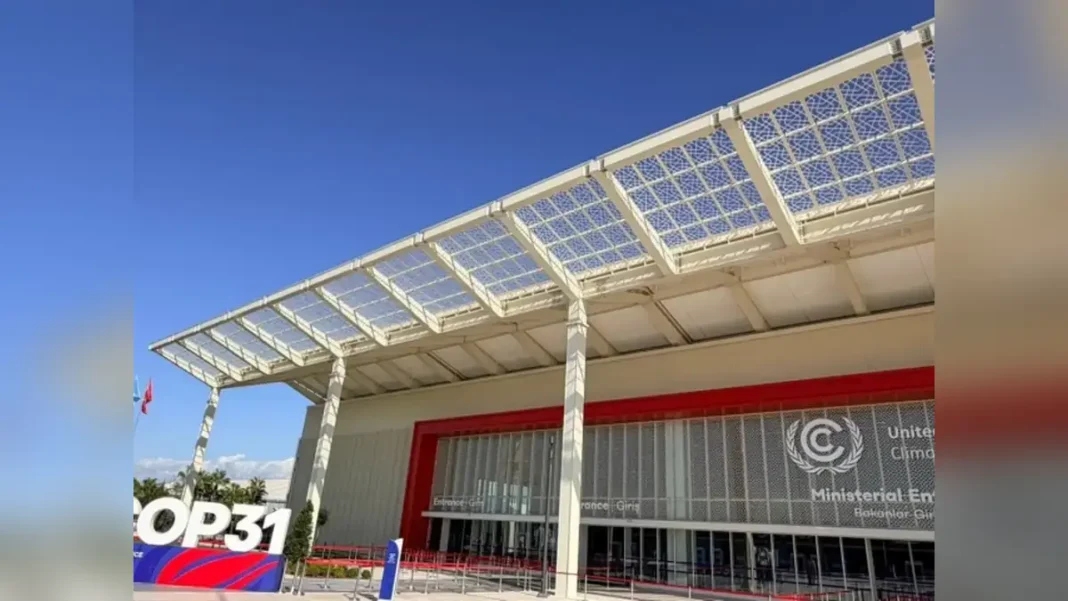
Disabled delegates at COP31 in Antalya say the venue failed them, despite official claims every need was met. The COP31 disability access complaints range from missing tactile paths to no sign language interpretation and no quiet rooms.
About 100,000 people gathered at the conference. The gap between what organisers claimed and what disabled attendees found is the subject of a report from the talks.
A kilometre on a cane
Süheyla Düğen, a 69-year-old Turkish activist, walked about a kilometre on a cane from the tram station to the Blue Zone, over two pedestrian bridges. She got a wheelchair from the counter, but had to return it before leaving. “The wheelchair had to be returned before the exit at the venue,” she said.
Della Leonor, a disability advocate from the Philippines, described a similarly exhausting journey. “From the hotel we have to walk to the bus stop every day,” she said. “There was a slope from the exit down to the road, after that the road had humps, and a wheelchair needed to be carried to access the bus.” She said buses should have collected participants at the hotel exit.
A blind attendee from the Global South, speaking on condition of anonymity, said the pavilion area had no floor markings, tactile strips, Braille signage or guided path for visually impaired participants. “I could not visit the pavilions at all,” the attendee said.
What the COP31 disability access record claims
Officials told a different story. Turkish state-linked outlets reported the 1.1 million square metre Blue and Green Zone was “planned as accessible”, with a 114-person Accessibility Team for 521 registered disabled delegates. Organisers reported 77 wheelchairs, 30 interpreters and seven Quiet Rooms. Accessibility lead Mustafa Ertok said: “we have met the needs of all 521 participants, both in transportation and within the venue”.
But the official accessibility page still showed placeholders on the final day. Quiet spaces were “being explored”, and sign language arrangements were “being coordinated with the relevant authorities”.
Clare Gibellini, an Equality at Work Ambassador who attended COP31 for the National Disability Research Partnership, Australia, summed up the arrangements: “Honestly, they failed. Not partially, not ‘could do better.’ They failed.” She said there was no closed captioning, no sign language interpretation and no quiet spaces anywhere, and no Easy Read materials for people with intellectual disabilities or low literacy.
The Express Tribune approached the UNFCCC office, the media desk and the press office for comment. Despite repeated reminders in person and over email, no response was provided.
Why it matters for Pakistan
Disabled people are among those hit hardest by climate disasters, and Pakistan knows that cost. Pakistani farmers have sued German firms over the 2022 floods, which displaced millions and left the most vulnerable with least support.
Sindh has put climate justice at the centre of its COP31 message, and the Pakistan Red Crescent has pushed local climate action at the talks. A summit that cannot get its own disabled delegates into the room undermines those claims. The COP31 deal itself has also drawn criticism, after negotiators published a revised draft with no mention of fossil fuels.
Gibellini called the failure a human rights problem. Both Türkiye and Australia have ratified the Convention on the Rights of Persons with Disabilities. “A summit that decides the future of our planet, while locking out the people most affected by climate change, is not an inclusive summit,” she said.
She called for accessibility as a hosting condition, verified by a pre-conference audit; co-design with disabled persons’ organisations; captioning, interpretation, Easy Read and quiet rooms as standard; and Disability Caucus recognition as a formal constituency.
Frequently asked questions
What went wrong with access at COP31?
Delegates reported no tactile paths or Braille signage on pavilion floors, no closed captioning, no sign language in sessions, no quiet rooms, and transport wheelchair users could not reach without being carried over humps.
What did organisers claim was provided?
Organisers reported a 114-person Accessibility Team, 77 wheelchairs, 30 interpreters, seven quiet rooms for 521 registered disabled delegates.
Who is Clare Gibellini?
Gibellini is an Equality at Work Ambassador for the rights of women with disabilities. She attended COP31 for the National Disability Research Partnership, Australia, and said: “Honestly, they failed.”
What do disabled delegates want changed?
They want accessibility standards as a hosting condition, verified by a pre-conference audit, co-design with disabled persons’ organisations, captioning, interpretation, Easy Read and quiet rooms as standard, and Disability Caucus recognition as a formal constituency.
Why does it matter for Pakistan?
Disabled Pakistanis are among those hit hardest by climate disasters, including the 2022 floods. A summit that locks out disabled delegates weakens Pakistan’s climate justice case at COP31.