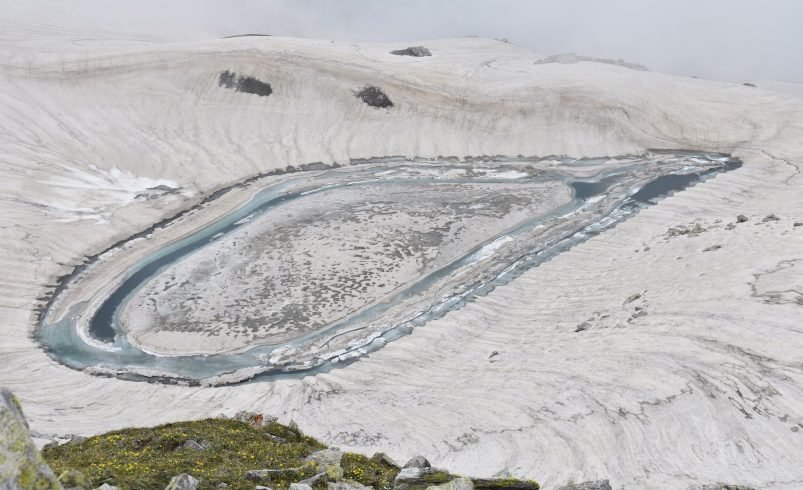
Hidden in the high Himalaya above the Kaghan Valley, at around 4,245 metres (13,927 feet), lies a lake shaped exactly like a teardrop — Ansoo Lake (“ansoo” means teardrop in Urdu). From above it looks even stranger: a human eye, with a central island of ice for the iris and a rocky ridge for the eyebrow. Until 1993, not even the local herders knew it existed; it was discovered by Pakistan Air Force pilots flying low over the peaks near Malika Parbat. Today it is one of Pakistan’s most mythologised high-altitude lakes — beautiful, difficult and dangerous in equal measure.
This Ansoo Lake travel guide gives you the full picture: the true story of the lake’s discovery, the two trekking routes (including the classic trek from Saif-ul-Malook), the narrow summer window when the trek is possible, how to reach Naran from Islamabad, Lahore and Karachi, where to stay, what to eat, and the safety rules that matter at this altitude. For more northern lakes and valleys, see our Hunza Valley guide and the Explore Pakistan collection.
Quick Facts
- Location: Manoor Valley, Kaghan Valley, Mansehra district, Khyber Pakhtunkhwa — near Malika Parbat in the Himalayan range
- Altitude: Around 4,245 metres (13,927 ft); a few sources cite higher figures, but 4,245 m is the most widely reported
- Famous For: Its perfect teardrop shape; the “eye with an iris” formation; discovery by PAF pilots in 1993
- Nearest City: Naran, the tourist hub of the Kaghan Valley
- Accessibility: Trekking only — no road; the standard route starts at Lake Saif-ul-Malook (7–9 hour round-trip trek)
- Known Landmarks: Lake Saif-ul-Malook, Malika Parbat base camp, Manoor Valley, Mahandri
- Best For: Fit, experienced trekkers and adventure travellers — not a casual sightseeing stop
Why Visit Ansoo Lake
Pakistan has no shortage of beautiful lakes, but Ansoo Lake occupies a category of its own. First, there is the shape: nature rarely draws this cleanly, and a lake that looks like a teardrop — or, depending on the light and the season’s ice, like a vast human eye staring at the sky — is something you simply do not see anywhere else. Photographs of it have a surreal quality that no filter can fake, which is why the lake has become a legend on Pakistani social media.
Second, there is the story. This is a lake that hid from humanity until 1993, when Pakistan Air Force pilots on a low flight over the Kaghan heights spotted an unfamiliar glint of water below. Think about that: in an age of satellites, a substantial alpine lake sat unknown, unvisited and unnamed within a day’s walk of one of Pakistan’s busiest tourist towns. Trekking to Ansoo Lake is, in a small but real sense, an expedition into the recently unknown.
Third — and this needs saying plainly — you should only attempt this trek if you understand what it demands. There is no lodging at the lake, no food stall, no rescue post. The round trip from Saif-ul-Malook takes seven to nine hours over steep, often snow-covered ground at altitudes where the air is thin and the weather turns in minutes. Locals do not recommend camping at the top; even they consider it risky. But for fit, well-prepared trekkers with a guide, reaching that ridge and looking down at the teardrop is one of the great payoffs in Pakistani adventure travel. If that sounds like you, read on — this guide will help you do it as safely as possible.
History of Ansoo Lake
Unlike the ancient sites of Gandhara, Ansoo Lake has almost no human history — and that is the most remarkable thing about it. The Kaghan Valley itself has been inhabited for centuries by Hindko-speaking communities and Gujjar herders who graze their animals in the high summer pastures. Yet none of them knew about the lake. It sat in its rocky bowl near Malika Parbat, frozen for most of the year, invisible from every valley floor and every herder’s trail.
In 1993, pilots of the Pakistan Air Force discovered the lake while flying low over the area — the standard, widely reported account of its discovery. Word spread slowly through mountaineering and adventure circles in the late 1990s and 2000s, and the lake acquired its name from its unmistakable shape: ansoo, the Urdu word for teardrop. Trekkers added a second description — the lake resembles a human eye, with a central ice island like an iris and a curved ridge like an eyebrow, the effect growing stronger as summer melt exposes the “brow.”
The 2005 Kashmir earthquake left its mark even here: the eyebrow ridge was partially damaged in the quake, slightly altering the formation that gives the lake its eye-like appearance. As interest grew, the Khyber Pakhtunkhwa authorities took notice — in 2010 a team was dispatched from Peshawar to document the lake and promote it as part of efforts to develop tourism in the province. Since then, Ansoo Lake has moved from mountaineers’ secret to bucket-list trek, though its difficulty has kept visitor numbers low and its wilderness character intact.
The broader region’s history frames the visit: the Kaghan Valley was opened to the outside world in the British era, Naran grew from a small settlement into the valley’s tourist capital in recent decades, and Lake Saif-ul-Malook — the starting point of the Ansoo trek — has its own deep roots in local folklore as the lake of the fairy-princess legend of Saif-ul-Malook. Ansoo Lake, the newcomer, now completes the valley’s trio of great lakes alongside Saif-ul-Malook and Dudipatsar.
Top Things to Do in Ansoo Lake
Trek from Lake Saif-ul-Malook (the classic route)
This is the trek the lake is known for: a steep, demanding round trip of seven to nine hours starting from Lake Saif-ul-Malook. The first half follows a valley alongside a stream towards the base camp of Malika Parbat; the second half climbs steeply to the ridge above the lake. The trail is snow-covered in most parts of the year, and the best — essentially the only — window is roughly 10 July to 15 August. Start around 6:00 in the morning to return before dark. Horses and local guides can be hired at Saif-ul-Malook; even with a horse, expect to walk more than half the distance yourself.
Stand on the ridge and see the teardrop
The lake reveals itself only at the very end: you climb a final hill, and on the far side, the teardrop lies below you. Note that fog or rain can hide it entirely — some trekkers walk all day and see only cloud. That uncertainty is part of the experience. When the view opens, take your photographs quickly; mountain weather rarely waits.
Trek via Manoor Valley from Mahandri (the alternative route)
A second, much less travelled route approaches from Mahandri (about 40 km below Naran) through Manoor village and the Manoor Valley. It is longer and its difficulties are less documented, which makes it suitable only for experienced, self-sufficient trekking parties with local guidance. Do not attempt it on hearsay — arrange it through knowledgeable locals in Mahandri.
Combine with Lake Saif-ul-Malook
Every Ansoo trek begins at Saif-ul-Malook, so plan to enjoy the famous lake itself: the jeep ride up from Naran, the fairy-tale views of Malika Parbat reflected in the water, and the lively cluster of stalls and pony rides. It makes the perfect acclimatisation and preparation day before your early start.
Famous Places In and Around Ansoo Lake
- Lake Saif-ul-Malook — the legendary lake and the Ansoo trek’s starting point
- Malika Parbat — the “Queen of the Mountains,” Kaghan’s highest peak, towering over the route
- Naran Bazaar — the valley’s lively market town and your logistical base
- Lulusar Lake — the long, mirror-like lake on the Naran–Babusar road
- Dudipatsar Lake — Kaghan’s other great wilderness lake, reached by its own tough trek
- Babusar Top — the 4,173-metre pass at the head of the valley (see seasonal road status)
How to Reach Ansoo Lake
Reaching Ansoo Lake is a two-stage journey: drive to Naran, then trek. There is no road to the lake and no mechanical alternative to walking the final stretch.
From Islamabad: Drive to Naran via Mansehra on the N-15 (Mansehra–Naran–Jalkhad road) — around 240 km, roughly 5 to 6 hours. From Naran, take a 4×4 jeep to Lake Saif-ul-Malook (about 9–10 km of steep jeep track, 45–60 minutes), then begin the 7–9 hour round-trip trek. Public transport options include coasters and vans from Islamabad’s Pirwadhai area to Mansehra and Naran.
From Lahore: Drive via the M-2/M-1 to Islamabad and onward to Naran — around 600 km total, roughly 10 to 12 hours. Most travellers overnight in Islamabad or drive straight through in the summer season.
From Karachi: Fly to Islamabad (about 2 hours) and continue by road as above. The full road journey from Karachi to Naran takes two very long days and is not practical for a trek with a tight weather window.
Nearest airport: Islamabad International Airport, about 5–6 hours’ drive from Naran. Road conditions: The N-15 to Naran is paved but mountainous — landslides can block it during monsoon rains, so check conditions before departing. The Saif-ul-Malook jeep track is rough and only for 4x4s. Transport options: Private car to Naran, then hired jeep to Saif-ul-Malook, then your own feet — with a local guide, which is strongly recommended.
Route Details
- Islamabad → Mansehra → Balakot → Naran (N-15; 5–6 hours).
- Naran → Lake Saif-ul-Malook by 4×4 jeep (early morning; 45–60 minutes).
- Saif-ul-Malook → hire a local guide (and optionally a horse) → trek the valley towards Malika Parbat base camp (first half).
- Base camp → steep climb to the ridge → Ansoo Lake viewpoint (second half).
- Return the same way, aiming to be back at Saif-ul-Malook before sunset; jeep back to Naran.
- Alternative: Mahandri → Manoor village → Manoor Valley → lake (longer, for experienced parties only).
Where to Stay in Ansoo Lake
There is no place to stay at Ansoo Lake. This is not a figure of speech: there are no huts, no campsites with facilities, nothing. Some hardy visitors have camped on the exposed ridge, but it is extremely cold and windy, and even locals advise against it. Ansoo Lake is strictly a day trek — you sleep in Naran.
Naran (mid-range hotels): Naran has the valley’s widest choice, from comfortable mid-range hotels with hot water, heating and restaurants to riverside properties along the Kunhar. In the July–August peak season, book ahead — the town fills up.
Naran (budget guesthouses): Dozens of simple guesthouses and hostels serve budget travellers and trekking groups. They are basic but adequate for a pre-trek night, and owners can help arrange jeeps and guides.
Camping: Camp only at established sites around Naran or Saif-ul-Malook’s designated areas — never on the Ansoo ridge itself.
Where to Eat: Local Foods of Ansoo Lake
You will eat in Naran, not at the lake — carry all trek food with you. Naran’s food scene is built for tourists but rooted in the region. The signature dish is fresh river trout from the Kunhar river, grilled or fried at the town’s many restaurants — the one meal no visitor should skip. Chapli kebab, chicken karahi, daal fry and mixed grill are standard across the bazaar, with fresh tandoori naan and doodh patti (milky tea) to finish.
For the trek, pack high-energy food: dry fruits, nuts, chocolate, biscuits, parathas and at least two litres of water per person — there is nothing to buy beyond Saif-ul-Malook’s small stalls. A hot breakfast in Naran before the early jeep ride is essential; you will not eat properly again until evening. Meal prices in Naran run higher than in the cities (everything is trucked up the mountain), but remain reasonable for domestic tourists.
Weather in Ansoo Lake
At around 4,245 metres, Ansoo Lake sits in a harsh alpine zone: freezing for most of the year, briefly and unpredictably accessible in high summer. The trekking window of roughly 10 July to 15 August exists because that is when the snow melts enough to walk — not because the weather is “nice.” Fog and rain can close the view on any day. The figures below are approximate for the lake’s altitude.
| Season | Temperature Range | Conditions |
|---|---|---|
| Winter (Dec–Feb) | Around −25 to −10°C | Deep snow, frozen solid; completely inaccessible |
| Spring (Mar–May) | Around −15 to −2°C | Still snowbound; route closed |
| Summer (Jul–Aug) | Around −5 to +8°C | The only trekking window (approx. 10 Jul–15 Aug); changeable, fog possible |
| Autumn (Sep–Nov) | Around −15 to 0°C | Snow returns quickly; route closes |
Language and Culture of Ansoo Lake
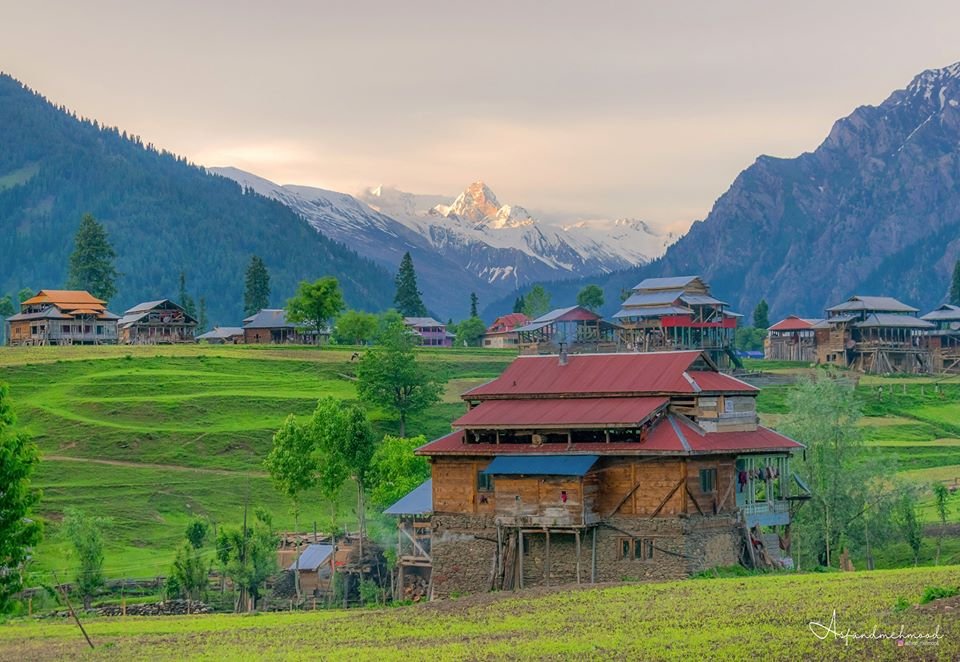
The Kaghan Valley’s people speak Hindko and Gojri (the Gujjar community’s language), with Urdu understood everywhere in Naran’s tourist economy. The valley’s culture is mountain-Pakistani: conservative but famously hospitable to guests, with a strong tradition of guiding, pony-handling and hospitality work built around the summer season.
Respect local norms: dress modestly (the Naran bazaar is tourist-friendly, but the villages and the trail are traditional), ask before photographing people, and deal fairly with guides, jeep drivers and horse handlers — agree prices before setting out. The people who make this trek possible earn their living in a four-month season; a fair tip is remembered all year.
Shopping in Ansoo Lake
There is nothing to buy at the lake — do your shopping in Naran Bazaar. The market sells woollen shawls, caps and socks (useful for the trek itself), dry fruits (almonds, walnuts, apricots), honey, and the usual tourist souvenirs: keychains, gemstones and printed hoodies. Buy your trek snacks, sunscreen and any forgotten gear here before the early jeep to Saif-ul-Malook. There are no shopping malls anywhere near this route — the bazaar is the authentic experience.
Travel Tips for Ansoo Lake
Packing Essentials
Broken-in trekking boots with ankle support, warm layers (temperatures can be near freezing even in August), a waterproof jacket, gloves and a warm cap, sunglasses and high-SPF sunscreen (UV is fierce at altitude), a headlamp, a basic first-aid kit, and at least two litres of water plus high-energy food. A walking stick helps enormously on the steep descent.
Safety Tips
This is the section that matters most. Never attempt the trek alone — hire a local guide at Saif-ul-Malook. Start by 6:00 am and turn back if you cannot make the ridge with ample daylight left; the descent in darkness is dangerous. Watch for altitude symptoms (headache, nausea, dizziness) and descend if they worsen. The trail crosses snowfields and steep scree — one slip can be serious. Check the weather the evening before; if heavy cloud is forecast, postpone — the lake may be invisible anyway. Tell your hotel in Naran your plan and expected return time.
Money & Connectivity
Carry all cash in rupees — there are ATMs in Naran but none beyond, and no card acceptance on the trail. Budget for the jeep, guide and horse hire in cash. Mobile signal (Jazz, Telenor, Zong, Ufone) works in Naran but fades on the trek; do not rely on your phone for navigation or rescue. A portable charger is useful; a satellite communicator is ideal for serious trekkers.
Best Time to Visit Ansoo Lake
Mid-July to mid-August — The only window
Roughly 10 July to 15 August is the realistic season: the snow has melted enough to trek, and the lake is most likely to be visible and ice-free. Even then, go on the clearest day of your Naran stay. This is the core advice of this Ansoo Lake travel guide — plan your whole trip around these five weeks.
June and late August — Marginal
Possible in a low-snow year, but expect more snow on the trail, a partially frozen lake and higher risk. Only for experienced trekkers with flexible schedules.
September to June — Not possible
The lake is snowbound and the route is closed. Visit Saif-ul-Malook and Naran instead, and save Ansoo for high summer.
Final Thoughts
Ansoo Lake is the rarest kind of destination: a place the modern world overlooked until 1993, still guarded by altitude, weather and an honest day’s walk. It does not flatter casual tourists, and that is its virtue. The teardrop rewards those who prepare properly, start early, respect the mountain and accept that the lake may choose not to show itself.
If you are fit, equipped and humble enough for the trek, put Ansoo Lake on your 2026 list — and give it the respect its story deserves. Travel with a guide, leave no trace, and carry the memory of that impossible teardrop home with you. For more high-valley adventures, explore our Hunza Valley guide, our Malam Jabba guide and the Explore Pakistan collection.
FAQs
Where is Ansoo Lake located?
Ansoo Lake is in the Manoor Valley of the Kaghan Valley, Mansehra district, Khyber Pakhtunkhwa — near Malika Parbat in the Himalayan range, at around 4,245 metres (13,927 ft).
Why is it called Ansoo Lake?
“Ansoo” means teardrop in Urdu, named for the lake’s perfect teardrop shape. From above it also resembles a human eye, with a central ice island like an iris.
How was Ansoo Lake discovered?
In 1993, Pakistan Air Force pilots flying low over the area spotted the lake. It was previously unknown even to local herders.
How do I reach Ansoo Lake?
Drive to Naran, take a 4×4 jeep to Lake Saif-ul-Malook, then trek 7–9 hours round trip with a local guide. An alternative, longer route runs from Mahandri via Manoor village.
What is the best time to visit Ansoo Lake?
Roughly 10 July to 15 August — the only reliable window when the trail is passable. Start the trek around 6:00 am.
Is the Ansoo Lake trek difficult?
Yes — it is steep, high-altitude (above 4,000 m), often snow-covered and takes 7–9 hours round trip. It suits fit, experienced trekkers with a guide; it is not a casual walk.
Can I stay overnight at Ansoo Lake?
No — there is no lodging, and camping on the exposed ridge is extremely cold, windy and risky. Even locals advise against it. Sleep in Naran and do it as a day trek.
What should I carry for the trek?
Trekking boots, warm and waterproof layers, gloves, sunglasses, sunscreen, headlamp, first-aid kit, at least two litres of water and high-energy food. Hire a guide at Saif-ul-Malook.