Quick Facts
- Location: Khoiratta (Khuiratta) Tehsil, Kotli District, Azad Jammu and Kashmir
- Altitude: Around 2,570 feet above sea level
- Famous For: Gateway to Banah Valley; green sub-mountainous scenery, natural springs, old Mughal-era gardens and fountains, rock-cut caves and historic forts
- Nearest City: Kotli (around 29 km); Mirpur (around 90 km by road)
- Accessibility: Moderate — metalled roads from Kotli via Dongi, the Battal–Dhanna Road or Nakyal; best explored with local guidance
- Known Landmarks: Shrine of Mai Toti Sahiba, Karjai Fort, Seri Border viewpoint, Durgoti Cross, Bais Nade, rock-cut caves
- Best For: Slow travelers, heritage explorers, photographers, families seeking green Kashmir scenery without the high-altitude strain
Why Visit Khoiratta & Banah Valley
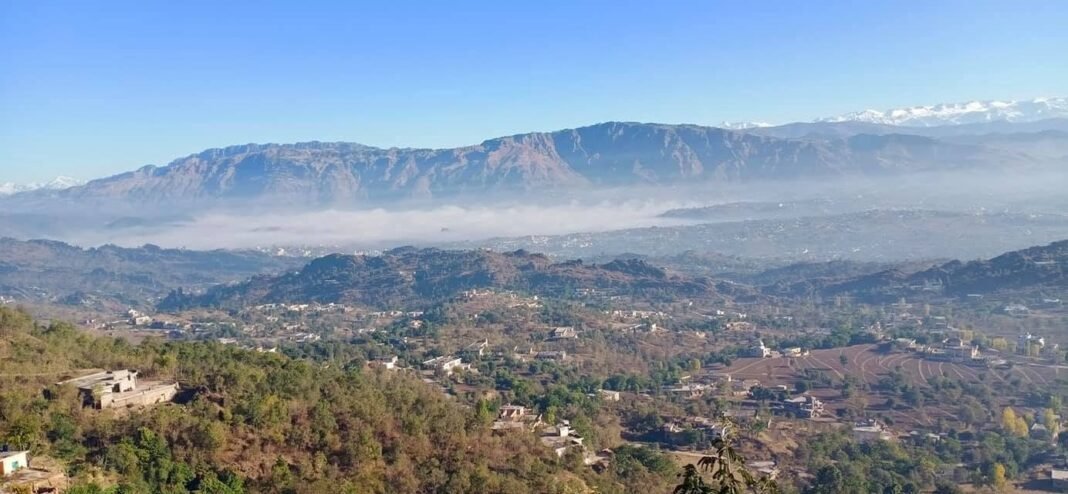
Everyone has heard of Neelum and Hunza. Almost no one outside Azad Kashmir has heard of Banah Valley — and that is exactly why you should go. Tucked into the green hills of eastern Kotli district, with Khoiratta town as its gateway, Banah is Kashmir in a gentler register: wooded slopes instead of glaciers, village roads instead of jeep tracks, natural springs and old stone fountains instead of tourist bazaars. It is the kind of valley where you drive short distances, stop often, drink tea with whoever is sitting outside, and let the landscape set the pace.
What elevates Khoiratta beyond pretty scenery is its heritage layer. This is old country. The remains of gardens and fountains from earlier centuries still dot the area; a fort locally associated with the Mughal era crowns a nearby hill; Sufi shrines draw hundreds of visitors daily; and the archaeology department has documented ancient rock-cut caves carrying old architectural and script traditions. Few valleys in southern Azad Kashmir pack this much history into such green, accessible hills.
Banah is also refreshingly honest travel. There is no single famous viewpoint to tick off, no queue for a chairlift, no curated “experience.” Instead there are village lanes, watercourses, wheat terraces, pine-dotted ridges and the warm, unhurried hospitality of the Pahari-speaking people. For travelers who feel the famous valleys have become too busy — and for photographers hunting scenes that haven’t been shot a thousand times — Khoiratta and Banah are a genuine discovery.
A Khoiratta & Banah Valley travel guide itinerary works beautifully as a one-to-two-day escape from Islamabad or Rawalpindi: drive down via Kotli, spend a full day wandering the valley and its heritage sites, overnight in Khoiratta or Kotli, and return refreshed. Pair it with Kotli’s other heritage — the Kaini Bayan Temples and Karchai Fort — and you have a southern Azad Kashmir circuit most travelers never attempt.
History of Khoiratta & Banah Valley
Khoiratta’s history is the history of southern Kashmir’s frontier hills. The wider Kotli region was part of the Jammu territories of the princely state of Jammu and Kashmir before 1947, and Kotli itself remained a subdivision of Mirpur district until it became a full district in 1975. Khoiratta — today the second-largest town of Kotli district after Kotli city — grew as a market and administrative center for the surrounding hill villages, sitting close to what is now the Line of Control, roughly 7 to 8 km away.
The area’s heritage sites speak of much older chapters. The remains of gardens and fountains around Khoiratta recall the Mughal taste for engineered water landscapes, and local tradition attributes the Karjai (Kurjai) Fort, about 4 km from the town, to the Mughal period — some accounts specifically to the reign of Emperor Akbar. Treat the attribution as tradition rather than documented fact: what is certain is that the fort is old, strategically placed, and part of a landscape of hill forts that guarded these valleys for centuries.
The spiritual history is equally rich. The shrine of Mai Toti Sahiba, about 4 km from Khoiratta, is visited by hundreds of people every day, and the tehsil also holds the shrines of Sheikh Mirza Rahman Baba, Meeraan Aashiq Ali Badshah and Sain Sadiq — markers of the Sufi Islam that shaped Kashmir’s religious culture. Meanwhile, the rock-cut caves documented near Khoiratta by Azad Kashmir’s archaeology department, carrying ancient architectural and script traditions, hint at habitation and sacred use stretching back far beyond the Mughal era.
In recent years, Banah Valley has been specifically promoted by AJK Tourism as a nature destination — a recognition that southern Azad Kashmir’s green valleys deserve the attention the northern alpine valleys have long enjoyed. For travelers, this means a destination on the cusp: known enough to be reachable, unknown enough to feel like exploration.
Top Things to Do in Khoiratta & Banah Valley
Wander Banah Valley’s Village Roads
The valley’s main pleasure is simply moving through it. The roads beyond Khoiratta wind past terraced fields, walnut and pine trees, small mosques and villages where life follows the agricultural seasons. Stop at the natural springs that surface along the routes — the water is famously sweet — and walk the village lanes. This is slow travel at its best, and a local guide adds enormous value in finding the prettiest stretches.
Visit the Shrine of Mai Toti Sahiba
About 4 km from Khoiratta, the shrine of Mai Toti Sahiba draws hundreds of devotees daily. Even for non-pilgrim visitors, it is worth experiencing: the atmosphere of a living Kashmiri shrine — the green cloth, the rose petals, the quiet murmur of prayers, the langar-style generosity — is a window into the valley’s spiritual heart. Dress modestly, remove shoes, and behave with the respect any place of worship deserves.
Explore Karjai Fort
The old fort at Karjai, roughly 4 km from town, rewards the climb with sweeping views over the surrounding hills toward the Line of Control. Local tradition links it to the Mughal era. Go with a local who knows the path, carry water, and treat the ruins gently — undocumented heritage survives only if visitors respect it.
Seek Out the Rock-Cut Caves
Azad Kashmir’s archaeology department has documented rock-cut caves near Khoiratta bearing ancient architectural and script traditions. These are not developed tourist sites — there may be no signposts — so arrange the visit through a knowledgeable local guide. For history lovers, standing inside hand-cut chambers of uncertain antiquity is a genuine thrill.
Take In the Border Viewpoints
Seri Border, Durgoti Cross and Bais Nade are among the local viewpoints visitors seek out — places where the hills open up and the frontier landscape unfolds. Given the proximity to the Line of Control, always follow local advice about where it is appropriate to stop and photograph, and never approach restricted or fenced areas.
Trace the Old Gardens and Fountains
Ask locals about the remains of the old gardens and fountains around Khoiratta — the crumbling channels and waterworks of earlier centuries. They are fragmentary, but for those who love reading landscapes, these ruins tell you this valley was once somebody’s idea of paradise engineered in stone and water.
Famous Places In and Around Khoiratta & Banah Valley
- Mai Toti Sahiba Shrine — revered Sufi shrine 4 km from Khoiratta, visited by hundreds daily
- Karjai Fort — old hill fort traditionally linked to the Mughal era
- Rock-cut caves — ancient caves documented by the archaeology department
- Seri Border viewpoint — panoramic frontier views
- Durgoti Cross & Bais Nade — local scenic spots
- Tattapani — sulphur water springs, 26 km from Kotli on a fair-weather road
- Kotli city — district headquarters with bazaars, rest houses and Poonch river views
How to Reach Khoiratta & Banah Valley
Khoiratta lies about 29 km southeast of Kotli and roughly 154 km from Islamabad to the east, making it very doable as an overnight trip from the capital. The town is connected to Kotli by metalled road via three routes — through Dongi, via the Battal–Dhanna Road, and through Nakyal — so access is straightforward for cars in fair weather.
From Islamabad or Rawalpindi, drive to Kotli via Kahuta, Sensa and Holar (around 117–141 km depending on the route, roughly 3 to 4 hours), then continue about an hour southeast to Khoiratta. From Lahore, the practical approach is to reach Islamabad/Rawalpindi first and continue from there. From Karachi, fly to Islamabad and drive — the overland journey is a multi-day undertaking. The nearest airport is Islamabad International Airport.
Public transport options include coasters and vans from Rawalpindi/Islamabad to Kotli, then local transport onward to Khoiratta. That said, this is a destination where having your own car — or a hired car with a driver who knows the valley — transforms the experience, because the best of Banah lies along the small roads beyond the town. In the monsoon months (July–August), check road conditions, as hill roads can be affected by rain.
Route Details
- From Islamabad/Rawalpindi, take the Kahuta road toward Azad Kashmir via Sensa and Holar to Kotli (roughly 3–4 hours).
- From Kotli, follow the metalled road southeast to Khoiratta — via Dongi, the Battal–Dhanna Road or Nakyal (about an hour).
- From Khoiratta town, the Banah Valley settlements spread out along village roads — explore with a local guide for the best springs, viewpoints and heritage spots.
Where to Stay in Khoiratta & Banah Valley
Accommodation here is simple and that is part of the experience. The AJK Tourism Department runs a rest house at Khoiratta itself — the most convenient base for exploring the town and valley, offering basic but comfortable rooms in a quiet setting. Book through the tourism department in advance, especially around holidays.
Kotli city, about an hour away, offers more choice: a PWD rest house, a tourism rest house and a handful of mid-range hotels in the town, suitable for families wanting proper amenities. For luxury stays, you will need to base yourself in Islamabad/Rawalpindi or Mirpur and visit as a longer day trip — though that sacrifices the valley’s lovely early mornings.
Practical notes: carry your own toiletries and a warm layer (nights are cool even in summer), confirm hot water in winter, and keep expectations aligned with small-town AJK hospitality — clean, kind and unpretentious rather than polished.
Where to Eat: Local Foods of Khoiratta & Banah Valley
The food of Khoiratta is Pahari home cooking — wholesome, ghee-rich and deeply satisfying after a day on the valley roads. In town dhabas and small hotels you will find makki di roti with saag in winter, dal, sabzi, chicken and mutton curries with fresh tandoori naan, and rice dishes. A dhaba meal is genuinely budget-friendly, typically a few hundred rupees per person.
Do not leave without trying Kashmiri pink tea (noon chai) — the salty, rose-hued tea that is the region’s signature drink — alongside regular doodh patti. The valley’s dairy is excellent: fresh lassi, butter and desi ghee feature heavily in local cooking. In season, buy walnuts and fresh fruit from village sellers. Kotli’s bazaar has a fuller range of restaurants if you want more choice for dinner.
Weather in Khoiratta & Banah Valley
Khoiratta sits in the sub-mountainous hills of southern Azad Kashmir, so its climate is moderate by Kashmir standards — warmer than the high valleys, cooler than the Punjab plains. Summers are hot, winters are mild with chilly nights, and the monsoon brings the hills alive with green. The valley is at its most beautiful in spring and autumn.
| Season | Temperature Range | Conditions |
|---|---|---|
| Winter (Dec–Feb) | 5–18°C | Mild days, cold nights; occasional fog; clear views of the hills |
| Spring (Feb–Apr) | 15–30°C | The best season — green hills, blossom, pleasant driving weather |
| Summer (May–Aug) | 28–40°C | Hot days; monsoon rains Jul–Aug turn the valley lush but can affect roads |
| Autumn (Oct–Nov) | 18–30°C | Clear skies, harvest season, excellent visibility — the other best season |
Language and Culture of Khoiratta & Banah Valley
The native languages of Kotli district are Pahari — spoken by roughly two-thirds of the population — and Gujari, spoken by about a third. Urdu is widely understood and works everywhere for visitors. The population is predominantly Muslim, with a strong Sufi tradition visible in the valley’s many shrines.
Cultural norms are conservative and hospitable in equal measure. Dress modestly, greet people warmly, and accept offered tea — refusing hospitality can offend. Ask permission before photographing people, particularly women. At shrines, cover your head, remove shoes and keep behavior reverent. Given the area’s proximity to the Line of Control, be discreet with cameras near any military or border installations, follow local guidance without argument, and avoid political discussions with strangers.
Shopping in Khoiratta & Banah Valley
Shopping here means village and small-town bazaars, not malls. Khoiratta’s bazaar sells everyday Kashmiri goods: walnuts, dried fruits, desi ghee, honey and warm woolens in winter. Look for Pahari handicrafts — handwoven items and traditional caps — and the embroidered fabrics sold in Kotli’s larger bazaar.
Prices are local prices — refreshingly low compared to tourist hubs — and gentle bargaining is normal. If you are passing through Kotli, its bazaar is the best place in the district for a wider selection of Kashmiri shawls and dry fruits. Buy the walnuts; they are genuinely excellent.
Travel Tips for Khoiratta & Banah Valley
Packing Essentials
Comfortable walking shoes for village lanes and the fort climb, a daypack with water and snacks, sun protection, and a light jacket — valley evenings cool down even in summer. Carry a scarf or cap for shrine visits. In monsoon season, add rain gear and check road conditions before setting out.
Safety Tips
The valley is generally peaceful, but its closeness to the Line of Control (around 7–8 km) means you should travel sensibly: stick to known routes, take local advice about viewpoints, never approach fenced or restricted areas, and keep identification with you. Hire a local guide for heritage sites — they know both the paths and the protocols. Drive carefully on narrow hill roads and avoid night driving.
Money & Connectivity
Carry cash — Khoiratta’s shops and dhabas are cash-only, and ATMs are limited outside Kotli city. Mobile signals from the major networks work in the town and along main roads but fade in side valleys; download offline maps in advance. There is no need for large amounts of cash — daily costs here are modest.
Best Time to Visit Khoiratta & Banah Valley
February to April — Spring Prime
The valley’s best season: green hills, blossom, comfortable temperatures and clear roads. This is when Banah looks most like the Kashmir of postcards, and when local tourism guidance specifically recommends visiting.
October to November — Autumn Prime
The year’s other sweet spot — harvest colours, crisp air, excellent visibility and quiet roads. Ideal for photography and unhurried heritage exploring.
May to June — Early Summer
Warm but workable, with long daylight hours. Start activities early, rest midday, and enjoy the long, soft evenings that hill valleys do so well.
July to September — Monsoon
The hills turn intensely green and the springs run full — beautiful, but travel with caution: heavy rain can disrupt hill roads. Check conditions locally before committing to remote lanes.
December to January — Winter Quiet
Mild by northern standards, with cold nights and occasional fog. A peaceful time for shrine visits and bazaar wandering, though the valley’s green glory is dormant.
Final Thoughts
Khoiratta and Banah Valley will not shout for your attention — and that is their gift. In a country where the famous valleys increasingly strain under their own popularity, this green corner of Kotli district offers something rarer: a Kashmir you can have largely to yourself, where the heritage is real, the springs are sweet, the shrines are alive with devotion, and the hills ask nothing of you except that you slow down.
For your Explore Pakistan journey, think of Banah as the southern counterpart to the great northern valleys — proof that Azad Kashmir’s beauty doesn’t stop where the high peaks end. Combine it with Kotli’s Kaini Bayan Temples and Karchai Fort, bring a local guide, and discover the valley the crowds haven’t found yet.
FAQs
Where are Khoiratta and Banah Valley located?
Khoiratta (Khuiratta) is a tehsil of Kotli District in Azad Jammu and Kashmir, about 29 km southeast of Kotli and roughly 154 km from Islamabad. Banah Valley spreads through the green hills beyond Khoiratta town, which serves as its gateway.
What is the best time to visit Khoiratta & Banah Valley?
February to April and October to November are the prime seasons — green hills, pleasant temperatures and clear roads. Monsoon (July–August) is lush but can disrupt hill roads.
How do I reach Khoiratta from Islamabad?
Drive via Kahuta, Sensa and Holar to Kotli (3–4 hours), then continue about an hour southeast to Khoiratta via Dongi, the Battal–Dhanna Road or Nakyal. The nearest airport is Islamabad International Airport.
Is Khoiratta safe for tourists?
The valley is generally peaceful, but it lies only 7–8 km from the Line of Control, so travel sensibly: follow local advice, avoid restricted areas, carry ID, and hire a local guide for heritage sites.
What are the main attractions in Khoiratta?
The shrine of Mai Toti Sahiba, Karjai Fort, ancient rock-cut caves, the Seri Border viewpoint, Durgoti Cross, Bais Nade, old Mughal-era garden and fountain remains, and the village scenery of Banah Valley itself.
Where can I stay in Khoiratta?
The AJK Tourism Department rest house in Khoiratta is the most convenient base. Kotli city, about an hour away, has PWD and tourism rest houses plus mid-range hotels.
What food should I try in Khoiratta?
Pahari home cooking — makki di roti with saag in winter, dals and curries with fresh naan, Kashmiri pink tea (noon chai), fresh lassi, desi ghee, walnuts and seasonal fruit.
How many days do I need for Banah Valley?
A full day covers the highlights; one night in Khoiratta makes for a relaxed two-day trip from Islamabad, giving you unhurried time on the valley’s village roads.