Quick Facts
- Location: Near Taxila Cantonment, Punjab, about 3 km east of the Taxila Museum on PMO Colony Road, close to the ancient city of Sirkap
- Altitude: Around 550 metres (Taxila valley floor)
- Famous For: The Great Stupa of Taxila, built by Emperor Ashoka in the 3rd century BCE over relics of the Buddha; the 1913 discovery of a silver reliquary with a Kharosthi inscription
- Nearest City: Taxila; Islamabad is roughly 32 km to the southeast
- Accessibility: Very easy; a 45-minute drive from Islamabad on good roads, then a short walk around the open site
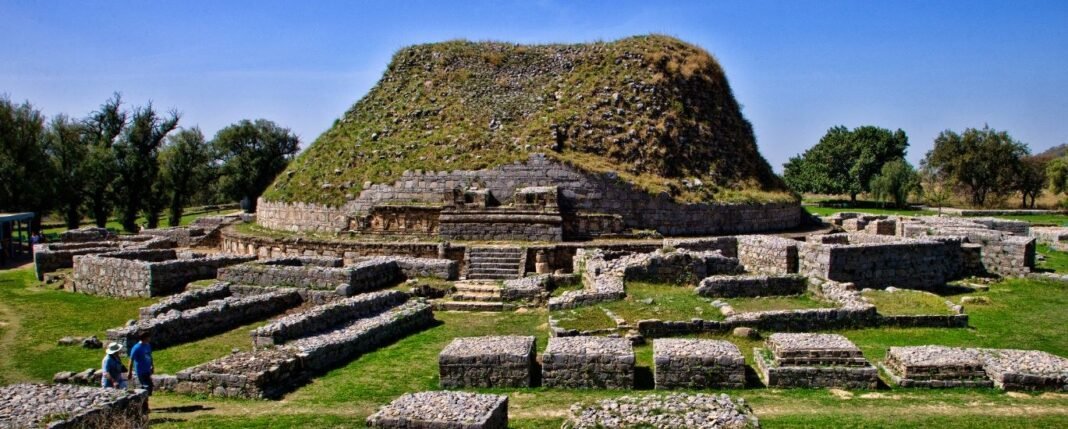
- Known Landmarks: The great hemispherical stupa, surrounding votive stupas, monastic quadrangles and chapels from the Kushan era
- Best For: History lovers, Buddhist pilgrims, students, photographers, and families on an educational day trip from Islamabad
Why Visit Dharmarajika Stupa, Taxila
There are places you visit for a view, and places you visit because the ground itself is heavy with time. Dharmarajika Stupa is the second kind, and then some. This is the Great Stupa of Taxila, raised by Emperor Ashoka in the 3rd century BCE over relics of the Buddha himself, and it has been a place of pilgrimage for more than two thousand years. Standing before its great dome, you are looking at one of the oldest Buddhist monuments on earth, in the heart of the Gandhara civilisation that carried Buddhism from the Indus to China, Korea and Japan.
What makes Dharmarajika magnetic is not just its age but its layers. Ashoka’s original stupa was rebuilt and ringed with smaller stupas, chapels and monasteries during the Kushan era in the 2nd century CE, when Taxila was one of the ancient world’s great centres of learning. The different brickwork styles visible across the complex let you read those centuries with your own eyes: Mauryan devotion, Kushan grandeur, and finally the silence that fell when the White Huns swept through in the 5th century CE. Few sites in Pakistan let you touch that much history in a single afternoon.
Then there is the sheer ease of it. This is world-class heritage forty-five minutes from Islamabad, which makes it the single best heritage day trip in the capital region. You do not need a jeep, a guide with ropes, or a week of leave. You need a morning, comfortable shoes, and curiosity. Walk the circumambulation path around the great stupa as pilgrims have done for two millennia. Climb nothing strenuous. Stand where Sir John Marshall stood in 1913 when his excavations pulled a silver casket, inscribed in Kharosthi and holding bone fragments believed to be the Buddha’s, out of this very earth.
This destination is perfect for almost everyone. Buddhist pilgrims from Sri Lanka, Thailand, Nepal and beyond already come here; in May 2026, Vesak was celebrated at the stupa for the first time in some fifteen centuries, with monks chanting where monks chanted 1,500 years ago. History lovers, archaeology students, photographers chasing Gandharan light, and families wanting a day trip with genuine substance will all find Dharmarajika unforgettable. Come between October and March, when the Taxila valley is cool, clear and golden.
History of Dharmarajika Stupa, Taxila
The story of Dharmarajika begins with the most famous convert in Buddhist history. In the 3rd century BCE, Ashoka, emperor of Magadha, embraced Buddhism after the bloody Kalinga war and set about spreading the faith across his empire, which then included Gandhara. Tradition holds that he built stupas across the land to enshrine relics of the Buddha, and the great stupa at Taxila, the Dharmarajika, was among them. Its very name means “the stupa of the righteous king,” a direct reference to Ashoka himself.
Taxila was already ancient when Ashoka built here. The valley had been a crossroads of empires: Achaemenid Persians, Alexander the Great (who passed through in 326 BCE), and then the Mauryans. Under the Mauryans and later the Indo-Greeks and Kushans, Taxila grew into one of the ancient world’s great university cities, drawing scholars and monks from across Asia. The Dharmarajika complex grew with it. In the 2nd century CE, during the Kushan era, the stupa was substantially rebuilt and enlarged, and a great monastic complex developed around it: rows of smaller votive stupas, chapels, and residential quadrangles for monks, built in the varied brick and stone masonry styles you can still trace today.
The end came in the 5th century CE, when the White Huns (Hephthalites) invaded Gandhara. Their campaigns devastated the Buddhist establishments of the region, and Dharmarajika, like the monasteries of Jaulian and Mohra Moradu nearby, was abandoned to fifteen centuries of silence. The stupas crumbled, the monks were gone, and the valley forgot.
Rediscovery began with the British archaeologist Sir John Marshall, Director-General of the Archaeological Survey of India, whose systematic excavations of Taxila started in 1913. At Dharmarajika, Marshall’s team uncovered one of the great finds of Gandharan archaeology: a silver reliquary casket inscribed in the Kharosthi script, containing bone fragments believed to be relics of the Buddha. The discovery confirmed the stupa’s identity and its Ashokan origins, and the relics and inscriptions became cornerstones of the Taxila Museum’s collection. In 1980, the Ruins of Taxila, with Dharmarajika at their heart, were inscribed as a UNESCO World Heritage Site, and the silence was finally, officially, broken.
Top Things to Do in Dharmarajika Stupa, Taxila
Circumambulate the Great Stupa
Begin as the pilgrims began: walk slowly around the great hemispherical dome. The stupa’s base and drum show the Kushan-era rebuilding over Ashoka’s original core, and the information boards explain the masonry styles. Walking the pradakshina path clockwise, in the traditional manner, with the late-morning light raking across the ancient brickwork, is a genuinely moving experience even for the non-religious. This is the oldest thing you will touch all year. Touch it with respect.
Read the Centuries in the Votive Stupas
Ringing the main stupa are dozens of smaller stupas, chapels and monastic cells added over centuries of devotion. Wander among them and notice how the construction changes: the diaper masonry of one era, the semi-ashlar of another. Each little stupa was someone’s act of faith, funded by a merchant, a monk or a pilgrim, and together they form a forest of devotion around Ashoka’s great dome. Photographers: the late afternoon side-light here is superb.
Visit the Taxila Museum
Three kilometres west of the stupa stands the Taxila Museum, one of Pakistan’s finest, housing the Gandharan sculptures, coins, jewellery and inscriptions excavated from Dharmarajika and the valley’s other sites, including material from Marshall’s digs. See the museum and the stupa on the same day and each illuminates the other: the art in the galleries, the architecture in the field. Allow at least an hour for the museum.
Walk Ancient Sirkap
Close to Dharmarajika lie the excavated streets of Sirkap, the Indo-Greek planned city with its grid of streets, stupas and the famous double-headed eagle stupa. Buddhist tradition held that monasteries should be neither too close nor too far from towns, and Dharmarajika’s position relative to Sirkap follows that rule beautifully. The two sites together show you both the sacred and the civic life of ancient Taxila.
Climb to Jaulian and Mohra Moradu
If Dharmarajika whets your appetite, the valley has more. The hilltop monastery of Jaulian, with its chapels of Buddha-life scenes, and the monastery of Mohra Moradu are short drives away and complete the great Taxila Buddhist circuit. Our companion guides map them both.
Famous Places In and Around Dharmarajika Stupa, Taxila
- Taxila Museum — about 3 km west; Gandharan art and Marshall’s excavation finds.
- Sirkap — the excavated Indo-Greek city, minutes from the stupa.
- Jaulian Buddhist Monastery — hilltop monastery with 59 chapels; see our dedicated guide.
- Mohra Moradu — another great Kushan-era monastery of the valley.
- Bhir Mound — the oldest Taxila city site, Achaemenid-era; see our guide.
- Khanpur Dam — blue water and picnic lawns, a relaxing add-on after the ruins.
How to Reach Dharmarajika Stupa, Taxila
Few world-heritage sites are this easy to reach. Dharmarajika sits just off the Taxila-Haripur road network near the cantonment, about 3 km east of the Taxila Museum along PMO Colony Road, and the final approach is on good paved roads with parking near the site.
From Islamabad: Roughly 32 km, about 45 minutes to an hour by car. Take the Grand Trunk Road (N-5) west through Rawalpindi toward Taxila, or the motorway to the Taxila interchange and then local roads. It is the classic capital day trip: leave after breakfast, see the stupa and museum, and be home for dinner.
From Lahore: Approximately 280 km via the M-2 and M-1 motorways, about 4 to 4.5 hours. A comfortable drive that makes Dharmarajika an easy weekend excursion from Lahore, especially combined with an Islamabad stay.
From Karachi: Fly to Islamabad (about two hours) and drive the 45 minutes to Taxila. The overland journey of some 1,400 km is only for the most dedicated road-trippers.
Nearest airport: Islamabad International Airport, about an hour’s drive from the site. Within Taxila, rickshaws and ride-hailing cover the short hops between the museum, Dharmarajika, Sirkap and Jaulian, though having your own car makes the circuit far smoother.
Road conditions are good year-round. In summer, start early to avoid the midday heat on the exposed site; in winter, the valley can be foggy in the early morning, so a mid-morning start is ideal.
Route Details
Step by step from Islamabad: (1) head west on the Grand Trunk Road toward Rawalpindi and Taxila, or take the M-1 motorway to the Taxila/Burhan interchange; (2) follow signs for Taxila Museum and Taxila Cantonment; (3) from the museum area, take PMO Colony Road east for about 3 km; (4) follow the brown heritage signboards to the Dharmarajika Stupa parking area; (5) explore the stupa complex on foot (an hour is enough, two is better), then loop back via Sirkap and the museum. Entry tickets to the archaeological sites are modest; carry small cash.
Where to Stay in Dharmarajika Stupa, Taxila
Most visitors see Dharmarajika as a day trip from Islamabad, and that is honestly the best plan: the capital’s hotels, from luxury to budget, are 45 minutes away, and the site deserves a fresh morning start rather than a tired overnight nearby. Base yourself in Islamabad or Rawalpindi and drive out.
If you prefer to stay closer, Taxila and neighbouring Wah Cantt have mid-range hotels and guesthouses that are clean, inexpensive and perfectly adequate for a night. They cater mainly to business and family travellers on the Grand Trunk Road, so expect practical comfort rather than resort atmosphere. A few rest houses associated with government departments exist in the area but generally require advance institutional booking.
For Buddhist pilgrim groups and archaeology-focused travellers spending two or three days working through the whole Taxila circuit (Dharmarajika, Sirkap, Jaulian, Mohra Moradu, Bhir Mound and the museum), a Wah Cantt or Taxila base saves back-and-forth driving. Book ahead in the October to March high season, when school and university groups also tour the valley.
Where to Eat: Local Foods of Dharmarajika Stupa, Taxila
The Taxila valley’s food is classic Punjabi-Pothohari fare, hearty and unpretentious. Around the museum, the cantonment and Wah Cantt, dhabas and restaurants serve the staples done well: chicken and mutton karahi bubbling in iron woks, dal makhani with fresh tandoori naan, chana chaat and dahi bhallay from street carts, and seekh kebabs and grilled fish in the evenings.
For breakfast, join the locals at a dhaba for halwa puri or paye with kulcha, washed down with doodh patti. If you are day-tripping from Islamabad, you might simply pack the heritage morning and plan lunch back in the capital, but the valley’s own food is worth at least one stop. Meals at local restaurants are budget-friendly; even a generous karahi lunch for two costs far less than a routine meal in Islamabad’s upscale sectors.
Carry water on the site itself, as the stupa complex is open and exposed with limited shade, and prefer busy, high-turnover eateries for the freshest food.
Weather in Dharmarajika Stupa, Taxila
Taxila shares the Pothohar plateau climate of nearby Islamabad: hot summers, a real monsoon, and crisp, golden winters. For a site that is almost entirely outdoors, with little shade among the ruins, the season matters enormously. October to March is the sweet spot: cool air, clear skies and that low winter light that makes the ancient brickwork glow. Summer visits are possible but should be confined to early morning.
| Season | Temperature Range | Conditions |
|---|---|---|
| Winter (Nov-Feb) | 2-18°C | Crisp, sunny days; morning fog possible; the best season for the ruins |
| Spring (Mar-Apr) | 15-30°C | Pleasant and green; wildflowers among the ruins; excellent visiting weather |
| Summer (May-Jun) | 30-42°C | Hot and dry; visit at opening time and carry water and sun protection |
| Monsoon (Jul-Sep) | 28-36°C | Humid with heavy showers; the valley turns lush but paths can be slippery |
| Autumn (Oct) | 18-32°C | Clearing skies, comfortable warmth; a lovely shoulder month |
Language and Culture of Dharmarajika Stupa, Taxila
The valley speaks Punjabi in its Pothohari flavour, with Urdu universal and English widely understood around the museum and tourist facilities. Taxila town itself is a mix of the old Grand Trunk Road bazaar culture and the orderly cantonment and industrial world of Wah next door.
As a sacred Buddhist site that is also an active place of pilgrimage, Dharmarajika asks for the same respect any shrine does. Dress modestly, keep your voice low near the stupa, do not climb on the ancient masonry, and follow the marked paths; these ruins are 2,300 years old and fragile. If monks or pilgrim groups are present, especially around Vesak, give them space and ask before photographing people. The site staff and the museum guides are knowledgeable and welcoming; a few questions will always earn you stories the signboards do not carry.
Shopping in Dharmarajika Stupa, Taxila
Souvenir shopping here is refreshingly honest. The Taxila Museum shop sells books on Gandharan art and archaeology, postcards and replicas that are far more meaningful than generic trinkets. In Taxila’s bazaar you will find everyday Punjabi market life: cloth, crockery, sweets and snacks, all at small-town prices.
Gandhara-style art replicas, stucco and stone carvings in the Greco-Buddhist style, are sold by shops around the tourist circuit; buy from established sellers and treat extraordinary claims about antiquity with the scepticism they deserve. Real antiquities are illegal to buy or export, and attempting to do so is a serious offence. There are no verifiable large shopping malls at the heritage sites themselves; the museum shop and the old bazaar cover everything a heritage traveller needs.
Local Events and Festivals
Vesak (May): The great Buddhist festival of Vesak, marking the birth, enlightenment and passing of the Buddha on the full moon of May, returned to Dharmarajika in a historic ceremony on 1 May 2026. Organised with the embassies of Sri Lanka, Thailand, Nepal, Vietnam and Myanmar together with the Punjab Archaeology Department, the peace-prayer ceremony filled the stupa complex with chanting monks, traditional offerings of incense, flowers, light and rice, and a Dhamma sermon for the first time in some fifteen centuries. The event is expected to recur, making May an extraordinary, if hot, time for Buddhist pilgrims to visit.
Beyond Vesak, the Taxila valley’s cultural calendar follows the Punjabi rhythm of Eid, Independence Day and the spring Basant mood, but for this site, the full-moon month of May is the date that matters.
Travel Tips for Dharmarajika Stupa, Taxila
Packing Essentials
Sun protection year-round: cap, sunglasses, sunscreen. Comfortable walking shoes with grip, because the ancient surfaces are uneven. A water bottle, especially from April to September. A camera or phone with plenty of storage; the site is relentlessly photogenic. In winter, a warm layer for the morning chill that burns off by noon.
Safety Tips
Dharmarajika is a managed archaeological site and very safe for visitors, including families. Stay on the marked paths, do not climb the stupas, and supervise children near the excavated edges. The area around Taxila Cantonment is orderly; normal city awareness in the bazaar areas is all you need.
Money & Connectivity
Entry tickets are modest; carry small cash for tickets and the museum shop. ATMs are plentiful in Taxila, Wah Cantt and on the route from Islamabad. Mobile signals from all major networks are strong across the valley, and data coverage is reliable for maps and ride-hailing.
Best Time to Visit Dharmarajika Stupa, Taxila
Winter (November to February) — Perfect
Cool, clear, golden. The ruins at their most beautiful and the walking at its most comfortable. This is the season the site was made for.
Spring (March to April) — Beautiful
Green valley, wildflowers among the votive stupas, pleasant temperatures. Arguably the prettiest weeks of the year here.
Early Summer and Vesak (May) — For Pilgrims
Hot, but spiritually unmatched if the Vesak ceremony is held. Come for the festival, plan around the heat, and carry water.
Monsoon and Autumn (July to October) — The Shoulder
Lush but humid in monsoon; October dries out into a fine, crowd-free visiting month.
Final Thoughts
Two thousand three hundred years ago, an emperor who had seen too much war built a dome over a handful of sacred bone and changed the spiritual geography of Asia. Monks walked this ground when Rome was still a republic. Then the Huns came, the chanting stopped, and the earth kept the secret until Marshall’s spades found it again. That is what you are walking into at Dharmarajika: not a ruin, but a resurrection.
And it is forty-five minutes from Islamabad. There is no excuse, really. Go in winter light, walk the old pilgrim path around Ashoka’s dome, stand in the museum before the silver casket that once lay inside it, and feel the peculiar vertigo of deep time. Few day trips in Pakistan give you so much. For more journeys through the ancient world, keep exploring our Explore Pakistan series, from Malam Jabba to the valleys of Hunza.
FAQs
Where is Dharmarajika Stupa located?
Near Taxila Cantonment in Punjab, about 3 km east of the Taxila Museum on PMO Colony Road, close to the ancient city of Sirkap.
Who built Dharmarajika Stupa and when?
Emperor Ashoka of Magadha built it in the 3rd century BCE to enshrine relics of the Buddha. It was rebuilt and expanded in the Kushan era (2nd century CE).
What is the best time to visit Dharmarajika Stupa?
October to March, when the weather is cool and clear. Buddhist pilgrims may also target Vesak in May.
How do I reach Dharmarajika from Islamabad?
About 32 km by road, 45 minutes to an hour via the Grand Trunk Road or the M-1 motorway to Taxila.
Is Dharmarajika Stupa a UNESCO World Heritage Site?
Yes. It forms part of the Ruins of Taxila, inscribed as a UNESCO World Heritage Site in 1980.
Is it suitable for families and children?
Absolutely. It is an easy, flat, open site and a wonderful educational outing; supervise children near excavated edges.
What else can I see nearby?
The Taxila Museum (3 km), Sirkap, Jaulian monastery, Mohra Moradu, Bhir Mound and Khanpur Dam all lie within a short drive.
What was found during the excavations?
In 1913, Sir John Marshall’s team found a silver reliquary casket inscribed in Kharosthi script containing bone fragments believed to be relics of the Buddha, confirming the stupa’s Ashokan origins.