Quick Facts
- Location: Khewra town, Pind Dadan Khan Tehsil, Jhelum District, Punjab
- Altitude: The mine sits in the Salt Range of the Pothohar Plateau; inside the mine the temperature stays around 18°C year-round
- Famous For: Pakistan’s largest and the world’s second-largest salt mine; birthplace of Himalayan pink salt; illuminated underground salt sculptures
- Nearest City: Jhelum (around 50 km); Pind Dadan Khan (around 20 km)
- Accessibility: Easy — paved road via the M-2 Motorway’s Lilla Interchange; a comfortable day trip from Islamabad, Rawalpindi or Lahore
- Known Landmarks: Badshahi Mosque replica in salt bricks, Minar-e-Pakistan replica, Sheesh Mahal, Assembly Hall, Pul-Saraat salt bridge, the world’s only salt-brick post office
- Best For: Families, school groups, photographers, geology lovers and anyone planning a day trip from Punjab’s big cities
Why Visit Khewra Salt Mine
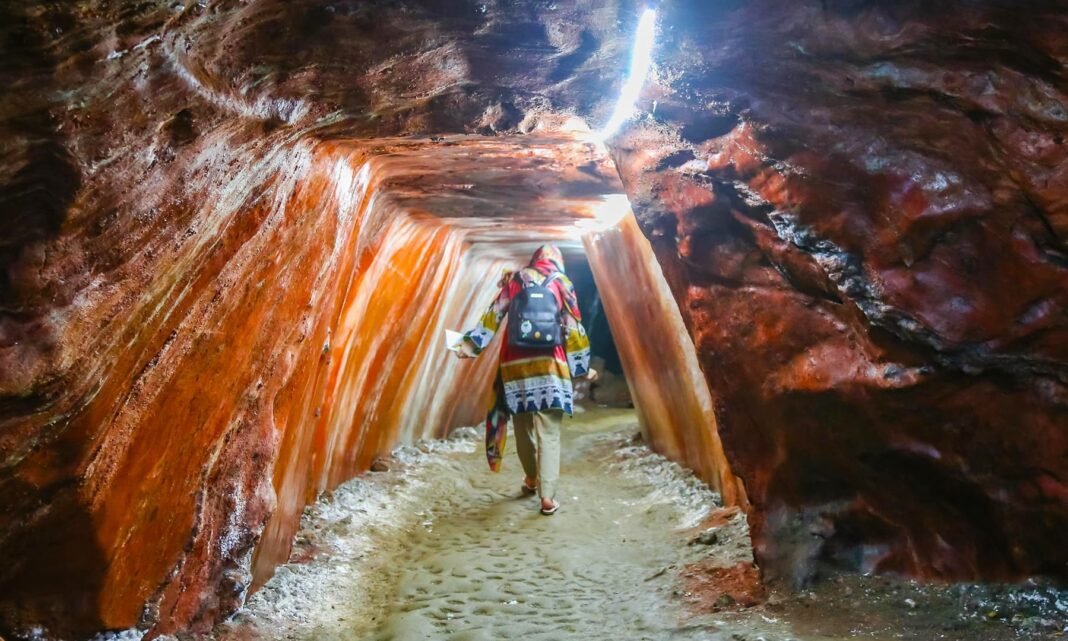
There are very few places on earth where you can walk into a mountain and step straight into a glowing, rose-tinted fantasy — and fewer still where that mountain has been feeding the world’s salt shakers for more than two thousand years. The Khewra Salt Mine is one of them. Descending into its tunnels feels like entering another planet: the walls shimmer pink, white and grey; great chambers open up lit by colored lights; and everywhere you look, skilled miners have carved entire landmarks out of solid salt. It is equal parts geological wonder, living factory and accidental art gallery, and it happens to be the world’s second-largest salt mine.
What makes Khewra special is that it is not a museum of a dead mine — it is a working industrial site that welcomes around 250,000 visitors a year. The same Pakistan Mineral Development Corporation operation that pulls out more than 350,000 tons of nearly pure halite annually also runs guided tours, a little electric train that carries you deep underground, and even a salt-therapy clinic where people with asthma and respiratory problems spend time breathing the dry, mineral-rich air. You get education and spectacle in one visit.
This is also, quite simply, the source of the famous Himalayan pink salt that sits in kitchens from Lahore to London. The deposits here formed when a prehistoric sea evaporated some 540 to 800 million years ago — you are walking through a chapter of the planet’s deep history that predates dinosaurs by hundreds of millions of years. For families, it is a rare trip that children actually enjoy while learning something; for photographers, the salt crystals and light shows are irresistible; and for anyone short on time, it is one of the easiest major attractions in Pakistan to reach.
If you are planning a Khewra Salt Mine travel guide itinerary, think of it as the perfect day trip: arrive by mid-morning, ride the little train into the mountain, spend two to three hours exploring the chambers, and be back in Islamabad or Lahore by evening. Pair it with the nearby Katas Raj Temples or Kallar Kahar Lake if you want a full weekend of the Salt Range, and you will have one of Punjab’s most rewarding road trips mapped out.
History of Khewra Salt Mine
The story of Khewra begins, according to legend, in 326 BC. Alexander the Great’s army was campaigning in the region — tradition places the discovery during his fight against Raja Porus — when the troops camped near the Salt Range. Soldiers noticed their horses licking the rocks on the ground, and on tasting the stones themselves, discovered they were salt. Whether or not every detail of the tale is exact, the historical record agrees that Alexander’s troops were the first outsiders to discover the salt deposit, and the mine’s history is conventionally traced back to around 326 BC.
Actual commercial mining began much later. The mine first started trading in the Mughal era, with recorded mining initiated under the Mughal emperor Akbar in the 16th century — around 1500 AD by some accounts. The Mughals understood the deposit’s value and organized its extraction as the empire’s appetite for salt grew. Salt was a strategic commodity then, taxed and controlled, and the Khewra deposits were among the finest in the empire.
The modern mine took shape under British rule. In 1872, a mining engineer named Dr. H. Warth developed the main tunnel at ground level, introducing systematic room-and-pillar mining methods that are still used in the working sections today. The British administration also renamed it the Mayo Salt Mine, in honour of Lord Mayo, the Viceroy of India who visited it. Production climbed steadily through the colonial decades — by 1890 the annual output had already crossed 50,000 metric tons.
After Partition, the mine passed through several hands: first the BMR until 1956, then the Pakistan Industrial Development Corporation (PIDC) until 1965, then the West Pakistan Industrial Development Corporation (WPIDC) after the 1965 war, and finally the Pakistan Mineral Development Corporation (PMDC) in 1974, which operates it to this day. PMDC remains the country’s largest source of salt, producing more than 350,000 tons per annum of about 99 percent pure halite, while estimates of the remaining reserves range from 82 million tons to 600 million tons. In 2003 the tourist facilities were upgraded in two phases, transforming a great industrial asset into one of Pakistan’s most-visited attractions.
Top Things to Do in Khewra Salt Mine
Ride the Little Electric Train
Most visitors enter the mine aboard the Khewra Salt Mines Railway, a charming narrow-gauge electric train that trundles deep into the mountain. The ride is short but atmospheric: you glide from bright daylight into a tunnel of pink-lit salt, and it immediately sets the tone for everything that follows. Children love it, and it is the easiest way for elderly visitors or anyone with limited mobility to reach the main chambers.
Admire the Salt Badshahi Mosque
Deep inside the mine stands a faithful miniature of Lahore’s Badshahi Mosque, built entirely from multi-coloured salt bricks about fifty years ago. Lit from within, its domes and minarets glow in soft pink and amber. It is the mine’s most photographed structure and a quiet reminder of how beautifully local craftsmen have worked this unusual medium for generations.
Explore the Assembly Hall
The 75-meter-high Assembly Hall is one of the largest chambers visitors can enter — a vast underground hall supported by massive salt pillars left behind by the room-and-pillar mining method. Standing inside it gives you a real sense of the mine’s scale: this is a mountain that has been carefully hollowed out by human hands, one “room” at a time, while the “pillars” hold the mountain up.
Cross Pul-Saraat
Pul-Saraat is a slender salt bridge with no supporting pillars, arching over a brine pond some 25 meters deep. Crossing it — you are allowed to walk over — is one of the most thrilling moments of the tour. The greenish brine below and the pink salt above make it feel like a scene from a fantasy film.
Visit Sheesh Mahal (Palace of Mirrors)
Sheesh Mahal is a chamber where the salt crystals are a delicate light pink, so reflective that they sparkle like mirrors under the lights. Guides often dim the lamps here to show how the crystals catch even the smallest light. Photographers should linger — this is where the most magical shots of the mine are made.
See the Salt-Carved Landmarks
Scattered through the tour route are extraordinary carvings: a replica of Minar-e-Pakistan, a model of the Great Wall of China, a statue of Allama Iqbal, a miniature of Murree’s Mall Road, and — the most moving for many visitors — an accumulation of crystals that naturally forms the name of Muhammad in Urdu script. There is also a model of the Mall Road and, near the entrance to some sections, crystal formations in Crystal Valley. These works were made by miners themselves and show salt as an art material as much as a commodity.
Experience the Light Show and Salt Water Pools
In several chambers, fibre-optic lighting paints the natural salt formations in shifting colours, turning geological strata into a natural light show. Along the route you will also pass pools of briny water — some still, mirror-like — with salt stalactites hanging above them. Ask your guide about the halotherapy chamber and the asthma clinic: in 2007 a 20-bed clinical ward was established inside the mine for salt therapy, a treatment tradition with roots in European salt mines.
Post a Letter from the Salt Post Office
Near the tourist area stands the world’s only fully functional post office built entirely of salt bricks. Even if you don’t mail anything, step inside — the walls glow faintly pink and the novelty is delightful. It is a great souvenir stop, and the small shops nearby sell Himalayan salt lamps, soaps, edible salt and salt-carved decorations.
Famous Places In and Around Khewra Salt Mine
- Katas Raj Temples — an ancient Hindu temple complex around the sacred pond at Katas, near Choa Saidanshah in Chakwal district
- Kallar Kahar Lake — a scenic saltwater lake in the Salt Range with peacocks and boating
- Gurdwara Chowa Sahib — a historic Sikh shrine near Rohtas Fort
- Dulmial — a charming Pothohar village with colonial-era history, on the Salt Range route
- Pind Dadan Khan — the old tehsil town that has served the salt trade for centuries
How to Reach Khewra Salt Mine
Reaching Khewra is straightforward and one reason it makes such a popular day trip. The mine lies about 160 km from both Islamabad and Lahore, and the entire approach is on good paved roads — the final stretch from the motorway is well signposted toward the Khewra Salt Mine Tourist Resort.
From Islamabad the drive is around 160 km and takes about 2 to 2.5 hours. From Lahore the distance is roughly 160 to 200 km, taking 3 to 4 hours depending on traffic and which interchange you use. From Karachi, the sensible approach is to fly to Islamabad or Lahore and drive from there — the overland journey across the country is a full multi-day trip. The nearest airport for all practical purposes is Islamabad International Airport.
By public transport, you can take a bus or coaster to Pind Dadan Khan and then a taxi or rickshaw to the mine. Pakistan Railways has also operated special tourist trains from Lahore and Rawalpindi to the Khewra railway station, which was refurbished for tourist services — check the current schedule before planning around it, as services run seasonally. Many visitors simply hire a car with a driver from Islamabad or Lahore for the day, which is comfortable and affordable when split among a group.
Route Details
- From Islamabad or Lahore, join the M-2 Motorway heading toward the other city.
- Exit at the Lilla Interchange.
- Follow the Lilla–Pind Dadan Khan road for about 30 km toward Pind Dadan Khan.
- Follow the brown tourist signs to the Khewra Salt Mine Tourist Resort — the final approach is paved and well marked, suitable for all standard vehicles.
Roads are in good condition year-round; the only caveat is Punjab’s winter fog (December–January), which can slow early-morning driving on the motorway. In summer the drive is hot, so leave early.
Where to Stay in Khewra Salt Mine
Most visitors do Khewra as a day trip and sleep in Islamabad, Lahore or Jhelum — and that is honestly the best plan, because the mine itself is a two-to-three-hour experience and the bigger cities offer far more choice. If you want to stay overnight near the mine, the PMDC runs a tourist resort with guest houses at the site itself, which is simple, clean and atmospheric — you sleep a few minutes from the mine entrance.
Pind Dadan Khan, the nearby tehsil town, has basic local hotels and guest houses suitable for budget travelers. Jhelum city, around 50 km away, offers a wider range of mid-range hotels with proper amenities. For luxury stays, plan on Islamabad or Lahore, both within easy reach, where everything from five-star hotels to serviced apartments is available.
Practical notes: book the on-site resort guest houses in advance, especially on public holidays and in winter when day-trip traffic peaks. Carry your own toiletries if staying in budget places, and confirm hot water availability in winter.
Where to Eat: Local Foods of Khewra Salt Mine
You won’t find a gourmet scene at the mine, but the Pothohar region’s food is hearty and worth seeking out. The dhabas and small restaurants around the mine and in Pind Dadan Khan serve classic Punjabi fare: daal, chicken karahi, mutton dishes, fresh tandoori naan and makki di roti with saag in winter. A filling dhaba meal is generally budget-friendly, typically costing a few hundred rupees per person — always confirm prices before ordering.
There is a café inside the mine itself for tea, cold drinks and light refreshments — eating underground in a salt chamber is a novelty in its own right. Do try the fresh lassi at roadside shops on the way, and pick up some local rewri and gajak (sesame sweets) from Jhelum or Pind Dadan Khan bazaars as snacks for the road.
The broader Jhelum region is known for its meat dishes and desi ghee cooking; if you stay overnight in Jhelum city, the food streets there offer a proper Pothohari dinner. As always, drink bottled water and eat at busy, freshly-cooking establishments.
Weather in Khewra Salt Mine
The weather story at Khewra has two chapters: outside and inside. Outside, the Salt Range shares the Pothohar climate — scorching summers, pleasant winters and monsoon rain. Inside the mine, it is always around 18°C, cool and dry, whatever the season. That makes the mine a year-round destination; the only seasonal question is how comfortable the journey to the mine will be.
| Season | Temperature Range | Conditions |
|---|---|---|
| Winter (Dec–Feb) | 5–18°C | Cool and pleasant; morning fog possible on the motorway; mine feels slightly warm inside |
| Spring (Mar–Apr) | 18–32°C | Mild and sunny; ideal driving weather; fields green around the Salt Range |
| Summer (May–Aug) | 30–45°C | Very hot outside — travel early morning; the 18°C mine is a blissful escape; monsoon showers Jul–Aug |
| Autumn (Sep–Nov) | 20–33°C | Warm days, cooler evenings; comfortable and the best all-round season for the trip |
Language and Culture of Khewra Salt Mine
Khewra sits in the Pothohar region, where Punjabi in its Pothohari dialect is the everyday language; Urdu is universally understood and English works at the tourist facilities. The local population is predominantly Muslim, with the warm, direct hospitality typical of Punjab.
Cultural norms are relaxed by northern-areas standards but still conservative: dress modestly (covered shoulders and knees are appreciated), ask before photographing people — especially women — and greet shopkeepers warmly. Inside the mine, follow your guide’s instructions strictly; the working sections are an active industrial site. Respect prayer times when visiting the salt mosque replica area, and keep the chambers clean — this is a point of pride for the community that works here.
Shopping in Khewra Salt Mine
Shopping at Khewra is all about salt — and it is genuinely good. The stalls and small shops near the mine sell Himalayan salt lamps in every size, salt candle holders, salt cooking slabs, bath salts, salt soaps and beautifully carved salt decorations and animal figures. Edible pink salt is sold in decorative packaging that makes excellent gifts.
Prices are reasonable and bargaining is normal; the same lamps sell for several times more in Islamabad or abroad. Check lamps for cracks before buying, and confirm whether the price includes packaging for travel. In Pind Dadan Khan’s bazaar you can also find everyday Punjabi goods — khussas (traditional shoes), cotton fabrics and local sweets. There are no shopping malls here, and that is part of the charm: this is bazaar-and-craft shopping, not retail tourism.
Travel Tips for Khewra Salt Mine
Packing Essentials
Carry a light jacket or shawl — the mine is a cool 18°C even when it is 45°C outside, and the contrast surprises many visitors. Wear comfortable closed shoes with grip; the tunnel floors can be damp in places. Bring a camera (photography is allowed in designated areas, though flash and unrestricted movement may be restricted), drinking water, and a small backpack. If visiting in summer, add sunscreen and a cap for the walk from the parking area to the entrance.
Safety Tips
The tourist section of the mine is very safe — it is a guided, well-lit route with maintained pathways and informational signage. Stay with your group, do not wander into unlit side tunnels or working areas, and supervise children near the brine ponds and the Pul-Saraat bridge. The mine is not recommended for people with severe claustrophobia, though the chambers are large and airy. In winter, check motorway fog advisories before an early departure.
Money & Connectivity
Carry cash — small shops and dhabas around the mine may not accept cards, and there are no ATMs at the mine entrance itself (use ATMs in Pind Dadan Khan or Jhelum). Mobile signals from all major networks generally work in the area, though coverage can dip inside the mine. Entry fees have historically been modest for locals (around Rs 150) with higher rates for foreign visitors and small train/trolley charges — confirm current rates at the gate, as they are revised periodically.
Best Time to Visit Khewra Salt Mine
October to March — The Sweet Spot
This is the best time to visit Khewra. Punjab’s weather is mild and sunny, the drive is comfortable, and the mine’s constant 18°C feels pleasantly warm compared to a crisp winter morning outside. Winter is also peak season, so expect more crowds on weekends and public holidays — arrive early.
April and May — Shoulder Season
Warm but manageable, with fewer crowds than winter. The Salt Range looks its best in spring, and this is a good time for combining the mine with Katas Raj and Kallar Kahar in one trip.
June to August — Summer Strategy
It is brutally hot outside, but the mine itself is a natural air-conditioned refuge at 18°C. If you must visit in summer, leave Islamabad or Lahore at dawn, tour the mine in the late morning, and head back before the afternoon heat peaks. The monsoon can make the final approach road slippery — drive carefully.
September — The Hidden Gem
Post-monsoon September brings clear skies, green hills and thinning crowds. It is arguably the most pleasant month of all for a Salt Range road trip.
Final Thoughts
The Khewra Salt Mine is one of those rare attractions that exceeds its reputation. You go expecting a hole in a mountain and come out having walked through a glowing cathedral of pink crystal, crossed a salt bridge over a bottomless brine pond, and stood inside a mosque made of salt. Few day trips from Islamabad or Lahore deliver this much wonder per hour of driving — and the fact that you are inside a living, breathing industrial site, not a theme park, makes it all the more remarkable.
For your broader Explore Pakistan journey, treat Khewra as the anchor of a Salt Range weekend: the Katas Raj Temples, Kallar Kahar Lake and the Pothohar villages like Dulmial all lie within easy reach. Pack a light jacket, charge your camera, and go see where the world’s most famous salt is born.
FAQs
Where is Khewra Salt Mine located?
Khewra Salt Mine is in Khewra town, Pind Dadan Khan Tehsil of Jhelum District, Punjab, in the Salt Range of the Pothohar Plateau — about 160 km from both Islamabad and Lahore via the M-2 Motorway’s Lilla Interchange.
What is the best time to visit Khewra Salt Mine?
October to March is ideal, when Punjab’s weather is mild and the drive is comfortable. The mine’s interior stays around 18°C all year, so it is visitable in any season — summer visitors just need to travel early in the day.
How do I reach Khewra Salt Mine from Islamabad?
Drive the M-2 Motorway, exit at Lilla Interchange, and follow the road about 30 km toward Pind Dadan Khan to the mine. The trip is around 160 km and takes 2 to 2.5 hours.
Is Khewra Salt Mine safe for families and children?
Yes. The tourist route is guided, well-lit and maintained, and the little electric train makes it easy for children and elderly visitors. Supervise kids near brine ponds and the salt bridge.
How long does a visit to Khewra Salt Mine take?
Plan 2 to 3 hours inside the mine for the train ride, guided walk and photography, plus driving time — it fits comfortably into a day trip from Islamabad, Lahore or Rawalpindi.
Where can I stay near Khewra Salt Mine?
Most visitors day-trip from Islamabad, Lahore or Jhelum. The PMDC runs a tourist resort with guest houses at the mine itself, and Pind Dadan Khan has basic budget hotels.
What food is available at Khewra Salt Mine?
There is a café inside the mine for refreshments, and dhabas nearby serve Punjabi dishes like karahi, daal, tandoori naan and, in winter, makki di roti with saag. Jhelum city has a fuller food scene.
What makes Khewra salt (Himalayan pink salt) special?
It is mined from deposits formed 540 to 800 million years ago, is about 99 percent pure halite, and gets its pink colour from trace minerals such as iron oxide. Khewra is the authentic source of the pink salt sold worldwide as Himalayan salt.