Quick Facts
- Location: Near Ganghu Dher village, about 12 km from Gohati on the Mardan-Swabi road, Swabi district, Khyber Pakhtunkhwa
- Altitude: Around 350 metres above sea level, on the Mardan-Swabi plain
- Famous For: A Gandhara Buddhist stupa settlement; the largest stupa found in the subcontinent, uncovered in the 2013 excavations
- Nearest City: Swabi city; Mardan is close to the west
- Accessibility: Road access via the Mardan-Swabi road; Swabi district lies on the Islamabad-Peshawar motorway corridor
- Known Landmarks: The main stupa mound, three smaller stupas, the Kharoshthi inscription finds, nearby Rani Ghat and the Asota megaliths
- Best For: History lovers, archaeology enthusiasts, cultural travelers, photographers of ancient ruins
Why Visit Aziz Dheri, Swabi
Most travelers speed through Swabi district on the motorway without knowing what lies beneath its fields. Aziz Dheri is the reason to stop. This quiet Buddhist mound in the Mardan-Swabi plain holds one of the most important archaeological discoveries in Pakistan’s recent history: the largest Buddhist stupa found anywhere in the subcontinent, brought to light by the 2013 excavations. For anyone interested in the Gandhara civilization — the remarkable culture that blended Greek, Persian, and Indian art into the world’s first images of the Buddha — this aziz dheri swabi travel guide opens a door to a site most tourists have never heard of.
What makes Aziz Dheri special is not just a single monument but a whole settlement. Archaeologists describe it as a stupa settlement site with both a religious area and a residential area, showing how a Buddhist community actually lived here two thousand years ago. The excavations have produced more than 500 sculptures, Kharoshthi inscriptions, gold coins of the Kushan emperor Kanishka, beads of crystal, carnelian, and lapis lazuli, and stucco panels telling episodes from the Buddha’s life — the dream of Queen Maya, the offering of dust, the worship of relics. Standing on the mound, you are standing on layers of continuous occupation stretching from the Indo-Greek period to the Islamic era.
The setting adds to the experience. The site sits on the open plain with mountains rising to the north, north-east, and north-west, and the surrounding villages of Swabi give it an unspoiled, lived-in atmosphere that the more famous Gandhara sites have partly lost. There are no crowds here, no ticket queues, no gift shops — just the ruins, the fields, and the Kara Mar mountain range to the west. For travelers who want their history unfiltered, Aziz Dheri is as good as it gets.
It also makes a practical day trip. From Islamabad or Peshawar, you can reach the site, explore the mound, and combine it with other Swabi-area heritage — the Rani Ghat remains to the north-east, the mysterious Asota megaliths to the south-west, and the great UNESCO-listed monastery of Takht-i-Bahi further west in Mardan — all in a single well-planned day.
History of Aziz Dheri, Swabi
The name itself is recent. “Dheri” is a local word for a raised mound of earth, and the mound is named after Aziz Khan, a religious scholar from Sheikh Jana in Swabi district who lived about two hundred years ago and owned the land. The history beneath the mound, however, goes back more than two thousand years, to the heart of the Gandhara civilization that flourished in what is now Khyber Pakhtunkhwa and eastern Afghanistan.
The site first came to scholarly attention in 1976, when it was surveyed by an American expert from Temple University in the United States. But serious trouble followed discovery: illegal digging by treasure seekers damaged the mound through the 1980s and 1990s, before the government closed the site. Scientific excavation began in 1993 under the Directorate of Archaeology and Museums of Khyber Pakhtunkhwa, with work resuming in earnest in 1998, and it has continued in phases ever since.
The excavations revealed something extraordinary. Aziz Dheri is one of the largest and best-preserved stupa settlement sites in ancient Gandhara, with an uninterrupted cultural profile running from before the Indo-Greeks through the Kushan period and into the Islamic era. The area was first a residential settlement; during the early or late Kushan period, religious buildings were added, and later generations renovated and rebuilt them as needs changed. The Kharoshthi inscriptions recorded at the site in 1993, together with dozens of coins found in their proper archaeological context, gave scholars the chronological framework they needed to date the site’s hundreds of sculptures — many previously thought to belong only to the Kushano-Sasanian period.
The finds are remarkable. Excavations between 1993 and 2008 uncovered a head of a Bodhisattva, a seated Buddha in the preaching pose, a rectangular panel depicting the dream of Queen Maya, panels showing the offering of dust and the worship of relics, the Dipankara Jataka, stucco heads of the Buddha, terracotta figures, a clay model of a temple, gold coins of Kanishka, and beads of crystal, carnelian, and lapis lazuli — in all, more than 500 sculptures and antiquities. The stucco art at the site even narrates the life cycle of the Buddha, from Queen Maya’s dream to his death.
Then came the landmark discovery. In the 2013 excavation season, conducted by archaeologist Dr. Shah Nazar Khan — the former Provincial Director of Museums and Archaeology who had researched sites across the province — with Prof. Dr. Naeem Qazi of the University of Peshawar’s archaeology department as project director, the team uncovered the largest stupa in the Indian subcontinent, along with three smaller stupas. Dr. Qazi called the Aziz Dheri excavation the best work of his life. The discovery confirmed Aziz Dheri’s status as a central place of the Buddhist era in this region, a site of first-rank importance for understanding how Buddhism took root and flourished in Gandhara.
Today the site is protected, and its story is still being written. The area around it remains rich in archaeology — the megaliths at Asota near Shewa village, about 4 km to the south-west, with 24 great stones arranged in a circle under the Antiquity Act; the remains at Rani Ghat to the north-east; and dozens of smaller sites across the plain, many of them sadly looted or leveled for farmland. Aziz Dheri stands as the best-preserved witness to it all.
Top Things to Do in Aziz Dheri, Swabi
Walk the Stupa Mound
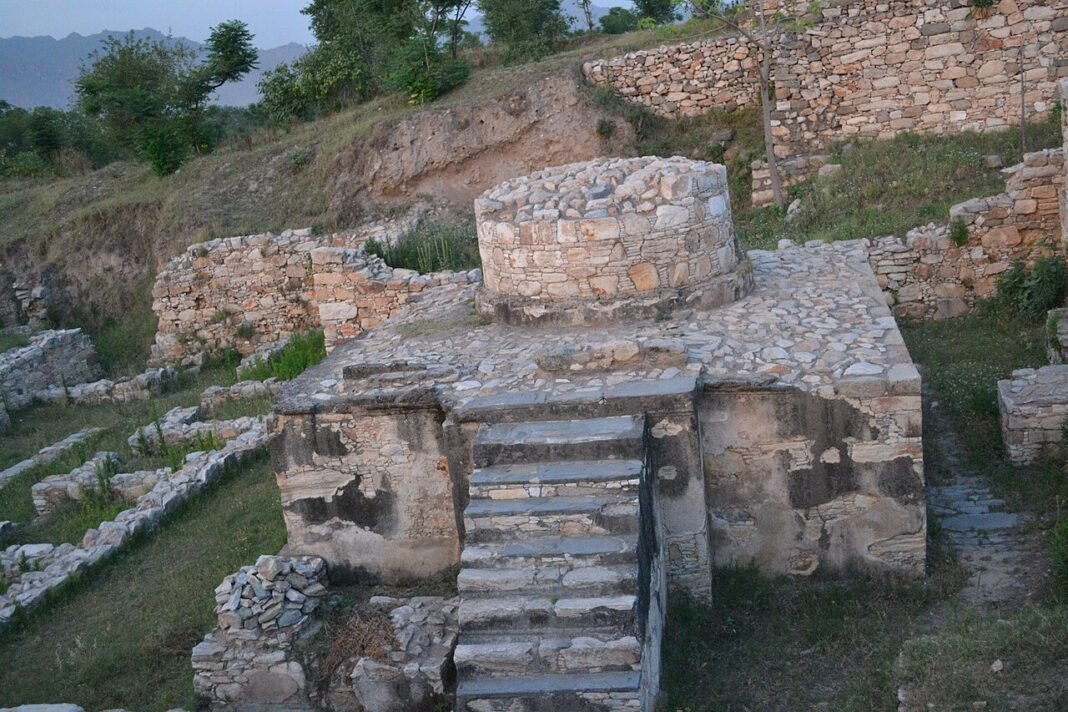
The main experience is simply walking the site. Climb the mound where the great stupa and its three smaller companions were uncovered, and take in the scale of the excavation. The exposed foundations, stair risers, and votive stupas show the layout of a working Buddhist religious complex. The stair risers in particular are worth studying — they carry the refined Gandhara art that made this region famous, blending classical and Indian styles.
Study the Stucco and Sculpture Remains
Look closely at the surviving stucco work and carved panels. The site’s art tells the Buddha’s story in stone and plaster: Queen Maya’s dream, the offering of dust, the worship of relics, episodes from the Jataka tales. Even in their weathered state, these panels connect you directly to the sculptors of the Kushan age. Remember that the finest portable finds — the Bodhisattva heads, the gold coins of Kanishka, the beads — are held in museums, not at the site, so what you see here is the architecture itself.
Visit the Kharoshthi Inscription Context
Aziz Dheri yielded important Kharoshthi inscriptions, the ancient script of Gandhara, which helped archaeologists date the entire site. While the inscriptions themselves are studied in academic publications, knowing their story transforms a walk across the mound: you are walking a site whose history is written not in legends but in dated, excavated evidence.
Combine with Rani Ghat and Asota Megaliths
If you have a full day, add the two remarkable neighbors. The remains at Rani Ghat lie to the north-east of Aziz Dheri, and the megaliths at Asota near Shewa village — about 4 km to the south-west — are a genuinely mysterious sight: two dozen three-metre stones arranged in a circle, protected under the Antiquity Act, with Kushan-period slab graves discovered nearby. Together the three sites give you Buddhist, megalithic, and funerary archaeology in one outing.
Photograph the Plain and the Kara Mar Range
The Kara Mar mountain range rises to the west of the site, and the open plain with its fields and villages makes for atmospheric photography, especially in the soft light of morning or late afternoon. The mound itself, with its exposed brickwork and excavated trenches, photographs best in raking light.
Famous Places In and Around Aziz Dheri, Swabi
- Rani Ghat — Buddhist remains to the north-east of Aziz Dheri, worth combining in one trip.
- Asota Megaliths — about 4 km south-west near Shewa village; 24 large stones in a circle, a prehistoric mystery.
- Swabi city — the district town, useful for food, fuel, and supplies.
- Takht-i-Bahi (Mardan district) — the great UNESCO World Heritage Buddhist monastery complex, further west and the natural companion visit to Aziz Dheri.
- Peshawar Museum — in Peshawar, home to one of the world’s finest Gandhara sculpture collections, the perfect follow-up to seeing the site itself.
How to Reach Aziz Dheri, Swabi
Aziz Dheri is reached by road through the Mardan-Swabi corridor. From Islamabad, take the M-1 motorway toward Peshawar and exit at the Swabi interchange, then drive toward Gohati and the Mardan-Swabi road; the site lies about 12 km from Gohati and roughly 3 km west of Ganghu Dher village, near the Jrando bridge flyover on the main road. The final approach is on village roads, so a car with decent clearance is helpful, though the route is manageable in an ordinary sedan in dry weather.
From Peshawar, take the M-1 motorway east toward Islamabad, exit at Swabi, and follow the same local route via Gohati. From Lahore, the drive runs via the M-2 to Islamabad and then the M-1 to Swabi — a long day’s journey that is best combined with an overnight stay in Swabi, Mardan, or Peshawar. From Karachi, fly to Islamabad or Peshawar and continue by road.
Public transport will get you to Swabi city or Mardan on intercity buses and vans, but the last stretch to the mound is easiest with a hired car or rickshaw from Gohati or the nearby villages. Consider hiring a local driver who knows the village tracks. Mobile navigation will get you close; asking locals for “Aziz Dheri” near Ganghu Dher will get you the rest of the way.
Route Details
- From Islamabad: M-1 motorway to the Swabi interchange, then local roads toward Gohati and the Mardan-Swabi road. The site is about 12 km from Gohati, near the Jrando bridge.
- From Peshawar: M-1 motorway to Swabi, then the same local approach from the east.
- From the Mardan-Swabi road: Look for the Jrando bridge flyover over the canal; the mound is about 11 km north of the bridge, roughly 3 km west of Ganghu Dher village.
- Local tip: Visit in daylight, carry water, and wear sturdy shoes — the mound surface is uneven and there are no visitor facilities at the site.
Where to Stay in Aziz Dheri, Swabi
There is no accommodation at the archaeological site itself — Aziz Dheri is a field monument, not a tourist complex. Plan to stay in Swabi city, which has a range of budget and mid-range hotels and guesthouses catering to business travelers and visitors to the district’s institutions. The options are functional rather than luxurious: clean rooms, attached baths, and straightforward local food.
For more choice, Mardan to the west and Peshawar to the south-west both offer wider selections, from mid-range hotels to better-known chains, and both make reasonable bases for a day trip to the site. Travelers coming from Islamabad sometimes prefer to base themselves in Islamabad or Taxila and visit Swabi as a long day trip. Book ahead only during major local events; on ordinary days, walk-in availability in Swabi is usually fine. For broader trip planning across the region, see the Explore Pakistan section.
Where to Eat: Local Foods of Aziz Dheri, Swabi
You will eat like a local in Swabi — and that is a pleasure. This is Yusufzai Pashtun country, and the food is the hearty cuisine of the region: chapli kebabs (the spiced minced-meat patties Peshawar and its surroundings are famous for), lamb karahi cooked in its own fat with tomatoes and green chilies, Kabuli pulao with carrots and raisins, and rosh — slow-cooked meat that falls off the bone. Fresh tandoori naan and sheer chai or kahwa complete the meal. Roadside dhabas around Swabi and Gohati serve all of this at budget-friendly prices.
There are no restaurants at the archaeological site, so eat in Swabi city or pack food for the outing. If you continue to Mardan or Peshawar, the food scene widens further — Peshawar’s namkeen karahi, dumpukht, and the old city’s sweet shops are worth the detour. Carry drinking water for the site visit, as there are no shops at the mound.
Weather in Aziz Dheri, Swabi
Swabi sits on a low plain, so its climate is much hotter than the mountain valleys to the north. Summers are long and intense, winters are mild and pleasant, and the shoulder seasons are the most comfortable for walking an exposed archaeological mound.
| Season | Temperature Range | Conditions |
|---|---|---|
| Winter (Dec-Feb) | 5-20°C | Mild and sunny; the best season for site visits. Mornings can be foggy on the plain. |
| Spring (Mar-Apr) | 20-32°C | Warm and green; wheat fields around the site are at their most beautiful. Visit in the morning. |
| Summer (May-Aug) | 32-42°C | Hot, with monsoon humidity from July. Visit only very early in the morning; carry water and sun protection. |
| Autumn (Sep-Nov) | 20-33°C | Cooling down; October and November are excellent for archaeology walks. |
Language and Culture of Aziz Dheri, Swabi
Swabi is Yusufzai Pashtun territory, and Pashto is the first language of the villages around Aziz Dheri. Urdu is widely understood, especially by younger people and in Swabi city, and you will manage fine with Urdu and basic English. Some Hindko is also spoken in parts of the district.
The culture is conservative and hospitable in the classic Pashtun pattern. Guests are treated with genuine warmth — the archaeologists who excavated here remarked on the hard work and hospitality of the local people — and visitors who show respect are welcomed warmly. Dress modestly (shalwar kameez is ideal and easily bought locally), ask permission before photographing people, and avoid visiting during Friday prayer hours when villages quieten down. Women travelers should consider traveling with a companion and dressing conservatively; the site itself is open ground with no facilities, so plan accordingly.
Shopping in Aziz Dheri, Swabi
There is no souvenir trade at the archaeological site — and that is part of its charm. For shopping, head into Swabi city’s bazaars, where you will find everyday clothing, Peshawari chappals, local sweets, and dry fruits at honest local prices. The district is agricultural, so fresh produce, honey, and desi ghee are good buys when in season.
If you want Gandhara-themed keepsakes, the better bet is Peshawar, where shops near the old city and museums sell replica sculpture, traditional caps, and handicrafts. Do not buy “ancient” artifacts from anyone near archaeological sites: apart from the legal risk, the trade in looted antiquities is exactly what damaged sites like Aziz Dheri for decades.
Travel Tips for Aziz Dheri, Swabi
Packing Essentials
Sturdy walking shoes, a hat, sunscreen, and plenty of water are essential — the mound is exposed with no shade and no shops. Bring a camera with a zoom lens for detail shots of the brickwork and panels. A printout or offline copy of the site’s background will enrich the visit, since there is no on-site interpretation.
Safety Tips
The area is a quiet rural district and visitors are generally safe, but standard precautions apply: visit in daylight, travel with a companion, keep valuables minimal, and let your hotel know your plans. Do not climb on fragile excavated walls or remove anything — the site is protected, and even picking up a potsherd damages the archaeological record. Stick to paths and be careful on loose rubble.
Money & Connectivity
Carry cash in Pakistani rupees — there are no card facilities anywhere near the site. ATMs are available in Swabi city and Gohati’s commercial areas. Mobile coverage from the major networks is generally good on the plain, though data speeds vary in the villages. Download offline maps before leaving the motorway.
Best Time to Visit Aziz Dheri, Swabi
Winter (December to February) — Best Overall
Mild, sunny days make this the ideal season for walking the mound and combining it with Rani Ghat and the Asota megaliths. Morning fog usually lifts by mid-morning. Carry a light jacket for the early hours.
Spring (March to April) — Excellent
The surrounding wheat fields are green and the weather is warm without being harsh. This is arguably the prettiest time to photograph the site. Start early to make the most of the soft light.
Summer (May to August) — Difficult
Heat makes midday visits punishing, and the exposed mound offers no shade. If summer is your only option, arrive at sunrise, finish by 9 AM, and retreat to Swabi city for the rest of the day.
Autumn (September to November) — Very Good
Temperatures fall back into a comfortable range, the harvest season brings activity to the villages, and October-November offers some of the clearest skies of the year for photography.
Final Thoughts
Aziz Dheri will never be a mass-tourism destination, and that is precisely why it matters. In a country whose Gandhara heritage draws scholars from around the world, this quiet mound in Swabi produced the largest stupa found in the subcontinent — and most Pakistanis have never heard of it. An honest aziz dheri swabi travel guide has to say that visiting requires effort and offers no facilities, but it also offers something the famous sites cannot: the feeling of discovering history for yourself.
Come for the archaeology, stay for the landscape, and leave with a deeper sense of what Gandhara was — not just museum sculptures in Peshawar and Taxila, but living settlements on this plain, where monks once walked and sculptors once carved the Buddha’s story in stone. If you make the trip, you will be among the few travelers who have stood where the subcontinent’s largest stupa was found.
FAQs
Where is Aziz Dheri located?
Aziz Dheri is a Buddhist archaeological mound near Ganghu Dher village in Swabi district, Khyber Pakhtunkhwa — about 12 km from Gohati on the Mardan-Swabi road, near the Jrando bridge.
What is Aziz Dheri famous for?
The 2013 excavations here uncovered the largest Buddhist stupa found in the Indian subcontinent, plus three smaller stupas. The site has also yielded more than 500 sculptures, Kharoshthi inscriptions, and gold coins of the Kushan emperor Kanishka.
How old is the Aziz Dheri site?
The settlement was founded before the Indo-Greek period (over 2,000 years ago), with religious buildings added during the Kushan period. Its cultural layers run continuously into the Islamic era.
How do I reach Aziz Dheri from Islamabad?
Take the M-1 motorway to the Swabi interchange, then drive via Gohati toward the Mardan-Swabi road. The mound is about 12 km from Gohati, roughly 3 km west of Ganghu Dher village. A hired car for the last stretch is recommended.
Is Aziz Dheri safe to visit?
Yes, in daylight with normal precautions. It is a quiet rural area; visit with a companion, carry water, wear sturdy shoes, and do not climb on or remove anything from the protected excavations.
What is the best time to visit Aziz Dheri?
Winter (December to February) and autumn (October-November) offer the most comfortable weather for walking the exposed mound. Avoid midday visits in summer.
Where can I stay near Aziz Dheri?
Swabi city has budget and mid-range hotels and guesthouses. Mardan and Peshawar offer wider choices and work well as bases for a day trip to the site.
What food will I find around Aziz Dheri?
Pashtun cuisine dominates: chapli kebabs, lamb karahi, Kabuli pulao, rosh, and fresh tandoori naan, served at budget-friendly dhabas in Swabi and Gohati. There are no restaurants at the site itself.