Some buildings are old. A very few are witnesses. The Chaqchan Mosque in Khaplu has stood for more than 650 years — since 1370 — watching the people of Baltistan turn from Tibetan Buddhism to Islam, watching empires rise and fall across the Karakoram, and watching, in our own time, travelers from around the world come to stand quietly in its wooden halls. Its name means “the Miraculous Mosque,” and standing before its weathered timber walls with the mountains of Ghanche rising behind, you will understand why.
This chaqchan mosque travel guide is for the traveler who believes that the deepest journeys are through time. Whether you are drawn by sacred architecture, by the story of how Islam came to Baltistan, or simply by the beauty of one of the oldest mosques in Pakistan, Chaqchan rewards the journey to Khaplu many times over. Here is everything you need to plan your visit.
Quick Facts
- Location: Khaplu town, Ghanche district, Gilgit-Baltistan — on the banks of the Shyok River, about 103 km east of Skardu
- Altitude: Around 2,600 metres above sea level
- Famous For: Dating from 1370 CE, one of the oldest mosques in Pakistan; a unique blend of Tibetan, Kashmiri, and Persian architecture
- Nearest City: Skardu, about 103 km west (2.5–3.5 hours by road)
- Accessibility: Paved road from Skardu along the Shyok River; the mosque is in Khaplu town itself, an easy walk
- Known Landmarks: Khaplu Palace (Yabgo Khar), the old Khaplu bazaar, Thoksikhar viewpoint
- Best For: Heritage lovers, architecture enthusiasts, spiritual travelers, photographers, history buffs
Why Visit Chaqchan Mosque
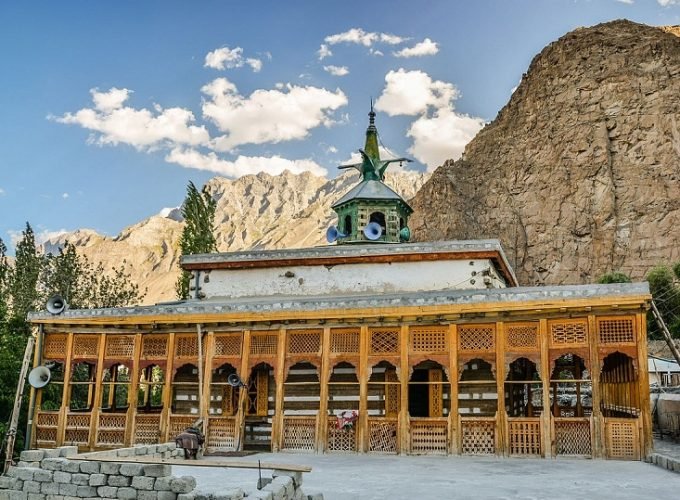
Pakistan has no shortage of beautiful mosques, but Chaqchan belongs to a different category: it is a survivor from the very moment of a civilization’s transformation. Built in 1370, it dates from the era when the people of Baltistan were converting en masse from Tibetan Buddhism to Islam — and its architecture tells that story in wood and stone. The building is a perfect fusion of Tibetan, Kashmiri, and Persian styles: a two-storey timber-and-mud cube that looks as much like a Himalayan monastery as a mosque. There is nothing else quite like it in the country.
The experience of visiting is as moving as the history. The mosque is still active — still in daily use after extensive conservation work, and listed as a Pakistan Heritage Site. You can walk its wooden galleries, study the intricate carvings, and pray where generations of Baltis have prayed for six and a half centuries. Few heritage sites in Pakistan offer that combination: great age, living use, and profound beauty, all in a setting of apricot orchards with Masherbrum on the horizon.
And then there is Khaplu itself, which the Italian explorer Filippo De Filippi called “perhaps the loveliest oasis in all the region” over a century ago — and it still is. A trip to Chaqchan naturally becomes a journey into one of Baltistan’s most beautiful valleys: the royal Khaplu Palace, the old bazaar, the Shyok River gorge. If you are planning a Skardu trip, the road east to Khaplu is the finest day of the whole journey.
History of Chaqchan Mosque
The story of Chaqchan begins in the 14th century, when Sufi missionaries were carrying Islam across the high valleys of Baltistan. According to some accounts, the mosque was built by the great Persian Sufi Mir Sayyid Ali Hamadani, who travelled through Kashmir and Baltistan spreading the faith. Another tradition holds that when the Sufi saint Syed Nurbakhsh arrived from Kashmir and the local ruling Raja accepted Islam, the Raja commissioned the mosque in 1370 CE. Historians note a wrinkle in the second account: the mosque’s dating suggests it was likely built more than two decades before Syed Nurbakhsh was even born — a reminder that the deep history of these valleys still holds mysteries.
What is certain is the era: 1370 CE, a time when Baltistan stood at the hinge between two worlds. The region’s people were turning from Tibetan Buddhism to Islam, and Chaqchan was built to serve the new faith in a architectural language the old world would recognize. Its timber-frame construction, its carved wooden details, its very silhouette all carry the memory of Tibetan building traditions, fused with the new Islamic purpose.
The name “Chaqchan” is traditionally translated as “the Miraculous Mosque,” and local tradition holds the building in special reverence — some accounts even suggest it occupies the site of an earlier Buddhist place of worship, which would make the continuity of sacredness here stretch back even further. In our own time, the Government of Pakistan has listed Chaqchan as a Pakistan Heritage Site, and extensive conservation work has stabilized the ancient structure while keeping it in active use. It remains, as it has been for 650 years, a working mosque of the Noorbakhshia Sufi tradition.
Top Things to Do in Chaqchan Mosque
Study the Timber Architecture
Chaqchan is a masterclass in Himalayan building craft. The mosque is a two-storey cubic complex — a semi-basement, a ground floor, and a turret atop — whose perimeter walls are made of wooden slabs stacked to form a frame, with the spaces daubed with clay and mud. This technique, one of the oldest known methods of making weatherproof structures, is remarkably suited to harsh winters. Walk slowly around the building and look at how the great timber beams lock together without a single nail of modern steel.
Admire the Woodcarving
The carved wooden details — on doors, pillars, balconies, and the open jharoka windows — are among the finest in Baltistan. The carvings blend Buddhist, Sufi, and Islamic motifs, a visual record of the region’s layered faiths. The big open jharokas frame views of the surrounding mountains, so that worshippers pray quite literally surrounded by the Karakoram.
Visit During Prayer Time
Unlike a museum, Chaqchan is alive. Visiting around prayer time lets you experience the mosque as it was meant to be experienced — with the murmur of worship under the ancient timbers. Be respectful: dress modestly, remove your shoes, keep your voice low, and ask permission before photographing people at prayer.
Climb to the Turret Level
The upper storey and turret offer views across Khaplu town, the orchards, and the Shyok valley. The climb is part of the experience — the old wooden staircases and galleries creak with six centuries of footsteps.
Famous Places In and Around Chaqchan Mosque
- Khaplu Palace (Yabgo Khar): The 19th-century royal palace of the Yabgo dynasty, now partly a Serena heritage hotel and museum — a masterpiece of Balti-Tibetan royal architecture, minutes from the mosque.
- Amburiq Mosque (Shigar): A 14th-century mosque near Shigar Fort, built by Iranian craftsmen who travelled with Mir Sayyid Ali Hamadani — the perfect companion visit to Chaqchan.
- Khaplu Bazaar: The old town bazaar, with Balti handicrafts, dried apricots, and everyday mountain life.
- Thoksikhar: The viewpoint above Khaplu town, for the classic panorama of the valley, the Shyok River, and the high peaks.
- Saling Valley: A beautiful side valley near Khaplu, famous for its orchards and organic produce.
- Hushe Valley: The gateway valley for treks toward Masherbrum, K6, K7, and the Gondogoro Pass — for serious mountaineers.
How to Reach Chaqchan Mosque
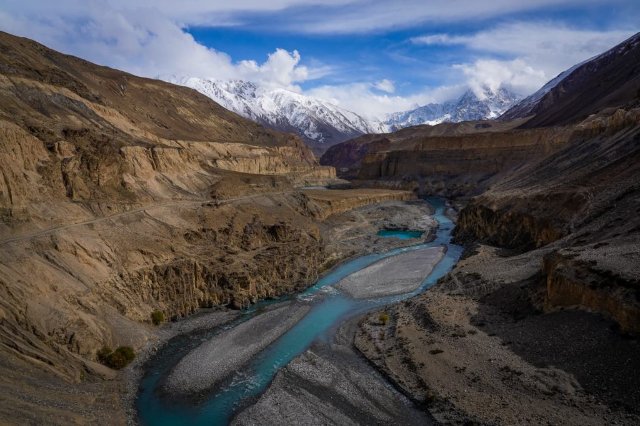
Chaqchan stands in Khaplu town, the headquarters of Ghanche district, about 103 km east of Skardu. The Skardu–Khaplu road follows the Shyok River through a dramatic gorge — one of the great drives of Gilgit-Baltistan — and takes roughly 2.5 to 3.5 hours. The mosque is in the town itself, an easy walk from the bazaar and the palace.
Route Details
From Islamabad: Fly to Skardu (about an hour, with several daily flights) or drive the Karakoram Highway and the Skardu road (roughly 640 km, 14–18 hours). From Skardu, drive east along the Shyok River to Khaplu — 103 km of spectacular mountain road. Many travelers spend a night in Skardu first to acclimatise.
From Lahore: Fly to Islamabad and onward to Skardu, or drive the full route via the M-2, the Karakoram Highway, and Jaglot–Skardu road. The journey is long — plan at least two days of driving — which is why most Lahore travelers fly to Skardu.
From Karachi: Fly to Islamabad and connect to Skardu (or fly Karachi–Lahore–Skardu). The road journey from Karachi is over 1,800 km — flying is the only practical option.
Nearest airport: Skardu International Airport, about 103 km from Khaplu, with regular flights from Islamabad, Lahore, and Karachi. Gilgit Airport is a further alternative, though the Gilgit–Skardu road adds several hours.
Road conditions and transport: The Skardu–Khaplu road has improved greatly in recent years, with long paved sections along the Shyok, though some stretches remain rough — a 4WD is recommended but not always essential in summer. Local buses and shared vans run between Skardu and Khaplu (a few hours, very economical); most tourists hire a private car or jeep. In winter, check road conditions before setting out, as snow can affect the higher sections.
Where to Stay in Chaqchan Mosque
Khaplu offers some of the most characterful accommodation in Gilgit-Baltistan. The standout is the Serena Khaplu Palace itself — the restored 19th-century royal residence, now a heritage hotel where you can sleep in a former palace of the Yabgo Rajas. It is the most atmospheric stay in the valley and worth the splurge if your budget allows.
Beyond the palace, Khaplu town has a range of family-run guesthouses and mid-range hotels, many set among orchards with mountain views. These are comfortable, hospitable, and budget-friendly. Book ahead in the peak summer season (June–August), when Khaplu fills with domestic and foreign tourists. Skardu, 103 km away, offers the full range of hotels for those who prefer to day-trip — though an overnight in Khaplu is far more rewarding.
Where to Eat: Local Foods of Chaqchan Mosque
Balti cuisine is one of Pakistan’s great undiscovered food cultures, and Khaplu is the place to taste it. The local table centers on hearty mountain staples: mamtu (steamed meat dumplings), chapshuro (savoury meat pies), kisir and prapu (buckwheat pancakes and breads), balay (hand-pulled noodle soup), and khambir (stone-baked wholewheat bread). Dairy is everywhere — fresh butter, yoghurt, and cheese from mountain herds.
Khaplu is also orchard country: apricots, apples, mulberries, and cherries in season, plus dried apricots and apricot oil year-round. The town’s small restaurants and hotel dining rooms serve both Balti specialties and standard Pakistani-Chinese fare. A filling local meal is very budget-friendly; the Serena Palace restaurant offers a more refined (and pricier) take on the regional cuisine. Do not leave without trying the fresh apricot juice in summer.
Weather in Chaqchan Mosque
Khaplu sits at about 2,600 metres in the rain shadow of the Karakoram, giving it a dry mountain climate: warm, pleasant summers and cold, snowy winters. Ghanche is known as one of the coldest inhabited places in Pakistan. Here is the seasonal picture:
| Season | Temperature Range | Conditions |
|---|---|---|
| Winter (Dec–Feb) | -10 to -20°C | Cold and snowy; the mosque looks magical in snow, but travel can be difficult. |
| Spring (Mar–Apr) | 5–18°C | Apricot and cherry blossom season; the valley turns pink and white. Exquisite. |
| Summer (May–Sep) | 15–30°C | Warm days, cool nights; orchards in fruit. The prime travel season. |
| Autumn (Oct–Nov) | 0–15°C | Golden poplars, harvest time, crisp air. Beautiful and quieter than summer. |
Language and Culture of Chaqchan Mosque
The people of Khaplu are Balti, speaking the Balti language — a Tibetan dialect written in the Perso-Arabic script — along with Urdu. The valley’s religious life follows the Noorbakhshia Sufi tradition, to which Chaqchan belongs, alongside other communities. Baltis are renowned for their gentleness and hospitality; guests are treated as a blessing.
When visiting the mosque, observe the courtesies of any living place of worship: dress modestly (women should cover their heads), remove shoes before entering, speak quietly, and ask before photographing worshippers. Friday midday prayers are the week’s main congregation — a wonderful time to witness the mosque in full use, but visit as a respectful observer. A small donation to the mosque’s upkeep is a gracious gesture.
Shopping in Chaqchan Mosque
Khaplu’s bazaar is small but rewarding. Look for Balti handicrafts: hand-knitted woolen socks, caps, and shawls; wood carvings; and traditional Balti daggers and ornaments in the older shops. The valley’s dried apricots, apricot oil, and wild mountain honey are the edible souvenirs to carry home — all genuinely local. The shops around the bazaar and near Khaplu Palace stock a good selection. For gemstones and a wider range of northern handicrafts, Skardu’s bazaars offer more choice on your way through.
Travel Tips for Chaqchan Mosque
Packing Essentials
Layers are the rule in the mountains: even summer nights in Khaplu are cool, and spring and autumn demand a proper jacket. Bring sun protection — the high-altitude sun is strong — sturdy walking shoes for the town’s lanes and viewpoints, and a camera with plenty of memory. A shawl or scarf is useful for mosque visits.
Safety Tips
Khaplu is peaceful and very safe for tourists, including families and solo travelers. The usual mountain cautions apply: acclimatise sensibly, stay hydrated, and drive the Shyok road in daylight. Ghanche district is near the Line of Control — carry your CNIC or passport, cooperate at checkpoints, and do not photograph military installations.
Money & Connectivity
Carry cash in rupees — Khaplu has a few ATMs and banks, but they can run dry in peak season, and smaller shops take cash only. Mobile signals from the major networks work in Khaplu town, though data speeds vary and coverage fades quickly outside the town. Download offline maps before leaving Skardu.
Best Time to Visit Chaqchan Mosque
Summer (May–September): The Prime Season
Warm days, open roads, fruit in the orchards, and the mosque at its most accessible. This is when most travelers come, and Khaplu is at its liveliest. Book accommodation ahead.
Spring Blossom (Late March–April): The Most Beautiful
Apricot and cherry blossom transform the valley into a pink-and-white dreamscape, with snow still crowning the peaks. For photographers and romantics, this is arguably the finest fortnight of the year.
Autumn (October–November): Golden and Serene
Poplars turn gold, the harvest comes in, and the summer crowds depart. The light is superb and the valley feels contemplative — a fine season for a spiritual visit.
Winter (December–February): For the Hardy
Deep snow and biting cold, but the mosque under snow is unforgettable, and you will have Khaplu almost to yourself. Only for well-prepared winter travelers; check road access first.
Final Thoughts
There are older buildings in Pakistan, and there are grander mosques. But there is only one Chaqchan: a 14th-century timber mosque where Tibetan craft and Islamic faith became a single architecture, still alive with prayer after 650 years. To stand in its wooden halls is to touch the very moment when Baltistan changed its soul — and to feel, in the quiet, how deeply the mountains keep their memories.
Pair the mosque with Khaplu Palace, the old bazaar, and the Shyok River road, and give the valley at least two days — one is never enough. For more journeys into Pakistan’s sacred and historic places, explore the Explore Pakistan collection and our Hunza Valley guide for the road that leads here.
FAQs
Where is Chaqchan Mosque located?
Chaqchan Mosque is in Khaplu town, Ghanche district, Gilgit-Baltistan — about 103 km east of Skardu, on the road along the Shyok River.
How old is Chaqchan Mosque?
It dates from 1370 CE, making it more than 650 years old and one of the oldest mosques in Pakistan.
What does “Chaqchan” mean?
The name is traditionally translated as “the Miraculous Mosque.”
How do I reach Chaqchan Mosque from Skardu?
Drive east from Skardu along the Shyok River road to Khaplu — 103 km, roughly 2.5 to 3.5 hours by car or jeep. The mosque is in Khaplu town itself.
What is special about the mosque’s architecture?
It blends Tibetan, Kashmiri, and Persian styles: a two-storey timber-frame cube with clay-daubed walls, intricate woodcarving, open jharoka windows, and a turret — built in a technique suited to harsh Himalayan winters.
Is Chaqchan Mosque still in use?
Yes. It is an active mosque of the Noorbakhshia Sufi tradition and a listed Pakistan Heritage Site, conserved while remaining in daily use.
What is the best time to visit?
May to September for the easiest travel; late March to April for the spectacular apricot and cherry blossom; October to November for golden autumn calm.
What else should I see in Khaplu?
Khaplu Palace (Yabgo Khar), the old bazaar, the Thoksikhar viewpoint, Saling Valley, and — with more time — the 14th-century Amburiq Mosque near Shigar.