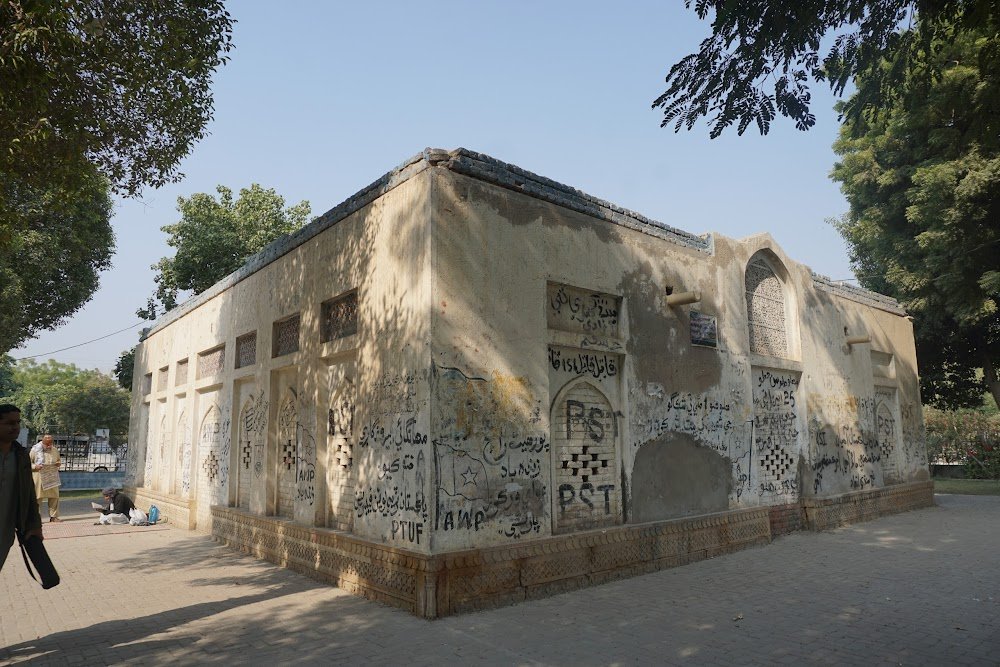
Larkana is famous for Mohenjo-daro, the 5,000-year-old city in its backyard — but the city’s own story lives in a small brick building with arches in the middle of Jinnah Bagh. The Tajjar Building, built in 1832 as the temporary resting place of a Khairpur nobleman’s coffin, has been a royal tomb, a public meeting hall, a colonial-era library, a broadcasting station, and even a canteen — and today it houses Larkana’s City Museum. If you want to understand how layers of Sindhi history stack up in a single place, there is no better classroom. This City Museum / Tajjar Building travel guide will convince you to add it to your Larkana day, and show you when to go and how to make the most of it.
## Quick Facts
– **Location:** inside Jinnah Bagh (historically Tajar Bagh), just southeast of the Town Hall, in the heart of Larkana, Sindh
– **Altitude:** Larkana sits on the flat Indus plain — this is a heritage visit, not a mountain one
– **Famous For:** the 1832 brick mausoleum of Nawab Wali Muhammad Khan Leghari, its arches (tajjar means “arch” in Sindhi), traces of glazed tile work and floral frescoes, and its current role as Larkana’s City Museum
– **Nearest City:** Larkana itself; Sukkur lies to the northeast, and Mohenjo-daro is a short drive to the south
– **Accessibility:** easy — a walk or short rickshaw ride from anywhere in central Larkana; the museum sits in a public garden
– **Known Landmarks:** the Tajjar Building’s 42-by-42-foot brick structure with its central hall and side galleries
– **Best For:** history lovers, architecture enthusiasts, students, families, and anyone pairing Mohenjo-daro with the city’s own heritage
## Why Visit City Museum / Tajjar Building, Larkana
Most visitors blow through Larkana on their way to Mohenjo-daro and never see the city itself — which is a shame, because the Tajjar Building compresses two centuries of Sindh into one small, beautiful structure. Where else can you stand in a room built for a nobleman’s coffin in 1832, that hosted public courts under both Khairpur’s prime minister and British commissioners, that lent books to Larkana’s readers in the 1860s, and that now keeps the city’s museum collections? It is not a grand palace or a sprawling fort. It is something rarer: an ordinary-looking building with an extraordinary biography.
The architecture rewards a slow look. The baked-brick structure — 42 feet square — is all arches, which is exactly what its name means: tajjar is the Sindhi word for arch. Look closely and you can still find traces of the glazed tile work and floral frescoes that once decorated it, faded ghosts of the craftsmanship of the early 19th century. For anyone interested in how buildings adapt and survive, the Tajjar is a masterclass: tomb, court, library, radio station, canteen, museum — each era leaving its mark, some eras taking too much away.
There is also a practical argument. Mohenjo-daro deserves a full morning, and the Tajjar Building fits perfectly into the same day — an hour in the cool of the garden, wandering three rooms of local history, before or after the ancient city. It gives your Larkana trip a second anchor, and it supports the city’s own heritage at a time when old Larkana needs friends. If you care about Pakistan’s built heritage beyond the famous names, this small museum in a garden is exactly the kind of place your visit helps keep alive.
## History of City Museum / Tajjar Building, Larkana
The story begins with a death. Nawab Wali Muhammad Khan Leghari — a prominent nobleman who served as prime minister of the Khairpur state — died in 1832, and his coffin was placed temporarily (as an amanat, a trust) in a garden in Larkana. Over his grave, the small brick Tajjar Building was constructed: 42 feet by 42 feet of baked brick, with a central hall and galleries, decorated with glazed tiles and floral fresco paintings. The coffin remained there for about five years before his son, Nawab Ahmed Khan, had the remains transferred to Hyderabad, where the Nawab was finally buried in the family’s ancestral graveyard.
But the building stayed, and Larkana kept finding uses for it. Before his death, Nawab Leghari himself had used it as a public meeting place, and British officials continued the tradition of holding kachehris (public courts) there well into the colonial era. In 1864, the Commissioner of Sindh established a library in the building — the Giles Library, with a public reading room that, by later accounts, held more than a thousand books and welcomed members of every community for a modest fee. For decades it was one of Larkana’s windows onto the wider world of letters.
The 20th century was less kind. The building served at various times as a local broadcasting station and — remarkably — as a canteen, and successive rounds of alteration stripped away much of its original grandeur. Restoration efforts began during Zulfikar Ali Bhutto’s government in the 1970s, and on 20 May 1980 the Tajjar Building was declared a protected monument under the Antiquities Act of 1975; its care was formally handed to the archaeology authorities in 1981. Today it serves as Larkana’s City Museum under the Sindh Antiquities department — three rooms (a central hall with a gallery on each side) holding the city’s smaller histories, with traces of those original tiles and frescoes still visible to the careful eye. The garden around it, Jinnah Bagh, was itself laid out in the Kalhora era as Tajar Bagh, making the whole compound older than the building at its heart.
## Top Things to Do in City Museum / Tajjar Building, Larkana
### Study the Arches That Gave It Its Name
Start with the architecture. Walk slowly around the 42-foot-square exterior and count the arches — tajjar means “arch” in Sindhi, and the building wears its name honestly. The baked-brick construction, the proportions of the central hall (about 14 by 38 feet) with its flanking galleries, and the rhythm of the openings are a fine example of early-19th-century Sindhi building craft. It is a small structure; that is the point. Great architecture does not have to be enormous.
### Hunt for the Faded Frescoes and Tile Work
Inside, look closely at the walls. Traces of the original glazed tile work and floral fresco paintings survive in patches — faded, damaged by centuries of reuse, but unmistakably the work of skilled hands. Finding them feels like a small act of archaeology in itself, and it tells you more about what the building once was than any plaque could. Photography is usually fine, but avoid flash on the old surfaces and ask the caretaker if you are unsure.
### Explore the City Museum’s Three Rooms
The museum occupies the central hall with a gallery on each side — compact enough to see properly in under an hour, which makes it ideal for families and for fitting into a Mohenjo-daro day. The displays cover Larkana’s local history and archaeology: the kind of smaller, regional collections that national museums overlook. Take your time with the labels; regional museums reward readers. If a caretaker or guide is present, ask questions — the oral history around this building is half the exhibit.
### Walk Jinnah Bagh
The garden containing the museum — historically Tajar Bagh, laid out in the Kalhora era — is one of old Larkana’s surviving green spaces. Stroll it in the late afternoon when the light softens and the city comes out to walk. It is a pleasant, shaded counterpoint to the intensity of a Mohenjo-daro morning, and a reminder of how much of historic Larkana’s garden heritage has already been lost to encroachment.
### Pair It With Mohenjo-daro
The essential Larkana day: Mohenjo-daro in the cool of the morning (the ruins, the site museum, the Great Bath and the street grid of the 5,000-year-old Indus city), lunch and rest through the midday heat, then the Tajjar Building and Jinnah Bagh in the late afternoon. The two sites are a perfect dialogue — one the ancient Indus civilization, the other the layered history of the living city that grew up in its shadow.
### Famous Places In and Around the Tajjar Building
– **Mohenjo-daro** — the UNESCO World Heritage Indus Valley city, a short drive south of Larkana; the reason most travelers come, and rightly so.
– **Garhi Khuda Bakhsh** — the Bhutto family mausoleum, a major site of modern political history; see our Garhi Khuda Bakhsh travel guide.
– **Jhukar-jo-Daro** — an ancient mound site about 8 kilometres from Larkana on the Larkana-Karachi road, for archaeology enthusiasts.
– **Larkana’s old bazaars** — for ajrak, Sindhi embroidery, and the everyday life of Upper Sindh.
– **The Indus riverbank** — the great river that made this whole region, best at sunset.
## How to Reach City Museum / Tajjar Building, Larkana
The Tajjar Building is the easiest destination in this guide to reach: it sits in Jinnah Bagh, southeast of the Town Hall, in central Larkana. From anywhere in the city, it is a short rickshaw or taxi ride — just ask for Jinnah Bagh or the City Museum; every local driver knows it. If you are staying near the city centre, it is walkable in the cooler months.
Getting to **Larkana** itself is a road journey. From **Karachi**, the route runs north via Hyderabad and Dadu along the Indus Highway — a long day’s drive through the heart of Sindh. Comfortable coach services connect Karachi and Larkana, and many travelers do it overnight. From **Islamabad** or **Lahore**, the practical option is to fly to Sukkur or Karachi and continue by road; the nearest airports with regular service are at Sukkur and Karachi, with Mohenjo-daro’s small airport offering only limited flights. From **Sukkur**, Larkana is a straightforward drive to the southwest.
Once in Larkana, local transport is simple: auto-rickshaws and Qingqi rickshaws go everywhere cheaply, and ride-hailing works in the city centre. For Mohenjo-daro, hire a rickshaw or taxi for the half-day trip — agree on the fare and waiting time before you set off.
### Route Details
1. **Reach Larkana** — by road from Karachi (full-day drive or overnight coach) or from Sukkur; by air to Sukkur/Karachi plus road from Islamabad or Lahore.
2. **Base yourself in central Larkana** — mid-range hotels cluster near the main roads and bazaar.
3. **Morning: Mohenjo-daro** — drive south to the ruins and site museum in the cool early hours.
4. **Midday: rest** — Larkana’s summer heat is serious; eat, hydrate, and wait out the worst of it.
5. **Late afternoon: Tajjar Building** — rickshaw to Jinnah Bagh, tour the museum’s three rooms, walk the garden.
6. **Evening: bazaar and dinner** — finish with Larkana’s markets and a proper Sindhi meal.
## Where to Stay in City Museum / Tajjar Building, Larkana
Larkana is a working city, not a tourist town, so its hotels serve business travelers and wedding parties — which means good value and no pretension. Mid-range hotels on and around the main roads offer clean air-conditioned rooms, attached baths, and usually a restaurant; this is the sweet spot for most visitors. Budget guesthouses near the bazaar and bus stands are plentiful and very affordable, though simpler. A small number of better-appointed hotels cater to those who want more comfort.
You do not need to stay long: one or two nights covers Mohenjo-daro, the Tajjar Building, and Garhi Khuda Bakhsh comfortably. Book ahead only if you are visiting during a major political anniversary at Garhi Khuda Bakhsh, when the city fills. As ever in Sindh’s interior, confirm that your hotel has reliable air-conditioning if you are visiting outside winter — you will need it.
## Where to Eat: Local Foods of City Museum / Tajjar Building, Larkana
Upper Sindh eats well, and Larkana’s food is unapologetically desi. The dish to seek out is **sai bhaji** — the classic Sindhi slow-cooked spinach, lentil, and vegetable medley, eaten with steaming rice or bhuga chawal. **Daal chawal** in its Sindhi avatar, **Sindhi biryani**, and fresh **river fish** from the Indus (ask what the catch of the day is) anchor the local menu. For breakfast, find a dhaba doing **halwa puri** or fresh tandoori parathas with doodh patti. Wash it down with **lassi**, and save room for **mithai** — Larkana’s sweet shops do a brisk trade, and rightly so.
Eat where the locals eat: the bazaar-area dhabas and family restaurants serve generous portions at genuinely budget-friendly prices — a full, filling meal at a local eatery costs little by city standards. Hotel restaurants charge more for more comfort. Street snacks — samosas, pakoras, fresh sugarcane juice in season — fill the gaps between meals. For food inspiration from across the country, browse our Explore Pakistan collection.
## Weather in Larkana
Larkana has one of the most extreme climates of any major Pakistani city: ferociously hot summers and short, mild winters, with very little rain. Summer daytime temperatures routinely cross 43 to 46°C in May and June, and the heat is humid as well as fierce — this is not a place to sightsee at noon in June. Winter, from December to February, is the reward: dry, sunny days in the low to mid-20s and cool nights. A brief monsoon influence brings some rain in July and August, but Larkana stays far drier than the coast. The rule for visiting is simple: winter for comfort, and if you must come in summer, do everything before 10 AM or after 5 PM.
| Season | Temperature Range | Conditions |
|—|—|—|
| Winter (Dec-Feb) | 8 to 25°C | Dry, sunny, and ideal; cool nights; the best season for the museum, Mohenjo-daro, and walking the city |
| Spring (Mar-Apr) | 21 to 40°C | Warming rapidly; March is still pleasant, April turns fierce |
| Summer (May-Jul) | 30 to 46°C | Extreme heat and humidity; sightsee only in early morning or late evening; hydrate constantly |
| Monsoon (Aug-Sep) | 28 to 41°C | Hot and humid with occasional rain; slightly cooler than peak summer but still demanding |
| Autumn (Oct-Nov) | 21 to 39°C | Cooling down; November becomes genuinely pleasant and the crowds are thin |
## Language and Culture of Larkana
**Sindhi** is the mother tongue and the soul of Larkana — you will hear it in the bazaars, the dhabas, and the rickshaws, with Urdu understood everywhere. This is Upper Sindh, where traditional culture is worn daily rather than saved for festivals: the **ajrak** shawl over shoulders, the embroidered **Sindhi topi**, and a Sufi-inflected warmth toward guests. Larkana’s hospitality is direct and proud — people will ask where you are from and launch happily into history, politics, and poetry.
A few cultural notes for visitors. Dress modestly — Larkana is a conservative city, and loose clothing covering arms and legs earns easy respect. If your visit coincides with a religious observance or a political gathering at Garhi Khuda Bakhsh, follow local guidance on access and photography. At the museum, the usual courtesies apply: quiet voices, no touching exhibits, ask before photographing people. And accept the tea when it is offered — in Sindh, refusing hospitality is the only real faux pas.
## Shopping in Larkana
Larkana’s bazaars are the real thing: busy, local, and free of tourist markup. The signature buy is **ajrak** — the block-printed shawl of Sindh, made in grades from everyday cotton to fine pieces worth keeping for years. **Sindhi embroidery** — mirror work, appliqué, and intricate stitching on suits, cushion covers, and wall hangings — is widely available and very reasonably priced at source. Potters and sweet-makers ply their trades in the older markets, and the dry-fruit and spice sections of the bazaar are worth a wander.
There are no verifiable large tourist shopping malls in Larkana, and you will not miss them — the bazaar is the experience. Bargain politely; carry cash, as card acceptance is limited; and if you are buying ajrak as a gift, ask the shopkeeper to show you the difference between hand-blocked and machine-printed pieces. It is a small education in itself.
## Travel Tips for City Museum / Tajjar Building, Larkana
### Packing Essentials
For a winter visit (recommended): light layers, a jacket for cool evenings, comfortable walking shoes for the ruins and the garden, sun protection, and a reusable water bottle. For summer: the lightest, loosest cotton you own, a wide-brimmed hat, strong sunscreen, sunglasses, oral rehydration salts, and a water bottle you refill constantly. Year-round: modest clothing, a small daypack, and a power bank. If Mohenjo-daro is on your itinerary, add a hat with a strap — the site is completely exposed.
### Safety Tips
Larkana is a busy, working city and normal urban awareness applies: keep valuables discreet, use registered transport at night, and stay in well-trafficked areas after dark. The far bigger risk is the **heat** — summer temperatures here hospitalize the unprepared every year. Never start a Mohenjo-daro walk at midday in summer, drink water before you feel thirsty, and know the signs of heat exhaustion. At the museum and garden, the risks are minimal; standard heritage-site manners suffice. For a complete contrast on your next trip — snow instead of sun — our Malam Jabba travel guide covers the mountains of Swat.
### Money & Connectivity
Larkana is a cash city: ATMs exist but can run dry, and small shops, rickshaws, and dhabas are cash-only, so carry enough rupees for your stay. All major Pakistani mobile networks cover the city well, and 4G data is generally reliable — a welcome contrast to the remoter destinations in this series. Hotels usually offer Wi-Fi of varying quality. Keep small change handy for rickshaws and the bazaar.
## Best Time to Visit City Museum / Tajjar Building, Larkana
### Winter (November to March) — The Season
This is when Larkana is at its best: dry sunshine, daytime temperatures in the comfortable 20s, and cool nights. November through February is ideal for combining the Tajjar Building with Mohenjo-daro and Garhi Khuda Bakhsh — you can walk the ruins at 10 AM without suffering and stroll Jinnah Bagh at sunset in a light jacket. If you have any flexibility, put Larkana in these months.
### Spring Shoulder (March to April) — Still Possible
March remains pleasant; by April the heat is building toward 40°C and midday sightseeing becomes punishing. Early starts salvage the season.
### Summer and Monsoon (May to September) — Avoid If You Can
With daytime highs of 41 to 46°C and stifling humidity, this is the hardest season in one of Pakistan’s hottest cities. If you must visit, restrict all outdoor sightseeing to dawn and dusk, and treat the midday hours as sacred indoor time.
## Final Thoughts
The Tajjar Building will never compete with Mohenjo-daro for grandeur, and it does not try to. Its power is quieter: a small brick building that has been a tomb, a court, a library, a radio station, a canteen, and now a museum — two hundred years of Larkana’s life under one 42-foot roof. In an hour among its arches and faded frescoes, you learn something the grand sites cannot teach: how ordinary places carry extraordinary histories, if someone bothers to keep them.
So when you plan the Larkana trip — and if you love Pakistan’s heritage, you should — give Mohenjo-daro its morning, and give the Tajjar Building its afternoon. Walk the garden, find the traces of tile work, read the small museum’s labels slowly. Some destinations impress you; this one quietly earns your respect. That is rarer, and worth the journey.
## FAQs
**Where is the Tajjar Building / City Museum?**
Inside Jinnah Bagh (historically Tajar Bagh), just southeast of the Town Hall in central Larkana, Sindh. It is a short rickshaw ride or walk from anywhere in the city centre.
**What is the best time to visit Larkana?**
November to March, when days are dry and comfortable (roughly 8 to 25°C). Avoid May to September, when temperatures reach 41 to 46°C with oppressive humidity.
**What is the history of the Tajjar Building?**
Built in 1832 as the temporary resting place of Nawab Wali Muhammad Khan Leghari’s coffin, it later served as a public meeting hall, a colonial-era library (from 1864), a broadcasting station, and a canteen. Declared a protected monument in 1980, it now houses Larkana’s City Museum under the Sindh Antiquities department.
**What does “Tajjar” mean?**
Tajjar is the Sindhi word for “arch” — the building is named for its many arches. The 42-by-42-foot baked-brick structure centres on a hall with galleries on each side.
**How much time do I need at the City Museum?**
Under an hour for the three rooms, plus time to walk Jinnah Bagh. It pairs perfectly with a Mohenjo-daro morning in a single Larkana day.
**How do I reach Larkana?**
By road from Karachi (a full-day drive or overnight coach via Hyderabad and Dadu) or from Sukkur; from Islamabad or Lahore, fly to Sukkur or Karachi and continue by road. The museum is in central Larkana, easily reached by rickshaw.
**Is the Tajjar Building suitable for families?**
Yes — it is a compact, shaded, easy visit in a public garden, ideal for children and older travelers. Combine it with the bazaar for a relaxed family afternoon.
**What else should I see in Larkana?**
Mohenjo-daro (the Indus Valley World Heritage site), the Bhutto family mausoleum at Garhi Khuda Bakhsh, the Jhukar-jo-Daro mound, and Larkana’s old bazaars for ajrak and Sindhi handicrafts.