Some destinations impress you with scale; others move you with story. Dera Baba Bhuman Shah, in the quiet village of Bhuman Shah near Depalpur in Punjab’s Okara district, is firmly the second kind. Behind its fort-like walls stands one of the great Sikh heritage complexes of Pakistan — a gurdwara with jewel-like frescoes, the residence of a saint revered by Sikhs, Hindus, and Muslims alike, samadhis of mahants, and hundreds of rooms that once fed hundreds of people a day from an endless langar. If you are a heritage traveler, a Sikh pilgrim tracing sacred geography, or simply someone who believes Pakistan’s old shrines deserve to be seen before they fade, this Dera Baba Bhuman Shah Bhuman Shah travel guide is for you.
Baba Bhuman Shah (1687–1762) was an Udasi Sikh sadhu whose compassion crossed every religious line — Muslim landlords gifted him a village, and his langar famously never ran dry. His dera grew into a palatial complex: a grand gurdwara dedicated to Baba Sri Chand with painted walls narrating Sikh tradition, domed memorials, prayer halls, and a great tank. Today the complex is weathered and waiting for the restoration it deserves, which makes visiting now both a privilege and, in a small way, an act of witness. Come for the architecture, stay for the stories, and leave understanding a chapter of Punjab that textbooks rarely teach.
This guide covers the dera’s remarkable history, what to see inside, how to reach Bhuman Shah from Lahore, Islamabad, and Karachi, where to stay, what to eat, weather, language and culture, shopping, and practical tips for a respectful heritage visit.
Quick Facts
- Location: Village Bhuman Shah, Tehsil Depalpur, District Okara, Punjab, Pakistan
- Altitude: Around 170 meters (560 feet) — Punjab plains
- Famous For: The fort-like dera of Baba Bhuman Shah (1687–1762); the frescoed Gurdwara of Baba Sri Chand; Sikh heritage and the legendary endless langar
- Nearest City: Depalpur (about 20–25 km); Okara and Pakpattan nearby; Lahore about 150 km away
- Accessibility: By road via the Depalpur–Haveli Lakha road; best reached by private car or hired taxi from Lahore, Okara, or Depalpur
- Known Landmarks: Gurdwara Baba Sri Chand, the haveli-style residence, samadhis of the mahants, the dera tank
- Best For: Sikh heritage pilgrims, history lovers, architecture photographers, and cultural travelers
Why Visit Dera Baba Bhuman Shah, Bhuman Shah
Visit because this is one of the most significant — and least visited — Sikh heritage sites in Pakistan. While pilgrims flock to Nankana Sahib and Kartarpur, the dera of Baba Bhuman Shah waits quietly in the Okara countryside, holding some of the finest surviving Sikh fresco work in the country. The painted walls of the Gurdwara of Baba Sri Chand narrate stories from Sikh tradition in vivid color, framed by floral motifs and the sayings of the Gurus. For anyone interested in the art and architecture of Punjab’s Sikh heritage, it is a revelation.
Visit, too, for the story of the man himself. Baba Bhuman Shah was that rarest of figures: a saint claimed by everyone. Born in 1687 in Behlolpur near Depalpur, this Udasi sadhu became legendary for miracles of compassion — bringing comfort to the suffering, reviving lost crops, feeding the poor without pause. When the Muslim landlord Chaudhry Lakha Wattu was freed from prison after his mother sought the Baba’s blessings, the grateful family gifted him an entire village. That village is Bhuman Shah, and the dera rose at its heart. In a region too often divided by faith, the dera stands as a monument to a Punjab where devotion crossed every line.
And visit now, because the complex needs friends. Under the care of the Evacuee Trust Property Board, the buildings have weathered hard decades — cracked walls, collapsed roofs — and heritage voices have long called for conservation. Travelers who come with respect, who photograph and share and ask after the site’s future, are part of keeping its memory alive. Pair this journey with our Explore Pakistan heritage collection for more of Punjab’s sacred geography.
History of Dera Baba Bhuman Shah, Bhuman Shah
The history of the dera begins with Baba Bhuman Shah himself, born in 1687 in the village of Behlolpur near Depalpur. A sadhu of the Udasi sect of Sikhs — a tradition that was hugely influential across 19th-century Punjab — he became renowned for spiritual teaching wrapped in practical compassion: his langar, the free community kitchen, was said to flow endlessly, feeding hundreds of people every day of the year regardless of faith. Tradition holds that Guru Gobind Singh himself blessed Bhai Bhuman Shah that his langar would continue serving — a blessing the dera honored for generations.
The most famous story attached to the saint concerns Chaudhry Lakha Wattu, a Muslim landlord arrested by the governor of Punjab. His mother sought Baba Bhuman Shah’s blessings for her son’s release; when the blessings bore fruit, Lakha Wattu and his tribesmen were so grateful that they gifted the Baba an entire village for his religious work. That village took his name — Bhuman Shah — and became the seat of his dera.
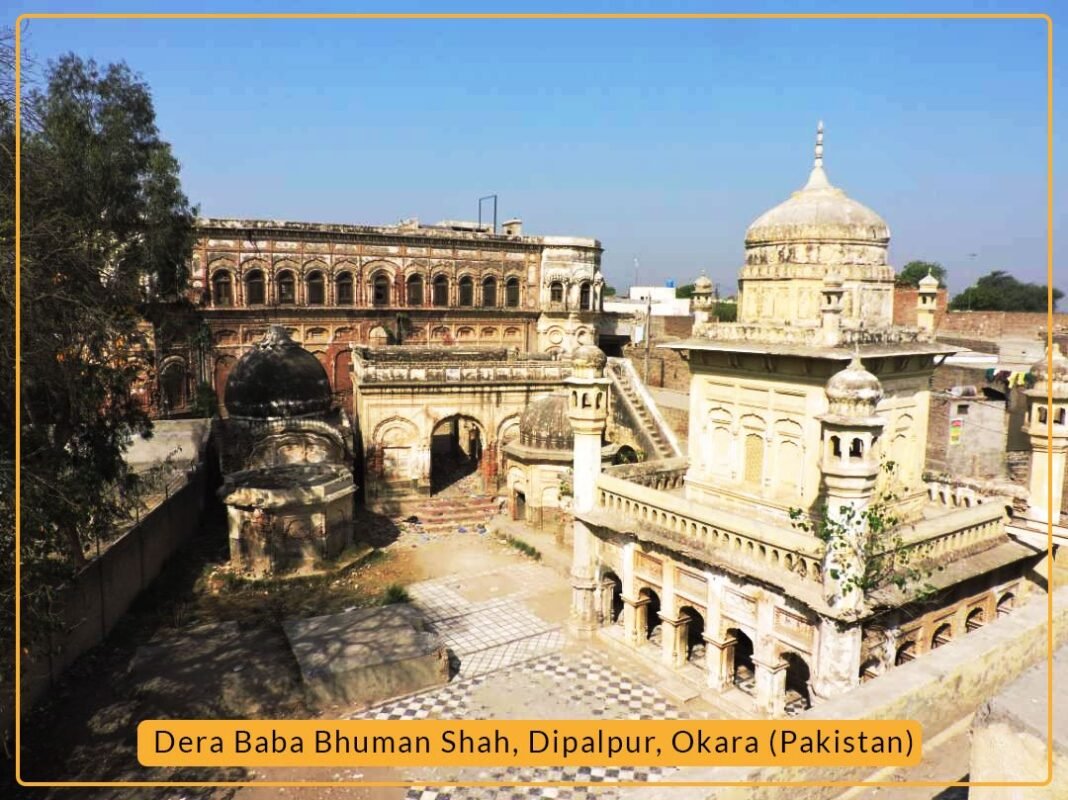
Over the 18th and 19th centuries the dera grew into a palatial complex built like a great fort, with four big gates. Inside the walls rose the double-storeyed Gurdwara of Baba Sri Chand — the present richly decorated structure was built by Mahant Harbhajan Das in Samvat 1967 (1910 AD), with a beautiful Diwan hall and domed Prakashasthan — alongside the Baba’s residence, the samadhis of successive mahants, prayer halls, hundreds of rooms for visitors and pilgrims, the langarkhana, and a great tank. More than a thousand ghumaon of agricultural land were endowed to support it. An annual fair once drew thousands of devotees to Bhuman Shah, and the dera was among the most important Udasi centers in Punjab.
Partition in 1947 broke the dera’s living tradition. Mahant Girdhari Das, who was serving at the dera, had to leave with the departing Sikh community, and the dera re-established itself at Sangar Sadha village in Sirsa district, across the new border in India. The Pakistani complex passed into the care of the Evacuee Trust Property Board. Without its resident community, the buildings declined: today visitors find a magnificent but fragile complex — cracked walls, collapsed roofs, fading frescoes — and a growing call from historians and heritage lovers for the conservation this treasure deserves before more of it is lost.
Top Things to Do in Dera Baba Bhuman Shah, Bhuman Shah
Enter Through the Great Gates
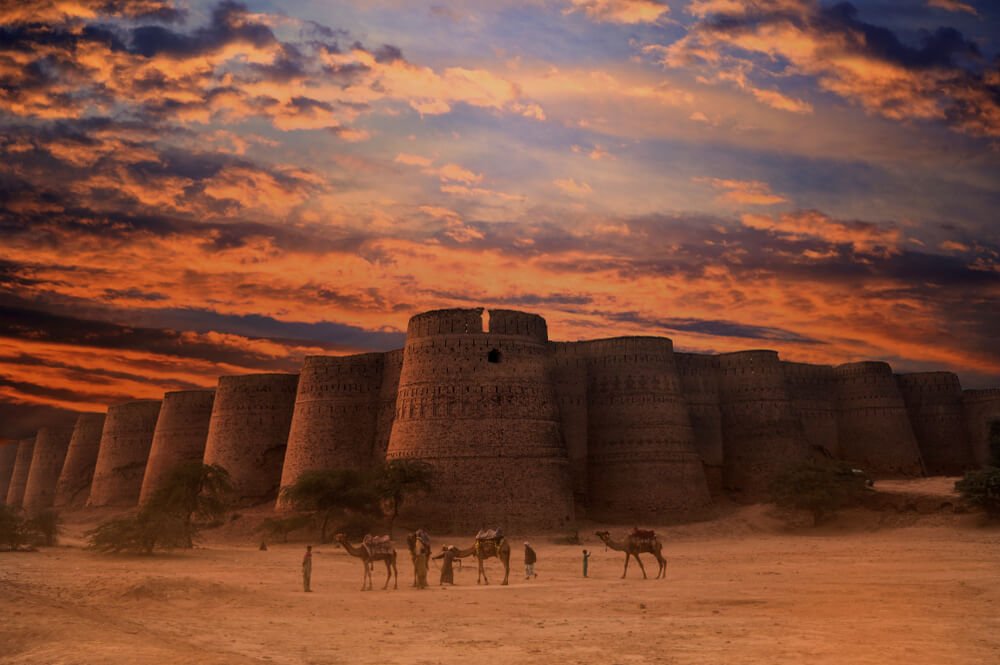
The dera announces itself like a fortress: massive walls and four great gates enclosing an entire world within. Walk the perimeter first to grasp the scale — this was not a single shrine but a self-contained religious township, with room for hundreds of pilgrims, kitchens that fed hundreds daily, and farmland to sustain it all.
Study the Frescoes of Gurdwara Baba Sri Chand
The artistic heart of the complex is the double-storeyed gurdwara built in 1910. Its walls carry elaborate frescoes depicting stories from Sikh tradition alongside floral motifs, while inscriptions preserve sayings of the Gurus. Bring a good camera and a patient eye: the Diwan hall and the domed Prakashasthan reward slow looking, and every wall is a page of Punjab’s visual history.
Visit the Samadhis of the Mahants
The memorials of the dera’s successive leaders stand within the complex — domed samadhis that trace the lineage of the Udasi tradition at Bhuman Shah. They are quiet, poignant places, and a reminder that this was a living institution for over two centuries.
Walk the Haveli and Residential Quarters
Beyond the gurdwara, explore the Baba’s residence, the prayer halls, and the long ranges of rooms that once housed pilgrims. The scale of the hospitality here — hundreds of rooms, a dedicated langarkhana, the great tank — tells you how central the dera was to the religious life of the region.
Reflect at the Tank
The dera’s tank, like the sacred pools of other Sikh shrines, was the ritual and communal heart of the complex. Even in its quiet present state, it is a place for reflection on the centuries of devotion these waters have witnessed.
Meet the Village
Bhuman Shah village itself is part of the experience. The dera gave the village its name and its story; walking its lanes, accepting a cup of tea, and hearing what the elders remember adds a living dimension no guidebook can provide.
Famous Places In and Around Dera Baba Bhuman Shah, Bhuman Shah
- Gurdwara Baba Sri Chand — 1910 double-storeyed gurdwara with frescoed walls, the complex’s crown jewel
- Residence of Baba Bhuman Shah — the haveli-style quarters of the saint
- Samadhis of the mahants — domed memorials of the dera’s lineage
- Depalpur — historic tehsil town, about 20–25 km away
- Pakpattan — shrine city of Baba Fariduddin Ganjshakar, about 40 km away
- Haveli Lakha — nearby town on the same road
- Okara — district city with bazaars and services
How to Reach Dera Baba Bhuman Shah, Bhuman Shah
The dera is reached by road through the Punjab countryside — a straightforward journey, but one that needs private transport, as public options to the village itself are limited.
From Lahore: The dera is about 150 km from Lahore (roughly 3 hours by car). Take Multan Road (N-5) south toward Okara/Depalpur, then follow the Depalpur–Haveli Lakha road to Bhuman Shah village. Hiring a car with a driver for the day from Lahore is the most comfortable option.
From Islamabad: Drive the M-2 Motorway to Lahore (about 380 km, 4–4.5 hours), then continue south as above — a full day’s journey of roughly 7–8 hours. Alternatively, take the train or Daewoo bus to Okara or Sahiwal and hire a local taxi for the last stretch.
From Karachi: Fly to Lahore (about 1 hour 40 minutes) and continue by road. The overland journey is over 1,000 km and best broken with stops.
Nearest stations and airports: The nearest practical railheads are Okara and Sahiwal on the main Karachi–Lahore line; the nearest airport is Allama Iqbal International Airport, Lahore.
Road conditions: The N-5 and the Depalpur-area roads are paved and fine for cars year-round, though village approach roads can be rough. Travel in daylight, carry water, and download offline maps — signage to the village is modest.
Route Details
- Base yourself in Lahore, Okara, or Sahiwal the night before.
- Drive south from Lahore on Multan Road (N-5) toward Okara and Depalpur (about 2.5–3 hours to the Depalpur area).
- Turn onto the Depalpur–Haveli Lakha road and follow it to Bhuman Shah village (about 20–25 km from Depalpur).
- Ask locally for the dera — everyone in the area knows “Baba Bhuman Shah da dera.”
- Allow 2–3 hours to explore the complex on foot, plus time for the village.
- Combine with Pakpattan (Baba Farid’s shrine, about 40 km) for a full Sufi-and-Sikh heritage day.
Where to Stay in Dera Baba Bhuman Shah, Bhuman Shah
Bhuman Shah is a village — there are no hotels at the dera itself. Plan to stay in a nearby town and visit on a day trip.
Mid-range: Okara and Sahiwal, both within reasonable driving distance, have the area’s best mid-range hotels with air-conditioning, attached baths, and restaurants. Sahiwal, the divisional city, offers the widest choice.
Budget: Depalpur and the smaller towns have simple budget hotels and guesthouses — basic but functional, and they put you closest to the dera for an early start.
Luxury: For full comfort, base yourself in Lahore (about 3 hours away) at the city’s five-star and boutique hotels, and do Bhuman Shah as a long day trip — easily combined with Pakpattan.
Tips: If you want sunrise or sunset light on the frescoes, stay in Depalpur or Okara the night before. Confirm air-conditioning in summer, and carry cash — small-town ATMs can be unreliable.
Where to Eat: Local Foods of Dera Baba Bhuman Shah, Bhuman Shah
This is the Punjab countryside, and the food is the honest, ghee-rich village fare the region is loved for.
Must-try dishes: Sarson da saag with makki di roti in winter, dal fry and desi chicken curries, fresh lassi churned the same morning, and kheer or gulab jamun from a town sweet shop. The dhabas along the N-5 serve some of the best roadside food in Punjab — charpoy seating, tandoor-fresh naan, and endless chai.
Where to eat: Eat in Depalpur, Okara, or at the highway dhabas en route. There are no restaurants at the dera itself, so carry water and snacks for the visit. If village families offer food, accept graciously — Punjabi hospitality is the real thing.
Costs: Village and dhaba meals are very budget-friendly — a hearty meal typically costs a few hundred rupees per person. Town restaurants cost a little more. Carry cash; cards are rarely accepted outside the cities.
Weather in Dera Baba Bhuman Shah, Bhuman Shah
Bhuman Shah shares the Okara plains’ classic Punjab climate: fiercely hot summers, a humid monsoon, and cool, foggy winters. The dera is an entirely outdoor visit — courtyards, rooftops, and lanes — so season matters.
| Season | Temperature Range | Conditions |
|---|---|---|
| Winter (Dec–Feb) | 5–18°C | Cool and pleasant days; cold nights; morning fog common |
| Spring (Mar–Apr) | 18–35°C | Warm and bright; good for exploring |
| Summer (May–Jun) | 32–45°C | Very hot; visit early morning or late afternoon only |
| Monsoon (Jul–Sep) | 30–40°C | Hot and humid with rain spells; old structures can be slippery |
| Autumn (Oct–Nov) | 15–32°C | Mild and dry — the best season for heritage visits |
October to November and February to March are the sweet spots: comfortable walking weather and clear light for the frescoes. In summer, aim for a 7–10 AM visit and be done before the heat builds.
Language and Culture of Dera Baba Bhuman Shah, Bhuman Shah
The village speaks Punjabi (the Majhi dialect of central Punjab), with Urdu widely understood. A greeting of “Assalam-o-Alaikum” — or “Sat Sri Akaal” when addressing Sikh heritage with reverence — opens doors and smiles.
Culturally, you are visiting a Sikh sacred site in a Muslim-majority village, and that layered identity deserves thoughtful respect. The dera is no longer an active gurdwara, but it remains a place of deep religious significance: keep your head covered inside the gurdwara buildings as you would at any Sikh shrine, remove shoes where custom suggests, speak quietly, and do not climb on fragile structures or touch the frescoes — oils from hands damage old paint. Dress modestly, ask before photographing people, and remember you are a guest in both a heritage site and a living village.
The story of Baba Bhuman Shah himself — revered across faiths — is the culture here: ask the elders about him and you will hear pride that transcends religion. For more Sikh heritage in Punjab, see our Explore Pakistan collection.
Shopping in Dera Baba Bhuman Shah, Bhuman Shah
This is not a shopping destination — it is a pilgrimage into heritage. But the surrounding towns offer authentic Punjabi market experiences.
Depalpur and Okara bazaars: Traditional markets selling khaddar cloth, Punjabi jutti shoes, steel and brass utensils, and farm-fresh produce. Okara district is known for its dairy country — pick up fresh desi ghee and khoya sweets if you can carry them.
Souvenirs: The most meaningful souvenirs here are photographs and knowledge — but Punjabi handicrafts, embroidered fabrics, and phulkari-style textiles from Okara’s markets make lovely keepsakes. Bargain politely.
Note: There are no malls or tourist shops at the dera; this is village Punjab at its most authentic. For modern shopping, Lahore’s malls are a day trip away.
Travel Tips for Dera Baba Bhuman Shah, Bhuman Shah
Packing Essentials
A head covering (scarf or cap) for the gurdwara buildings, comfortable walking shoes (uneven old floors), sunscreen and a hat, drinking water and snacks, a fully charged camera, and a power bank — there is nowhere to recharge at the site.
Safety Tips
The area is rural and generally safe for daytime visitors, but the old buildings are fragile: watch your step on damaged floors and staircases, do not enter structures with visibly collapsed roofs, and keep children close. Travel in daylight, let your hotel know your plans, and consider hiring a local guide from Depalpur who knows the complex.
Money & Connectivity
Carry all cash in rupees — there are no ATMs or card facilities at the village. Mobile signals (Jazz, Telenor, Zong, Ufone) generally reach the area, though data can be patchy inside the thick old walls. Download offline maps before you leave the highway.
Best Time to Visit Dera Baba Bhuman Shah, Bhuman Shah
October to November — Ideal
Mild, dry days and golden light on the old brickwork and frescoes. The most comfortable season for exploring the courtyards and climbing to the upper levels.
December to February — Cool and Clear
Crisp winter days made for heritage walks, with the countryside green from the rains. Mornings can be foggy — plan to arrive late morning for the best light and visibility.
March to April — Spring’s Window
Warm but manageable, with long days. A fine shoulder season before the summer furnace switches on.
May to September — Hot Season
Summer heat and monsoon humidity make midday visits grueling, and rain can make old floors slippery. If you must come now, visit at dawn, carry plenty of water, and wear a hat.
Final Thoughts
Dera Baba Bhuman Shah is the kind of place that stays with you precisely because it asks for nothing and offers so much: a saint’s story that crossed every boundary, a fortress of faith with painted walls, a village that still carries his name three centuries on. It is also a reminder that heritage is fragile — the cracked walls and fallen roofs are an invitation, not just a lament. Go, see, photograph, remember, and tell others.
Heritage travel in Punjab is full of such quiet giants, and this dera is among the most moving. Plan it as a day trip from Lahore or Okara, pair it with Pakpattan’s Sufi shrines, and keep exploring the region’s sacred geography with our Explore Pakistan guides.
FAQs
Where is Dera Baba Bhuman Shah located?
In the village of Bhuman Shah, Tehsil Depalpur, District Okara, Punjab — about 20–25 km from Depalpur on the Depalpur–Haveli Lakha road, and about 150 km from Lahore.
Who was Baba Bhuman Shah?
An Udasi Sikh sadhu (1687–1762), born near Depalpur, revered by Sikhs, Hindus, and Muslims alike for his compassion and his famously endless langar (free community kitchen).
What is the best time to visit?
October to November and February to March offer the most comfortable weather. Winter days are also pleasant; avoid midday in the May–September heat.
How do I reach Bhuman Shah from Lahore?
Drive about 150 km (3 hours) south on Multan Road (N-5) toward Depalpur, then take the Depalpur–Haveli Lakha road to the village. A hired car with driver is the easiest option.
Is the dera an active gurdwara?
No — the living dera moved to Sangar Sadha in India’s Sirsa district after Partition in 1947. The Pakistani complex is a heritage site under the Evacuee Trust Property Board; visit with the respect due a sacred place.
Is it safe for families?
Yes, for a daytime visit. The main cautions are the fragile old buildings — supervise children, avoid damaged structures, and wear sturdy shoes.
What should I wear and bring?
Modest clothing, a head covering for the gurdwara buildings, comfortable shoes, water, snacks, and a camera. Carry cash; there are no shops or ATMs at the site.
Why is the building in poor condition?
After the resident Sikh community left in 1947, the complex lost its living custodians. Decades of limited maintenance have left cracked walls and collapsed roofs — which is why heritage advocates call for its conservation, and why visiting now matters.