Quick Facts
- Location: Extreme north of the Kaghan Valley, Mansehra District, Khyber Pakhtunkhwa, Pakistan — inside Lulusar-Dudipatsar National Park
- Altitude: Around 3,800 metres (about 12,500 feet) above sea level
- Famous For: Being called the “Queen of Lakes” — mirror-still turquoise water ringed by snow-covered peaks
- Nearest City: Naran (about 40 km to the Besal trailhead, then a full day’s trek)
- Accessibility: Road to Besal (jeep from Naran), then a 17–19 km trek each way; no road reaches the lake; accessible roughly June to September only
- Known Landmarks: The lake itself, the Mulla ki Basti campsite on the trail, the surrounding 4,800-metre peaks
- Best For: Serious trekkers, adventure travelers, wilderness campers, landscape photographers, and anyone who wants Pakistan’s wildest alpine lake
Why Visit Dudipatsar Lake
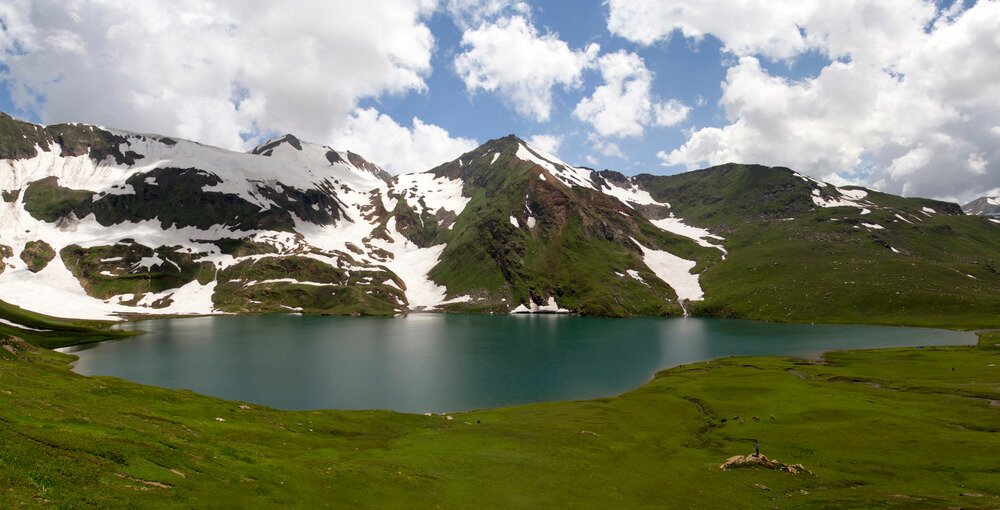
Some lakes you drive to. Dudipatsar Lake you earn. Hidden at around 3,800 metres in the far north of the Kaghan Valley, inside the Lulusar-Dudipatsar National Park, this is the lake that Pakistani trekkers speak about in lowered voices — the “Queen of Lakes,” a sheet of greenish-blue water so still on a calm morning that the snow peaks around it reflect perfectly, doubling the mountains. There are more famous lakes in Pakistan. There is no wilder one.
The name tells you everything: in the local tongue, “dudi” means white, “pat” means mountains, and “sar” means lake — the lake of the white mountains, named for the snow that crowns the peaks ringing it. On a clear summer day the water is a milky turquoise, cold enough to numb your fingers in seconds, set in a vast glacier-carved bowl where the surrounding ridges average around 4,800 metres. Marmots whistle from the boulders. Snow partridges call from the slopes. And because reaching it demands a genuine trek — 17 to 19 kilometres each way from the village of Besal — the crowds that choke easier lakes simply never arrive. A Dudipatsar Lake travel guide has to be straight with you: this trip will test your legs and your lungs. It will also give you one of the finest mountain days of your life.
Dudipatsar is perfect for a particular kind of traveler. If you have trekked before and want Pakistan’s definitive alpine-lake expedition, this is it. If you are a photographer, the mirror reflections at dawn are the stuff of portfolios. If you camp, the night skies here — far from any town’s glow — are among the darkest and clearest in the country. And if you simply want to know what the Himalaya feels like when the road ends and the trail begins, the walk from Besal through the golden meadows of Mulla ki Basti to the lake’s shore is the answer. This is not a picnic spot. It is an adventure, and that is exactly the point.
A word of honest framing: Dudipatsar is a summer-only, weather-dependent, physically demanding destination with no facilities at the lake — no hotels, no restaurants, no rescue post. You go with a guide, good boots, and respect for the altitude. Travelers who accept those terms are rewarded with something increasingly rare: a great natural wonder that still feels undiscovered.
History of Dudipatsar Lake
Dudipatsar Lake has no ancient temples on its shores and no recorded battles beneath its peaks — its history is the history of the high Kaghan itself. For centuries these upper valleys belonged to the Gujjar herders who moved their livestock to the summer pastures, and to the scattered mountain communities who lived by grazing, foraging, and trade across the passes. The lake’s very name, rooted in the local mountain vocabulary, suggests it was known to herders long before it was known to travelers: the white-mountains lake, a landmark on the summer grazing rounds.
The wider region carries deeper historical echoes. Nearby Lulusar Lake marks the place where, in the aftermath of the 1857 War of Independence, 55 participants of the uprising were arrested — a reminder that these remote valleys were never quite as isolated from history as they look. The Kaghan Valley as a whole was mapped, photographed, and written about by British-era travelers, but Dudipatsar’s remoteness kept it off the itineraries; even today it is described as one of Pakistan’s least-visited major lakes.
Modern history arrived abruptly. The devastating earthquake of 8 October 2005 damaged roads and infrastructure across the Kaghan Valley and made the already difficult access to Dudipatsar harder still. In response, the government announced in March 2006 a program to restore tourism in the valley, including rebuilding and new tourism facilities — part of the long, slow work of opening the high Kaghan to travelers. In 2003, the lake and its surroundings gained formal protection with the creation of the Lulusar-Dudipatsar National Park, which together with the adjacent Saiful Muluk National Park now protects some 88,000 hectares of Himalayan ecosystem. Dudipatsar’s history, then, is a short one on paper — but the lake itself, carved by glaciers and guarded by 4,800-metre peaks, is ancient beyond any record.
Top Things to Do in Dudipatsar Lake
Trek from Besal to the Lake
The trek is the experience. Starting from Besal — a small settlement at about 3,250 metres, roughly 40 km beyond Naran — the trail runs 17 to 19 kilometres each way through some of the finest alpine country in Pakistan. The route follows the valley past the Mulla ki Basti campsite, crossing streams and climbing through vast meadows that glow gold-green in late summer, with wildflowers scattered across the slopes. Expect 6 to 9 hours of walking each way depending on fitness, with real elevation gain along the way. Most trekkers do it over two or three days: trek in, camp near the lake, and trek out. Hire a local guide and porters at Besal — the trail is unmarked in places, river crossings can be tricky after rain, and the weather at 3,800 metres changes fast. This is a moderate-to-hard trek: you need stamina, proper boots, and a healthy respect for altitude.
Witness the Mirror Reflections at Dawn
If you camp near the lake, set your alarm before sunrise. On calm mornings Dudipatsar lives up to its legend: the water turns to glass and the snow peaks reflect so perfectly that it is hard to tell where the mountains end and the lake begins. This is the photograph every trekker comes for, and it lasts only until the morning breeze ripples the surface. Walk the shoreline slowly, find your angle, and take your time — you earned this view.
Camp Under Himalayan Skies
There is no accommodation at Dudipatsar Lake — camping is the only option, and it is magnificent. The meadows near the lake offer flat ground for tents, and the night sky at 3,800 metres, far from any artificial light, is dense with stars. Nights are cold even in August, often dropping near freezing, so bring a proper four-season sleeping bag and a warm tent. Camp on durable ground away from the water’s edge, carry out everything you carry in, and keep noise down — this is a national park, and the wildlife was here first.
Spot Marmots, Snow Partridges, and More
The Lulusar-Dudipatsar National Park protects a genuine Himalayan ecosystem. Himalayan marmots are the stars — plump, whistling, and surprisingly bold around the boulders near the trail. Snow partridges and snowcocks call from the upper slopes, and lucky, quiet trekkers have reported ibex on the ridges; the park is also home to black bear, lynx, weasel, and, very rarely, the snow leopard. Dawn and dusk are the best hours. Watch from a distance, never feed wildlife, and store food securely at camp.
Fish for Trout (Responsibly)
Dudipatsar’s waters once held abundant trout, though illegal fishing with dynamite and nets has sadly reduced stocks. Angling may be possible with proper permits — check current regulations with park authorities and local guides before you go, and practice strict catch-and-release if you fish at all. The lake’s ecology is fragile; the future of its trout depends on visitors who respect the rules.
Extend to Lulusar Lake and Babusar
Dudipatsar sits inside a national park named for two lakes — the other being Lulusar, the principal headwaters of the Kunhar River, about 48 km from Naran on the Naran–Babusar road. Lulusar is reachable by road and makes a natural add-on, as does the Babusar Top pass at the head of the valley. Together they form a superb high-Kaghan circuit: road-accessible wonders by day, wilderness trekking at Dudipatsar.
Famous Places In and Around Dudipatsar Lake
- Lulusar Lake — the park’s other namesake lake and source of the Kunhar River, reachable by road on the Naran–Babusar route.
- Mulla ki Basti — the traditional campsite on the Dudipatsar trail, set in sweeping alpine meadows.
- Besal — the trailhead village at 3,250 metres, with basic guesthouses and where guides and porters are hired.
- Lake Saif ul Maluk — Kaghan’s most famous lake, in the adjacent national park near Naran.
- Ansoo Lake — the remote tear-shaped lake also reached from the upper Kaghan, for trekkers wanting more.
- Naran bazaar — the valley’s main town and supply base, with hotels, restaurants, and gear shops.
How to Reach Dudipatsar Lake
Every Dudipatsar journey starts with the long road to Naran and ends with your own two feet. There is no shortcut — and that is what keeps the lake wild.
From Islamabad: Drive to Naran via the Hazara Expressway and Balakot — roughly 280 kilometres, 7 to 8 hours by road. From Naran, hire a jeep for the 40 km onward to Besal (about 2 hours on the mountain road toward Babusar). From Besal, the trek begins: 17 to 19 km each way to the lake.
From Lahore: Take the motorway to Islamabad (4.5 to 5 hours), then follow the Islamabad route. Most Lahore travelers overnight in Naran before starting the trek.
From Karachi: Fly to Islamabad and continue by road. The overland journey from Karachi is not practical for a trekking trip.
Nearest airport: Islamabad International Airport.
Road conditions: The road to Naran is good in season. Naran to Besal requires a jeep — the track is rough and can be affected by landslides. The Babusar Pass route (usually open June to October) is the standard approach. Beyond Besal there is no road at all: only the trekking trail, which is snowbound roughly October through May.
Route Details
- Islamabad → Naran via Hazara Expressway and Balakot (7–8 hours); overnight in Naran.
- Naran → Besal by hired jeep, 40 km (about 2 hours); arrange guide and porters at Besal.
- Besal → Mulla ki Basti → Dudipatsar Lake on foot, 17–19 km (6–9 hours); camp near the lake.
- Return the same way, or split the return with a night at Mulla ki Basti. Carry all food, water treatment, and camping gear — there are no facilities on the trail or at the lake.
Where to Stay in Dudipatsar Lake
Let’s be clear: there are no hotels at Dudipatsar Lake, and that is non-negotiable. You sleep in a tent, and you carry it in. The meadows near the lake provide natural campsites — choose flat, durable ground well back from the water, and follow strict leave-no-trace practice in this national park.
Your supported nights are at either end of the trek. Naran town has dozens of hotels and guesthouses across budget tiers, from basic rooms to comfortable mid-range options — book ahead in July and August, when the valley is at its busiest. At Besal, the trailhead, accommodation is basic: simple guesthouses and campsites catering to trekkers, plus parking for your jeep. Many trekking groups also use the Mulla ki Basti meadows as an intermediate camp to split the long trail. If you are going with an organized trekking company, they will typically arrange tents, food, and porters — for most visitors, this is the sensible and safest way to do Dudipatsar.
Where to Eat: Local Foods of Dudipatsar Lake
On the trail and at the lake, you eat what you carry — there are no restaurants beyond Besal. Pack high-energy trekking food: dried fruit, nuts, biscuits, energy bars, instant noodles, and plenty of water plus purification tablets (stream water looks pristine but should be treated). Your guide or trekking company will usually arrange a cook and a kitchen tent for multi-day trips, serving the hearty trekker’s staples: daal, rice, rotis, and endless chai.
In Naran, fuel up properly before and after the trek. The town’s restaurants serve fresh trout from the Kunhar River — grilled or fried, it is the valley’s signature dish — alongside mountain staples like makai ki roti with saag, daal chawal, and chicken karahi. A good restaurant meal in Naran is budget-friendly, and the dhabas near the bazaar do filling breakfasts of parathas, omelettes, and doodh patti. Eat well in town; the trail will demand it.
Weather in Dudipatsar Lake
Dudipatsar’s weather is the weather of the high Himalaya compressed into a four-month window. The lake is snowbound and inaccessible roughly October through May; the season runs June to late September, with July to September the reliable core. Even in midsummer, nights at 3,800 metres hover near freezing, afternoon thunderstorms can build with little warning, and snow is possible in any month. Check forecasts obsessively, start trekking early each day, and be ready to turn back if the weather closes in — the mountains will still be there next year.
| Season | Temperature Range | Conditions |
|---|---|---|
| Winter (Oct–May) | -15 to 0°C | Deep snow; the lake and trail are completely inaccessible |
| Early Summer (Jun) | 0 to 12°C | Snow melting, trail opening; streams high, patches of snow on the route |
| Peak Season (Jul–Sep) | 2 to 18°C | Best trekking weather; warm days, cold nights; meadows in full bloom; occasional afternoon storms |
| Autumn (late Sep) | -5 to 10°C | Golden meadows, crisp air; season ending as snow returns to the heights |
Language and Culture of Dudipatsar Lake
The Kaghan Valley is a linguistic mosaic: Hindko is widely spoken in the lower valley, while Gojri, Shina, and Kohistani are heard in the upper reaches around Besal and the grazing settlements. Urdu works everywhere as the bridge language, and the guides and porters at Besal are accustomed to working with visitors from across Pakistan and abroad. The mountain culture here is shaped by the Gujjar herding tradition and by Islam — conservative, hospitable, and deeply tied to the seasons.
On the trail, cultural respect takes practical forms: dress modestly even when trekking, ask before photographing herders and their families, and accept the rules of the national park as the price of admission to a protected wilderness. Do not leave litter — carry out every wrapper, bottle, and battery. The growing popularity of the Dudipatsar trek makes each visitor’s conduct matter more, not less.
Shopping in Dudipatsar Lake
There is nothing to buy on the trail — and nothing you need. Do your shopping in Naran bazaar before you set out: dried fruits and nuts for the trek, walnuts and pine nuts from the valley, wild honey, and warm woollen caps, gloves, and shawls knitted for mountain cold. Naran’s shops also stock basic trekking supplies, though serious gear is better bought in Islamabad or Lahore. There are no shopping malls anywhere near Dudipatsar Lake; the only things worth taking home from the lake itself are photographs and the memory of that mirror-still water.
Travel Tips for Dudipatsar Lake
Packing Essentials
This is a serious mountain trek — pack like one. Four-season sleeping bag, sturdy waterproof tent, broken-in trekking boots with ankle support, warm layers including a down or synthetic insulated jacket, waterproof shell, thermal base layers, warm hat and gloves, sunscreen and sunglasses (UV is fierce at 3,800 metres), headlamp with spare batteries, water purification, a comprehensive first-aid kit with altitude-sickness medication (consult your doctor), and twice the snacks you think you need. A trekking pole saves knees on the long descents.
Safety Tips
Never attempt Dudipatsar alone — go with a local guide who knows the trail, the river crossings, and the weather signs. Acclimatize: spend a night in Naran before pushing to Besal and the lake. Watch for altitude sickness (headache, nausea, dizziness) and descend if symptoms worsen. Start early each day to avoid afternoon storms, keep to the trail, and carry a satellite communicator or inform reliable contacts of your itinerary — there is no mobile signal on much of the route. Register your plans with your hotel or trekking company.
Money & Connectivity
Carry all the cash you will need in Pakistani rupees — withdraw in Islamabad, Mansehra, or Naran, as there are no ATMs beyond Naran and none on the trail. Pay your guide and porters fairly and agree on terms at Besal before setting out. Mobile signals fade beyond Besal; download offline maps and carry a power bank. Connectivity returns in Naran.
Best Time to Visit Dudipatsar Lake
July to September — The Trekking Window
The only reliable season. The trail is clear of snow, the meadows are at their greenest, wildflowers bloom across the slopes, and the lake shows its famous mirror reflections. August is the peak month — book Naran accommodation and Besal guides ahead. This is when a Dudipatsar Lake travel guide can promise the full experience.
June — The Early Season
The trail usually opens in June, but expect snow patches, higher streams, and colder nights. For experienced trekkers who don’t mind the extra challenge, June offers solitude the peak months can’t match.
October to May — Closed
Snow closes the trail and the lake. Not accessible, not safe, not an option — plan for summer.
Final Thoughts
Dudipatsar Lake does not try to please everyone, and that is its greatness. It asks for fitness, planning, and humility in the face of real mountains — and it repays all three with interest. The moment the lake first appears through the notch in the ridge, turquoise and impossibly still beneath its white mountains, you will understand why those who have been there speak of it the way they do. Few places in Pakistan feel this untouched. Fewer still make you work this honestly for the privilege.
If the high Kaghan is calling, answer it properly: train your legs, hire a good guide, watch the weather, and give the Queen of Lakes the respect she deserves. Pair the trek with Babusar Top and the meadows of Naran, and find more wild corners of the country in our Explore Pakistan collection.
FAQs
Where is Dudipatsar Lake located?
In the extreme north of the Kaghan Valley, Mansehra District, Khyber Pakhtunkhwa, inside the Lulusar-Dudipatsar National Park, at about 3,800 metres above sea level.
What is the best time to visit Dudipatsar Lake?
July to September, when the trekking trail from Besal is clear of snow. The lake is inaccessible roughly October through May.
How do I reach Dudipatsar Lake?
Drive from Islamabad to Naran (7–8 hours), take a jeep to Besal (40 km), then trek 17–19 km each way to the lake — typically a 2–3 day round trip with camping.
How difficult is the Dudipatsar trek?
Moderate to hard: 6–9 hours of walking each way with significant elevation gain at high altitude. Good fitness, proper gear, and a local guide are essential.
Is Dudipatsar Lake safe for tourists?
With a guide, proper preparation, and good weather, yes. The risks are natural — altitude, weather, and remoteness — so never trek alone and always check conditions.
Can families visit Dudipatsar Lake?
It suits fit teenagers and adults with trekking experience; it is not suitable for small children or anyone with heart or altitude-related health issues. Naran and Lulusar Lake are better family options.
Where can I stay near Dudipatsar Lake?
There is no accommodation at the lake — you camp. Naran has hotels across budgets, and Besal has basic guesthouses at the trailhead.
What does “Dudipatsar” mean?
“Dudi” means white, “pat” means mountains, and “sar” means lake — the lake of the white mountains, named for the snow-covered peaks reflected in its waters.