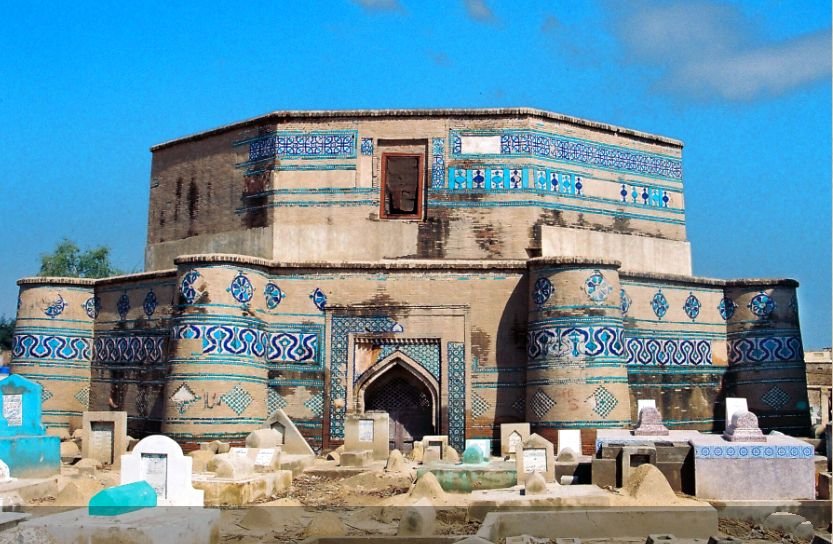
Southern Punjab does not shout for attention the way the northern mountains do, but it rewards the travelers who listen. In the heart of Dera Ghazi Khan city stands a weathered monument that gave the entire city its name: the tomb of Ghazi Khan Mirani, a 15th-century Baloch ruler whose resting place has watched over this corner of the Indus plain for more than five hundred years. It is the oldest building in the city, an octagonal structure wrapped in blue enamel tiles, ringed by conical minarets and holding eleven graves of the Mirani family.
This Ghazi Khan’s Tomb travel guide will help you decide whether this quiet heritage stop deserves a place on your itinerary. If you are a history lover driving between Multan and the Sulaiman mountains, a photographer hunting for blue-tile architecture beyond Multan’s famous shrines, or a traveler who simply wants to stand where the story of Dera Ghazi Khan began, the answer is yes.
Quick Facts
- Location: Mulla Quaid Shah Graveyard, Dera Ghazi Khan city, Punjab, Pakistan
- Altitude: around 120 meters above sea level (the tomb stands on the flat Indus plain)
- Famous For: the oldest building in Dera Ghazi Khan; the mausoleum of the ruler the city is named after; 15th-century blue tilework
- Nearest City: Multan, around 85 km to the east
- Accessibility: easy road access on the N-70 through DG Khan city; reachable by car, van, or local transport; no hiking involved
- Known Landmarks: the octagonal tomb itself, the surrounding historic graveyard, Ghazi Ghat on the Indus
- Best For: history enthusiasts, architecture fans, cultural travelers, photographers, and road-trippers passing through southern Punjab
Why Visit Ghazi Khan’s Tomb
Every Pakistani city has a founding story, but very few let you walk into it. In Dera Ghazi Khan, you can. The tomb of Ghazi Khan Mirani is not just another old monument on a list — it is the reason the city exists. When Haji Khan Mirani settled this stretch of the Indus bank in 1476 and named his new town after his son Ghazi Khan, he planted a flag that still flies in the city’s name more than five centuries later. Standing before the tomb, with its faded blue tiles and corner minarets, you are standing at the first page of that story.
The architecture is the real draw for design-minded travelers. The tomb was built in 1494 and modeled on the celebrated shrines of Multan — travelers have long compared it to the tomb of Shah Rukn-e-Alam. Its exterior was once decorated with beautiful enameled tiles in blue and Persian blue, arranged in geometric and floral patterns, with conical turrets rising at the corners. Five hundred years of sun, flood, and neglect have softened that glory, but the bones of the design are unmistakable, and for photographers the contrast between the blue tilework and the plain desert-colored brick is quietly stunning.
This is also one of the most accessible heritage stops in Pakistan. The tomb sits inside the city itself, in the Mulla Quaid Shah Graveyard, not at the end of a jeep track or behind a ticketed fortress. You can pair it in a single day with the shrine of Sakhi Sarwar, the Indus riverfront at Ghazi Ghat, and the climb up to Fort Munro, the hill station that looms over the city to the west. For travelers exploring the Explore Pakistan collection of destinations, Ghazi Khan’s Tomb is the perfect anchor for a southern Punjab circuit that most tourists never attempt.
Honesty matters in this guide: the tomb is in a fragile state. A Dawn report in recent years described it as deteriorating, with broken windows and thorny bushes placed to keep out intruders. Restoration work by the archaeology department, completed in 2012-13 at a cost of around Rs4.5 million, stabilized parts of the structure, but activists continue to raise their voices for its preservation. Visiting is therefore not just sightseeing — it is a small act of witness for a monument that needs Pakistan to remember it.
History of Ghazi Khan’s Tomb
The story begins in the late 15th century, when Sultan Hussain of the Langah dynasty of Multan, unable to hold his trans-Indus possessions, called in Baloch mercenaries and assigned these territories to Haji Khan Mirani. Haji Khan, a Baloch chieftain of the Dodai clan, moved toward the Indus with his son Ghazi Khan and founded a settlement on the western bank of the river around 1476. Local history once credited Ghazi Khan with founding the city, but the historian M. Y. Qaisrani clarified to Dawn that it was Haji Khan who founded the town and named it after his son — Dera Ghazi Khan, “the camp of Ghazi Khan.” Together with Dera Ismail Khan and Dera Fateh Khan, the settlement gave its name to the whole Derajat region.
Ghazi Khan succeeded his father and ruled the area from 1476 until his death in 1495. The tomb itself was built in 1494 — the date is written on the structure at village Choratta — and Ghazi Khan is believed to have commissioned it to bury his father, though he himself was later laid to rest there along with other members of the Mirani family. Historian Qaisrani notes that fifteen generations of the Miranis ruled Dera Ghazi Khan, seven of them bearing the name Haji Khan and eight the name Ghazi Khan, and the tomb holds eleven graves of the family, though their commemorative inscriptions are missing.
Locally the tomb is called the “handeera” in Balochi. It was built to resemble the great tombs of Multan, and a graveyard gradually grew up around it until the monument stood at the heart of the Mulla Quaid Shah Graveyard. The old city around it was devastated by flash floods when the Indus overflowed in 1908, and the British rebuilt Dera Ghazi Khan on its present site in 1910 — which is why the centuries-old tomb now sits inside the modern city rather than outside it. The region passed into British hands after the Sikh War in 1849 and was declared a district that same year.
Architecturally, the tomb carries the scars of its long life. The original dome collapsed at some point in the past, and the British government laid the simple flat wooden and iron roof truss that survives today — a roof that is itself now around 150 years old and preserved as part of the monument’s layered history. Inside, Quranic verses are engraved on the arches, and 28 steps rise along the northern side of the interior. The main chamber sits about two meters below the surrounding ground level, sunk by the growth of the modern graveyard around it. Conservation plans have been drawn up more than once, with experts recommending plinth protection to stop seepage, and the 2012-13 restoration repaired and cleaned the structure. Yet the monument remains fragile, and its blue tiles continue to fade a little more each summer.
Top Things to Do in Ghazi Khan’s Tomb
Study the Blue Tilework
Walk slowly around the exterior and look closely at the enameled tiles. The geometric and floral patterns in blue and Persian blue are the tomb’s signature feature, directly echoing the shrine architecture of Multan. Morning light is best for photography — the tiles catch the early sun before the heat of the day bleaches everything white.
Count the Minarets and Read the Geometry
The tomb’s octagonal form with conical corner minarets is unusual and worth a careful look. Each side of the structure measures around 13 feet 3 inches from the inside, and the minarets rise to about 19 feet. The symmetry of the design becomes obvious once you stand at one of the corner axes — a detail architecture students and photographers both appreciate.
Descend into the Burial Chamber
Step through the eastern entrance (with its two large side windows to the north and south) and descend into the main chamber, which lies about two meters below the surrounding graveyard level. Eleven graves of the Mirani family rest here, including that of Ghazi Khan himself. The engraved Quranic verses on the interior arches are best viewed with a flashlight in the late afternoon.
Walk the Old Graveyard
The Mulla Quaid Shah Graveyard that grew up around the tomb is itself a historical landscape. Wandering its lanes gives you a sense of how the monument functioned as the spiritual center of the old city for generations — the city’s oldest building anchoring centuries of burials.
Visit the Tomb with a Guide
A local guide or a knowledgeable elder from the area can tell you the story the plaque gets wrong. Dawn reporting noted that the information plaque installed at the monument contains incorrect historical details, so the real stories — the fifteen generations of Miranis, the handeera name, the British roof — come alive through people, not signboards.
Famous Places In and Around Ghazi Khan’s Tomb
- Shrine of Sakhi Sarwar: about 35 km from the city in the Sulaiman foothills, a 13th-century Sufi shrine later embellished under the Mughals, drawing thousands of devotees every March.
- Fort Munro: around 85 km west, a British-era hill station at 6,470 feet in the Sulaiman range with cool summer weather.
- Ghazi Ghat: the Indus river crossing named after the same family, with views across the great river.
- Multan: around 85 km east — combine the trip with the shrines of Shah Rukn-e-Alam and Bahauddin Zakariya, the architectural cousins of this tomb. See our guide to historic Multan for the full circuit.
- Taunsa Barrage: the road link between DG Khan and Multan, a working piece of Indus engineering.
How to Reach Ghazi Khan’s Tomb
The tomb lies inside Dera Ghazi Khan city, in the Mulla Quaid Shah Graveyard, so reaching it is simply a matter of reaching the city and asking any local driver for the “Ghazi Khan ka maqbara” or the handeera — everyone knows it.
Route Details
- From Multan (around 85 km, 2 hours): Take the N-70 west across the Taunsa Barrage and on to DG Khan. This is the easiest approach and the road is in decent condition.
- From Lahore (around 440 km, 7-8 hours): Head south on the motorway network toward Multan, then continue on the N-70 to DG Khan.
- From Islamabad (around 520 km, 8-9 hours): Travel south via the M-2/M-4 motorways to Multan, then west on the N-70.
- From Karachi (around 720 km, 11-12 hours): Drive north via the N-55 Indus Highway through Sukkur and Kashmore, then connect to DG Khan.
- Nearest airport: DG Khan has its own domestic airport with limited scheduled flights; Multan International Airport, around 85 km away, is the practical air gateway with far more connections.
Road conditions on the N-70 are generally good, though summer heat can make midday driving uncomfortable — travel early morning or late afternoon in the hot months. Within the city, rickshaws and Qingqi vans can take you to the graveyard. There is no entry fee culture here like at major museums; the site is open and free, though a small donation for upkeep is a kind gesture.
Where to Stay in Ghazi Khan’s Tomb
There are no hotels at the tomb itself — you stay in Dera Ghazi Khan city, where options span the usual tiers. Mid-range hotels cluster along the main roads and near the city center, offering air-conditioned rooms that are essential in summer. Budget guesthouses and lodges serve travelers watching their spending. DG Khan is a working city rather than a tourist town, so do not expect resort-style luxury; the top-end options here are comfortable business hotels. For a more memorable stay, consider splitting your trip: a night in DG Khan for the tomb and Sakhi Sarwar, then a night up in Fort Munro, where the cool mountain air and colonial-era rest houses offer a completely different experience just 85 km away.
Where to Eat: Local Foods of Ghazi Khan’s Tomb
South Punjab’s food is hearty, wheat-based, and unpretentious. In DG Khan you will find the staples of Saraiki cuisine: fresh tandoori roti, saag, daal, and grilled kebabs and tikka from roadside barbecue shops that stay busy late into the evening. Sweet milky chai and lassi are everywhere, and the region’s dates — harvested from the groves along the Indus — are sold fresh in season and dried year-round in the bazaars. A filling meal at a local dhaba is very budget-friendly, while a comfortable restaurant dinner costs little more. If you continue to Multan, add sohan halwa, the city’s famous sweet, to your list — the whole region shares a sweet tooth.
Weather in Ghazi Khan’s Tomb
Dera Ghazi Khan has one of the hottest climates in Punjab. Summers are extreme, winters are mild and pleasant, and the best time for sightseeing is firmly the cool season. The tomb has no shade structures around it, so plan your visit for early morning or late afternoon even in winter.
| Season | Temperature Range | Conditions |
|---|---|---|
| Winter (Dec-Feb) | 5°C to 22°C | Mild, sunny days and cool nights; the most comfortable season for exploring |
| Spring (Mar-Apr) | 18°C to 36°C | Rapidly warming; pleasant in March, hot by late April |
| Summer (May-Aug) | 30°C to 44°C | Extreme heat, peaking around 44°C in June; sightseeing only at dawn or dusk |
| Autumn (Sep-Nov) | 20°C to 38°C | Gradually cooling; November becomes genuinely pleasant |
Language and Culture of Ghazi Khan’s Tomb
Dera Ghazi Khan sits at a cultural crossroads. Saraiki is the language of the bazaars and the surrounding plains, Balochi is widely spoken as a legacy of the Mirani settlement, and Urdu works everywhere. The city has a deeply traditional, hospitable character — visitors to the tomb are often approached with curiosity and warmth rather than suspicion. Dress modestly, as you would at any religious or funerary site in Pakistan: cover shoulders and knees, and women may wish to carry a dupatta or scarf. Remove your shoes before entering the burial chamber, keep your voice low inside, and ask before photographing people at prayer in the graveyard.
Shopping in Ghazi Khan’s Tomb
The bazaars of DG Khan are working markets rather than tourist souks, which is part of their charm. The region is known for rug and carpet weaving and for wooden toys, both traditional industries of the town — look for them in the older bazaars near the city center. Dried dates from the Indus groves make an excellent edible souvenir, and embroidered Balochi textiles appear in shops catering to the tribal trade. There are no shopping malls attached to this heritage experience, and that is fine — the shopping here is about everyday southern Punjab life, not souvenirs manufactured for tourists.
Travel Tips for Ghazi Khan’s Tomb
Packing Essentials
Sun protection is non-negotiable: a wide-brimmed hat, sunglasses, sunscreen, and a refillable water bottle. Wear sturdy walking shoes — the graveyard ground is uneven. Carry a scarf for the burial chamber and a small flashlight for the interior arches.
Safety Tips
Dera Ghazi Khan is a settled, functioning city and the tomb visit itself is straightforward. Visit during daylight hours, keep valuables out of sight in the bazaars, and travel with a local driver if you are unfamiliar with the area. The tomb’s surroundings are quiet; go with a companion rather than alone at odd hours.
Money & Connectivity
ATMs and banks are plentiful in DG Khan city, so you do not need to carry large amounts of cash, though small notes help for rickshaws and dhabas. Mobile signals from all major networks (Jazz, Telenor, Zong, Ufone) work well in the city.
Best Time to Visit Ghazi Khan’s Tomb
Winter (November to February) — the ideal window
This is when to come. Daytime temperatures sit in the comfortable low 20s, the light is soft and golden, and you can walk the graveyard and study the tilework for hours without suffering. This is the season photographers and history lovers should target.
Spring (March to April) — good, warming fast
March is still pleasant and coincides with the annual celebrations at nearby Sakhi Sarwar, making it a good month for a combined trip. By late April the heat begins to build and midday visits become tiring.
Summer (May to August) — avoid if you can
With temperatures climbing toward 44°C, summer is punishing for heritage sightseeing. If you must come, visit the tomb at sunrise, then retreat to air conditioning — or escape upward to Fort Munro, where summer temperatures rarely cross 30°C.
Autumn (September to October) — the shoulder season
September is still hot, but October cools noticeably. Late autumn is a fine second choice after winter, with clear skies and thinning crowds.
Final Thoughts
Ghazi Khan’s Tomb will never compete with the crowds of Lahore Fort or the grandeur of Multan’s shrines, and that is precisely its appeal. It is a quiet, honest monument — the oldest building in its city, named for the man the city is named after, holding five centuries of Baloch, Langah, Mughal, and British history in a single octagonal chamber. For travelers who believe that understanding a place matters more than photographing it, this tomb is southern Punjab at its most authentic.
Come in winter, walk the graveyard slowly, study the blue tiles, and then drive west toward the Sulaiman mountains or east toward Multan with a fuller sense of where you have been. Monuments like this survive on attention — and yours, for an hour or two, is a small contribution to keeping the handeera standing for the next five hundred years.
FAQs
Where is Ghazi Khan’s Tomb located?
The tomb stands in the Mulla Quaid Shah Graveyard inside Dera Ghazi Khan city, Punjab, Pakistan — about 85 km west of Multan on the N-70.
Who was Ghazi Khan?
Ghazi Khan Mirani was the son of Haji Khan Mirani, a 15th-century Baloch chieftain. Haji Khan founded the settlement in 1476 and named it after his son; Ghazi Khan ruled the area from 1476 until his death in 1495.
When was Ghazi Khan’s Tomb built?
The tomb was built in 1494, and the date is written on the structure itself. It is the oldest building in Dera Ghazi Khan.
What is the best time to visit Ghazi Khan’s Tomb?
November to February, when daytime temperatures are mild (around 20-22°C) and sightseeing is comfortable. Avoid the extreme summer heat of May to August.
How do I reach Ghazi Khan’s Tomb?
Drive to Dera Ghazi Khan city (around 85 km from Multan on the N-70, 7-8 hours from Lahore) and ask any local driver for the Ghazi Khan tomb in the Mulla Quaid Shah Graveyard.
Is Ghazi Khan’s Tomb safe to visit?
Yes — it sits inside a settled city and the visit is straightforward. Go during daylight hours, dress modestly, and remove shoes before entering the burial chamber.
Is Ghazi Khan’s Tomb suitable for families?
Yes. There is no climbing or difficult terrain; the site is a short walk on flat ground, suitable for children and elderly visitors alike.
Where can I stay near Ghazi Khan’s Tomb?
Stay in Dera Ghazi Khan city, which has mid-range hotels and budget guesthouses. For a scenic alternative, spend a night at Fort Munro, 85 km west in the Sulaiman mountains.
What local food should I try in Dera Ghazi Khan?
Try the Saraiki staples — fresh tandoori roti with saag and daal, roadside kebabs and tikka, sweet lassi, and the region’s famous dates.
What makes the tomb architecturally special?
Its octagonal form with conical corner minarets, the blue and Persian-blue enameled tilework echoing Multan’s shrines, and its layered history — a collapsed original dome replaced by a 150-year-old British-era wooden and iron roof.