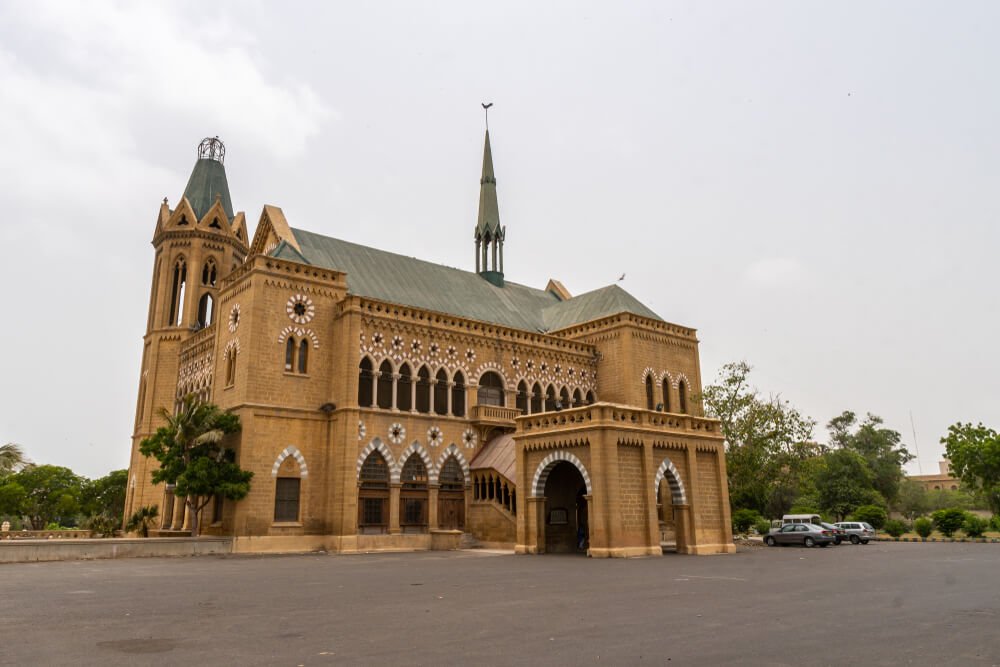
If Karachi had to choose one building to represent its soul, Frere Hall would win the argument. It is the city’s great Venetian Gothic town hall, completed in 1865, standing in the middle of green lawns between Abdullah Haroon Road and Fatima Jinnah Road — a building of yellowish Karachi limestone and red Jungshahi sandstone that has watched this city grow from a colonial port town into one of the largest metropolises on earth. Today it houses a public library and an art gallery beneath one of Pakistan’s most famous painted ceilings, and its gardens host the city’s beloved Sunday book bazaar.
This Frere Hall travel guide is your complete companion: the real history of the hall, why it deserves a place on your Karachi itinerary, what to see inside and around it, how to reach it, and the best time to go.
Quick Facts
- Location: Between Abdullah Haroon Road (Victoria Road) and Fatima Jinnah Road (Bonus Road), Civil Lines, Karachi
- Altitude: Sea level — central Karachi
- Famous For: Venetian Gothic colonial architecture (1865), the public library, Sadequain’s painted ceiling in Sadequain Hall, and the Sunday book bazaar in the gardens
- Nearest City: Karachi itself — Frere Hall is in the city’s historic Civil Lines district
- Accessibility: Very easy — central location, reachable by car, rickshaw, or ride-hailing from anywhere in Karachi; wheelchair-friendly gardens
- Known Landmarks: Bagh-e-Jinnah (Frere Hall Gardens, 15–16 acres), Sind Club, Marriott Hotel, Japanese Consulate nearby
- Best For: Families, history lovers, book hunters, art lovers, photographers, and anyone spending a day in old Karachi
Why Visit Frere Hall
Some landmarks you visit to tick a box. Frere Hall is one you visit to feel a city. The moment you walk through the gardens — the old Frere Hall Gardens, now called Bagh-e-Jinnah, some 15 acres of lawns and old trees — and the hall rises in front of you in yellowish limestone banded with red and grey sandstone, you understand why generations of Karachiites have treated this as their city’s living room. It is beautiful in the unhurried, confident way of 19th-century public architecture: pointed arches, an octagonal tower, a spirelet on the roof — the Venetian Gothic style transplanted to the Arabian Sea coast, and somehow entirely at home.
Inside, Frere Hall keeps giving. The building houses a public library where readers still sit with the day’s newspapers, and the Sadequain Hall art gallery — named for Pakistan’s iconic painter Sadequain — beneath his monumental painted ceiling, one of the great interior artworks of the country. This is not a roped-off museum piece; it is a working cultural space, full of students, readers, and art lovers. Few heritage buildings anywhere stay this alive.
Then there is the Sunday book bazaar. On Sunday mornings, the courtyards and lawns around the hall fill with booksellers’ stalls — piles of old and out-of-print books, novels, textbooks, magazines, and unexpected treasures sold at bargain prices. For Karachi’s readers, it is a weekly ritual; for a visitor, it is one of the most charming things you can do in the city. Come with an empty bag and a free morning, and you will leave with both full.
And Frere Hall is the perfect anchor for a heritage day. It sits in Civil Lines, minutes from the Freemasons’ Lodge building, Empress Market, and the Burns Road food street. The gardens are free, the library is welcoming, the architecture rewards every angle of your camera — and when you are done, some of Karachi’s best food is a short drive away. If you only see one colonial building in Karachi, make it this one.
History of Frere Hall
Frere Hall was built in honor of Sir Henry Bartle Edward Frere (1815–1884), the British Commissioner in Sindh, who was known for promoting economic development in Karachi. The idea began with a public meeting held to find a fitting way to commemorate Frere’s long and distinguished administration when he was called to the Viceroy’s Council in 1859. A sum of Rs. 22,500 was raised by public subscription, designs for a public hall were invited — and out of twelve submitted, the design by Lieutenant-Colonel St. Clair Wilson was chosen. It was, by one account, perhaps the first recorded architectural design competition for a public building in Sindh.
Construction began in 1863 and was completed in 1865; the hall was officially inaugurated by Commissioner Samuel Mansfield on October 10, 1865. The total cost came to about Rs. 180,000 — of which the government contributed Rs. 10,000 and the municipality paid the balance. The building rose in the Venetian Gothic style, constructed of the familiar yellowish Karachi limestone, relieved by white oolite quarried near Bholari south of Kotri and red and grey sandstones from the Jungshahi area. Its most distinctive features included an octagonal tower crowned with an iron cage and an acute roof spirelet coated with Muntz’s metal — details that the old Sindh gazetteer of 1919 called “incongruous excrescences,” though visitors today find them charming.
For decades, Frere Hall was the town hall of Karachi and the hub of the city’s social and cultural life under the Raj. It housed busts of imperial figures — including one of King Edward VII, a gift from the Parsi philanthropist Seth Edulji Dinshaw — and oil paintings of former Commissioners in Sindh, including Sir Charles Pritchard and Sir Evan James. The hall even earned a footnote in sporting history: in 1877, at Karachi, the first attempt was made to draw up a set of rules for badminton.
After the independence of Pakistan in 1947, the hall and its gardens remained a public landmark, and the large park grounds were frequently used for public gatherings by political leaders. In more recent times the site endured a difficult chapter: after an attempted terrorist attack on the U.S. Consulate, which faces the hall, the park was declared off-limits to the general public for several years. It was reopened in 2011 after the consulate relocated, and Karachiites reclaimed their gardens with evident joy. Today the hall houses the Frere Hall public library and the Sadequain Hall art gallery, and the building stands as one of the few well-preserved landmarks of the British Raj still gracing Karachi.
Top Things to Do in Frere Hall
Admire the Venetian Gothic Architecture
Give the exterior the slow look it deserves. Walk around the building and study the yellowish limestone relieved by white oolite and red-grey Jungshahi sandstone — the color play is the hall’s signature. Look up at the octagonal tower with its iron cage and the sharp little spirelet on the roof. The pointed arches, the stone banding, the confident proportions: this is textbook Venetian Gothic, and it photographs beautifully in the soft light of morning or late afternoon.
Visit Sadequain Hall and the Painted Ceiling
Inside the hall, the Sadequain Hall art gallery — named after Pakistan’s legendary artist Sadequain — is the cultural heart of the building. Its great treasure is Sadequain’s monumental painted ceiling in the main hall, a sweeping work that alone justifies the visit. Stand in the center of the hall and look up; few interiors in Pakistan reward the gesture so richly. Check whether an exhibition is on during your visit — the gallery regularly hosts shows by Pakistani artists.
Spend Time in the Library
The Frere Hall Library is a working public library with a reading hall where visitors can sit with newspapers and magazines — historically, ten Urdu dailies, six English dailies, and eighteen magazines. It is a calm, bookish refuge in the middle of one of the world’s busiest cities, and browsing its shelves gives you a sense of the hall’s continuing life as a place of learning rather than just a monument.
Hunt Treasures at the Sunday Book Bazaar
If your trip includes a Sunday, plan your Frere Hall visit for the morning. The book bazaar in the courtyards and gardens is a Karachi institution: stall after stall of old, rare, and out-of-print books at prices that make collectors weep with joy. Arrive early for the best picks, bargain politely, and bring cash. Even if you buy nothing, the atmosphere — readers crouching over piles of books under the old trees, with the Gothic hall behind them — is unforgettable.
Stroll Bagh-e-Jinnah
The 15-acre gardens around the hall — the old Frere Hall Gardens, renamed Bagh-e-Jinnah — are among central Karachi’s greenest public spaces. Old trees, wide lawns, and paths make it a favorite for morning walkers, families, and photographers. It is the perfect place to decompress after the intensity of Saddar’s bazaars.
Famous Places In and Around Frere Hall
- Freemasons’ Lodge Building — the historic 1914 yellow-sandstone lodge on Strachan Road, a short drive away.
- Empress Market — the great Victorian market hall of Saddar, Karachi’s commercial heart.
- Burns Road food street — the city’s legendary food quarter; the ideal dinner after a Frere Hall afternoon.
- Mohatta Palace Museum — the beautiful palace-museum in Clifton, an easy addition to a heritage day.
- Sind Club — the historic colonial club in the immediate vicinity (members and guests).
How to Reach Frere Hall
Frere Hall sits between Abdullah Haroon Road and Fatima Jinnah Road in Civil Lines — one of the most central and well-known locations in Karachi. Every driver in the city knows it.
From within Karachi: Take any taxi, rickshaw, or ride-hailing car to “Frere Hall” — from Saddar it is minutes away; from Clifton/DHA allow 20–30 minutes depending on traffic. The gardens have entry points from both flanking roads.
From Islamabad: Fly to Jinnah International Airport, Karachi (about 2 hours), then drive 30–45 minutes into Civil Lines. By road, the journey is roughly 1,400 km via the motorway network — realistically two days of driving.
From Lahore: Fly to Karachi (about 1 hour 45 minutes), then drive into the center. By road it is roughly 1,200 km.
Nearest airport: Jinnah International Airport, Karachi.
Transport options: Ride-hailing cars are the easiest option; auto-rickshaws and private cars work well too. Public buses serve the surrounding roads. Parking is available near the gardens but fills up on Sunday book-bazaar mornings — arrive early.
Route Details
- Step 1: Head to Civil Lines in central Karachi, between Abdullah Haroon Road (old Victoria Road) and Fatima Jinnah Road (old Bonus Road).
- Step 2: Enter Bagh-e-Jinnah (Frere Hall Gardens) from either road and walk the garden paths toward the hall.
- Step 3: Tour the exterior, then visit the library and Sadequain Hall inside.
- Step 4: On Sundays, browse the book bazaar in the courtyards; on other days, enjoy the gardens and continue to nearby Saddar or Burns Road.
Where to Stay in Frere Hall
Frere Hall is in the middle of Karachi, so you stay in the city — and the Civil Lines/Saddar area around the hall is one of the most convenient bases for a heritage-focused trip. The immediate vicinity includes the city’s grandest five-star hotel on the nearby Club Road as well as solid mid-range business hotels and budget guesthouses in Saddar. If your trip centers on old Karachi’s history, food, and bazaars, staying central saves you hours in traffic. If you want the sea, the Clifton and DHA hotel belt is 20–30 minutes away and puts the beach at your doorstep. For most visitors, two or three nights in Karachi comfortably covers Frere Hall, the old city’s markets, and a Clifton/Sea View excursion.
Where to Eat: Local Foods of Frere Hall
One of the great pleasures of a Frere Hall visit is that Karachi’s legendary food is all around it. A short drive takes you to Burns Road, the city’s most famous food street — an evening blaze of barbecue smoke, seekh kebabs, malai boti, fresh tandoori naan, lassi, rabri, and falooda. Closer to the hall, Saddar’s old Irani cafes serve bun kebab, chai, and omelettes in time-capsule surroundings. And no Karachi food tour is complete without the city’s signature biryani, nihari, and haleem, all available within minutes of the gardens. Street food here is delicious and budget-friendly; a full Burns Road feast costs little, while sit-down restaurants range from modest to mid-range. Plan your visit for the afternoon, then eat your way through the evening — it is the classic Karachi day.
Weather in Frere Hall
Karachi’s coastal climate shapes the Frere Hall experience: the gardens are best enjoyed in mild weather, and the Sunday book bazaar is most pleasant when it is not blazing hot. Winter is the prime season; summer visits are best kept to early mornings.
| Season | Temperature Range | Conditions |
|---|---|---|
| Winter (Dec–Feb) | Around 12–26°C | Mild, dry, sunny; perfect for gardens and book bazaar |
| Spring (Mar–Apr) | Around 22–34°C | Warm and pleasant; great for architecture walks |
| Summer (May–Sep) | Around 28–38°C | Hot, humid, sea-breezed; monsoon showers possible Jul–Aug; go early morning |
| Autumn (Oct–Nov) | Around 22–34°C | Warm with easing humidity; comfortable evenings |
Language and Culture of Frere Hall
Frere Hall belongs to all of Karachi, and the crowd in its gardens reflects the city: Urdu is the shared language, with Sindhi, Punjabi, Pashto, Balochi, and English all in the air. The hall’s own history — a British town hall turned Pakistani public library and art gallery — mirrors Karachi’s layered identity. Etiquette is simple city manners: keep the gardens clean, keep noise down in the library, ask before photographing people, and dress modestly. The book bazaar runs on friendly bargaining — offer a fair price with a smile and you will be welcomed into the ritual.
Shopping in Frere Hall
The Sunday book bazaar is Frere Hall’s own shopping experience — books, books, and more books, from out-of-print classics to textbooks to vintage magazines, at bargain prices. Beyond books, you are minutes from Saddar’s great bazaars: Empress Market for spices, dry fruits, and textiles; Zainab Market and Bohri Bazaar for fabrics and garments; and the surrounding streets for everything from electronics to street snacks. For souvenirs with a Karachi identity, look for Ajrak prints, Sindhi embroidery, and camel-skin crafts in the Saddar shops.
Local Events and Festivals
Frere Hall’s calendar is cultural rather than religious, and it is refreshingly regular. The Sunday book bazaar, held every Sunday morning in the courtyards and gardens, is the week’s anchor event — part market, part social ritual for the city’s readers. The Sadequain Hall art gallery hosts rotating exhibitions by Pakistani artists through the year; check local listings before your visit. The gardens themselves frequently host public gatherings, mushairas (poetry recitals), and cultural programs, especially in the mild winter months — a continuation of the hall’s 160-year role as Karachi’s public living room.
Travel Tips for Frere Hall
Packing Essentials
Comfortable walking shoes for the gardens, sun protection, a camera, drinking water, and — on Sundays — cash in small notes for the book bazaar and an empty tote bag. A hat helps on sunny garden afternoons.
Safety Tips
Bagh-e-Jinnah is a popular family park and generally safe during the day. As in any big-city public space, keep valuables discreet, stay in the main garden areas after dark, and use ride-hailing for late returns. The library is quiet — silence your phone inside.
Money & Connectivity
ATMs are plentiful in Civil Lines and Saddar; the book bazaar is cash-only, so withdraw beforehand. All major mobile networks (Jazz, Telenor, Zong, Ufone) have strong 4G coverage across the gardens.
Best Time to Visit Frere Hall
Winter (December–February)
The best season by far. Mild sunny days, cool evenings, the gardens at their greenest, and the Sunday book bazaar at its most comfortable — this is Frere Hall at its finest.
Spring (March–April)
Warm and lovely — ideal for long architecture walks and garden picnics before the summer heat arrives.
Summer (May–September)
Hot and humid. Visit early in the morning for the gardens and library, and save the book bazaar for a cooler month if you can — though Sunday mornings are still manageable with water and a hat.
Autumn (October–November)
A pleasant shoulder season: the humidity drops, the light turns golden, and the crowds thin out.
Final Thoughts
Frere Hall is the rare landmark that is simultaneously a masterpiece of colonial architecture, a working library, an art gallery under a Sadequain ceiling, a beloved public garden, and Karachi’s greatest weekly book market. It has been the city’s town hall, its cultural hub, and its living room across three centuries — and it is still, on any given Sunday morning, full of life. No visit to Karachi is complete without it.
Go in winter, arrive on a Sunday morning with an empty bag, walk the gardens, look up at the painted ceiling, haggle happily over old books, and finish the day on Burns Road. That is Karachi distilled into a single perfect day. For more of the city’s essential stops, explore our Explore Pakistan guides — including nearby Malam Jabba for a very different kind of Pakistani adventure.
FAQs
Where is Frere Hall located?
Between Abdullah Haroon Road and Fatima Jinnah Road in Civil Lines, Karachi, in the middle of Bagh-e-Jinnah (the old Frere Hall Gardens).
What is the best time to visit Frere Hall?
Winter (December–February) is ideal. If you can, visit on a Sunday morning to catch the famous book bazaar in the courtyards.
How do I reach Frere Hall?
It is in central Karachi — take a taxi, rickshaw, or ride-hailing car to “Frere Hall”; every driver knows it. From Jinnah International Airport it is a 30–45 minute drive.
Is there an entry fee for Frere Hall?
The gardens are a public park and freely accessible; the library and gallery are public cultural spaces. The Sunday book bazaar is free to browse — you only pay for the books you buy.
What is Sadequain Hall?
The art gallery inside Frere Hall, named after Pakistan’s iconic painter Sadequain, famous for his monumental painted ceiling in the hall’s main interior space.
Is Frere Hall good for families?
Absolutely — the gardens, library, gallery, and book bazaar make it one of Karachi’s most family-friendly heritage outings, suitable for all ages.
What food is available near Frere Hall?
Burns Road food street (kebabs, nihari, lassi, falooda), Saddar’s Irani cafes, and the full range of Karachi biryani, haleem, and barbecue are all within a short drive.
When was Frere Hall built?
Construction ran from 1863 to 1865 and it was inaugurated on October 10, 1865, in honor of Sir Henry Bartle Edward Frere, built in the Venetian Gothic style from Karachi limestone and Jungshahi sandstone.