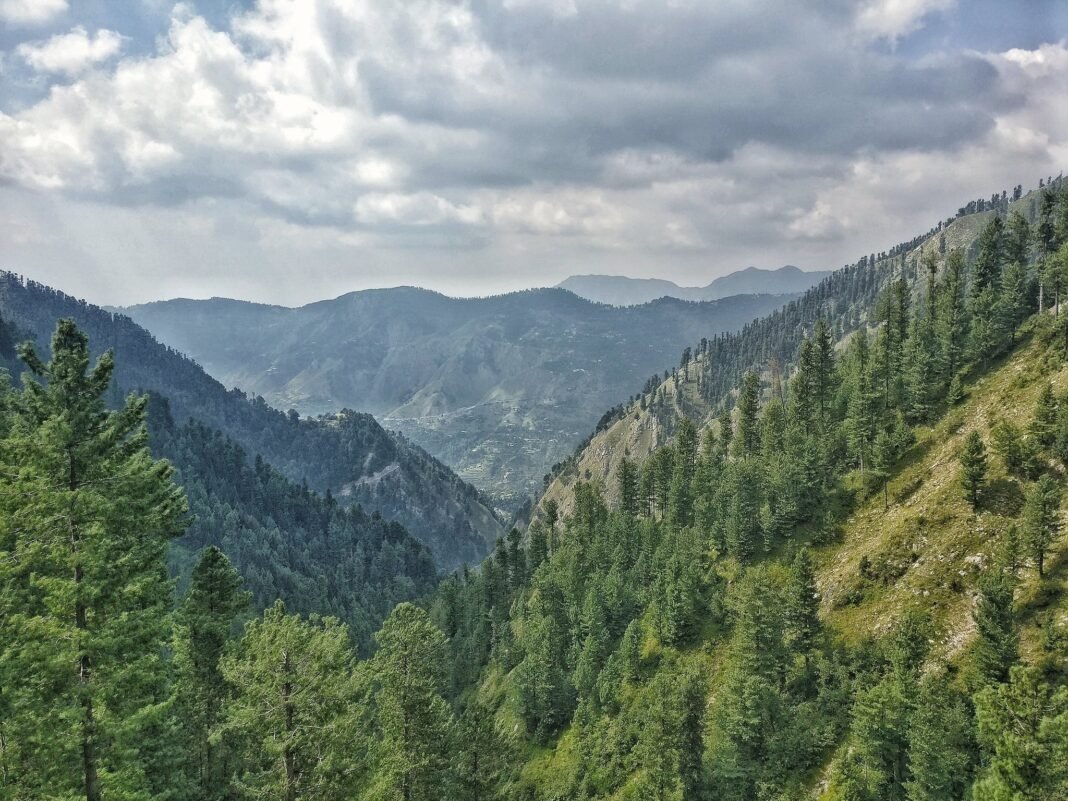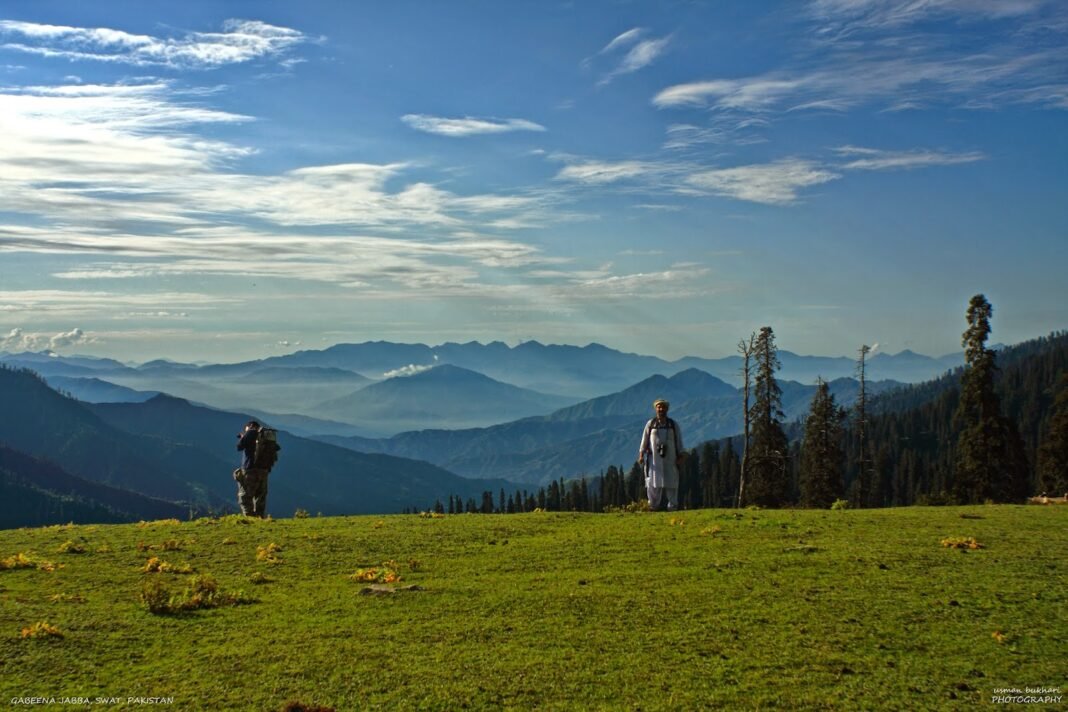
There is a moment, about an hour and a half out of Mingora, when the road climbs past the last village rooftops, the pine forest closes in, and then — suddenly — the trees open onto a vast green meadow ringed by high peaks. That is Gabin Jabba, and it stops first-time visitors mid-sentence. At 2,582 meters above sea level, this “honey marsh” of Swat Valley is one of Pakistan’s most beautiful high meadows: green pastures, dense forests, mineral springs, snow-clad summits on the horizon, and a silence so complete you can hear the birds negotiating in the treetops.
This Gabin Jabba travel guide is your complete planning companion — why this meadow deserves your next trip, who it is perfect for, the best time to visit, the real routes from Mingora and Islamabad, the famous camping pods, and everything practical from weather to food to packing.
Quick Facts
- Location: Swat Valley, Khyber Pakhtunkhwa, Pakistan — on the Matta Sakhra road, about 60 km from Mingora and 20 km from Matta Bazaar
- Altitude: Around 2,582 m (8,471 ft) above sea level
- Famous For: Lush green meadows (“honey marshes”), dense pine forests, mineral springs, camping pods, and as the gateway to Daral Lake
- Nearest City: Mingora (about 1 h 45 min by road)
- Accessibility: Road via Swat Motorway to Mingora, then mountain road via Bagh Dehri/Bagh Deri Road and Lalkoo Road; high-clearance vehicle recommended for the final stretch
- Known Landmarks: Daral Lake (gateway trek), Matta Bazaar, the camping pod site
- Best For: Families, campers, trekkers, photographers, honeymooners, and anyone who wants Swat’s beauty without the Kalam crowds
Why Visit Gabin Jabba
Swat has no shortage of famous names — Kalam, Malam Jabba, Mahodand — but Gabin Jabba offers something the famous ones increasingly cannot: room to breathe. Because it sits off the main tourist highway, about 60 kilometers from Mingora on the Matta side of the valley, it has stayed remarkably clean and uncrowded. The meadow itself is the headline: wide, vibrant green pastures rolling between walls of pine forest, with towering mountains behind and crystal-clear streams threading through the grass. It is the classic Himalayan-Hindu Kush postcard, except you are standing in it rather than looking at it.
Then there is the name, which tells you what kind of place this is. “Gabin Jabba” fuses two Pashto words — gabin, honey, and jabba, marsh — the “honey marshes.” Honey bees thrive here in unusual numbers, and the honey of Gabin Jabba is famous throughout Khyber Pakhtunkhwa. The meadows are dotted with medicinal plants that draw researchers, the forests ring with birdsong — Western Crowned Warblers are the most common singers, joined by laughingthrushes, whistling thrushes, and blackbirds — and cold, stony streams run clear enough to drink from (though you should still treat stream water).
For the practical traveler, Gabin Jabba solves the classic Swat dilemma. It is close enough to Mingora for a long day trip, yet high and remote enough to feel like a true mountain escape. The Khyber Pakhtunkhwa tourism authorities have installed camping pods here — small wooden units with warm blankets and solar-powered electricity — so you can sleep in the meadow itself without hauling a full expedition kit. And for trekkers, Gabin Jabba is the gateway to Daral Lake, sitting more than 500 meters higher — a serious high-altitude trek that starts right from the meadow’s edge.
Who is it perfect for? Families who want a safe, stunning mountain picnic spot with real facilities. Couples looking for a quieter alternative to crowded hill stations. Photographers chasing meadow-and-peak compositions. And trekkers using it as base camp for Daral Lake. In winter, it transforms entirely — three to four feet of snow turn it into a silent white wonderland for the truly adventurous. Whatever season you choose, Gabin Jabba rewards the traveler who goes one valley beyond the obvious.
History of Gabin Jabba
Gabin Jabba itself has no ancient monuments or recorded battles — its history is the history of Swat Valley, and that history is extraordinary. Swat was a major center of early Buddhism, part of the ancient Gandharan civilization; Gandharan Buddhism flourished here for centuries, and pockets of Buddhist practice persisted in the valley until the 16th-century conquest of Swat by the Yousafzai Pashtuns, after which the area became largely Muslim and underwent the Pashtunization that defines its culture today.
In the early 19th century, Swat emerged as an independent state under the leadership of Saidu Baba, and in 1918 the State of Swat became a princely state under British suzerainty as part of British India. The valley’s modern tourism story is much younger: for decades, Gabin Jabba was known mainly to locals — shepherds, honey collectors, and the people of nearby villages — while visitors from elsewhere in Pakistan flocked to Kalam and Malam Jabba. That changed as social media and improved roads began revealing Swat’s lesser-known corners. The installation of camping pods by the provincial tourism authorities marked Gabin Jabba’s arrival as an official destination, and today it is firmly on the map as one of Swat’s crown jewels — still quieter than its famous neighbors, but no longer a secret.
The meadow’s ecology is part of its heritage too. The dense forests, mineral springs, medicinal plants, and the famous honey-bee colonies have sustained local livelihoods for generations; Swat honey, to which Gabin Jabba contributes, is renowned across the province. Visiting with respect — carrying out your trash, staying on established paths, not disturbing the hives — is how travelers help keep this place the way the valley has always known it.
Top Things to Do in Gabin Jabba
Sleep in a Camping Pod
The signature Gabin Jabba experience is a night in one of the wooden camping pods installed in the meadow. These small, sturdy units come with warm blankets, and electricity is supplied through solar panels — with fans for the summer months. Falling asleep to mountain silence and waking to mist on the pasture is the kind of memory that outlasts any hotel stay. Book through the provincial tourism channels or your tour operator in season, because pods are limited and summer weekends fill up.
Trek Toward Daral Lake
Gabin Jabba is the gateway to Daral Lake, which sits more than 500 meters above the meadow’s altitude — a serious high-mountain trek for fit, well-equipped hikers. Even if you do not attempt the full lake trek, the trail’s lower sections offer superb day-hiking through forest and alpine pasture, with ever-grander views as you climb. Go with a local guide, start early, carry water and warm layers, and turn back well before dark.
Walk the Meadows and Streams
The simplest pleasure here is also the best: walk. The meadows are made for slow wandering — picnics on the grass, paddling in the cold, clear streams, watching clouds move across the peaks. The entire track from the base to the top is alive with birdsong; bring binoculars if you are a birder, because the Western Crowned Warblers, Variegated Laughingthrushes, Blue Whistling Thrushes, and Eurasian Blackbirds of these forests are a genuine attraction in their own right.
Photograph the Four Seasons
Gabin Jabba is a year-round photography destination. Summer brings the classic green-meadow composition — pasture, pines, peaks. Autumn sets the forests alight with color. Winter, for those who can reach it through the snow, offers a monochrome wonderland of white meadows and dark pines. And spring brings wildflowers to the pastures. Dawn and dusk light on the surrounding high peaks is spectacular in every season.
Taste the Famous Honey
Do not leave without trying — and buying — the honey. Gabin Jabba’s honey bees are found here in far greater numbers than in most of the country, and Swat honey is famous throughout Khyber Pakhtunkhwa for its purity and flavor. Buy from local sellers in the area or in Matta Bazaar on your way back; it makes a superb gift.
Famous Places In and Around Gabin Jabba
- Daral Lake — the high-altitude lake above Gabin Jabba, reachable by trek; the area’s great adventure objective.
- Matta Bazaar — the lively market town 20 km away; your last stop for supplies and honey.
- Malam Jabba — Swat’s famous ski resort and hill station, combinable in a wider Swat itinerary.
- Mingora and Saidu Sharif — the valley’s twin cities, with the Swat Museum, bazaars, and the airport.
- Kalam Valley — further up the valley; the classic Swat extension for longer trips.
How to Reach Gabin Jabba
Gabin Jabba is about 60 km from Mingora and roughly 390 km from Islamabad — around five hours of driving from the capital via the Swat Motorway, or about 1 hour 45 minutes from Mingora itself. The final approach is mountain road, so the last stretch is slow.
From Islamabad: Take the M-1 and then the Swat Motorway (M-16) to the Swat valley — roughly 390 km, about five hours. From Mingora, follow one of the two routes below to Gabin Jabba.
From Lahore: Take the motorway network to Islamabad and join the route above — roughly 700 km total, about nine to ten hours of driving. Most Lahore travelers break the journey or fly to Islamabad first.
From Karachi: Fly to Islamabad (about 2 hours), then drive the Swat route. There are no direct commercial flights to Swat’s Saidu Sharif airport on most schedules, so Islamabad is the reliable air gateway.
Nearest airport: Islamabad International Airport for reliable scheduled flights; Saidu Sharif Airport near Mingora has limited service.
Transport options: Private car or hired 4×4/SUV is the best option — the final mountain stretch favors high-clearance vehicles. Coaches and vans run from major cities to Mingora; from Mingora, hire a local jeep or car with a driver who knows the Lalkoo Road route. Tour operators in Mingora and Islamabad run Gabin Jabba trips in season.
Route Details
- Step 1: Reach Mingora in Swat via the Swat Motorway.
- Step 2 (Route 1): Follow the N-95 (Bahrain Road) through Manglor and Khwazakhela to Bagh Dehri Road (about 1 h 10 min / 39 km), then continue on Bagh Dehri Road to Lalkoo Road (about 50 min / 21 km) to reach Gabin Jabba.
- Step 2 (Route 2): Alternatively, go through Kanju across the Swat River: take Airport Road to Bagh Deri Road (about 1 h 15 min / 41 km), then continue on Bagh Deri Road to Lalkoo Road (about 43 min / 18 km) to arrive at Gabin Jabba. This route usually has less traffic congestion.
- Step 3: Expect delays on either route during peak tourist season; start early in the day.
Where to Stay in Gabin Jabba
Staying in Gabin Jabba means the camping pods — the meadow’s signature accommodation. These wooden units, installed by the tourism authorities, offer a bed, warm blankets, solar-powered electricity, and (in summer) fans: comfortable, atmospheric, and steps from the pasture. They are limited in number, so arrange yours in advance through tourism department booking channels or a Mingora-based tour operator, especially for summer weekends and Eid holidays. If pods are full, or you prefer conventional hotels, base yourself in Mingora/Saidu Sharif (the widest choice, from budget hotels to comfortable mid-range options, about 1 h 45 min away) or in Matta (closer, with simpler hotels and guesthouses, about 20 km from the meadow). For trekkers heading to Daral Lake, the pods are the natural base camp. Whichever you choose, book ahead in the May–August peak season.
Where to Eat: Local Foods of Gabin Jabba
There are no restaurants in the meadow itself — eat in Mingora or Matta before you ascend, and carry a picnic for the day. The food of Swat is hearty mountain fare: makai ki roti (maize flatbread) with saag or lassi, slow-cooked lamb karahi, chapli kebabs, and — the valley’s most famous specialty — Swat trout, served fried or grilled in the restaurants of the upper valley. Wash it down with qehwa (green tea), the drink of the mountains. In Matta Bazaar and Mingora you will find dhabas and restaurants at every budget level; a full dhaba meal is very budget-friendly, while trout at a proper restaurant costs more but is worth every rupee. For the meadow, pack bread, cheese, fruit, dry fruits, and plenty of water — and carry all your wrappers back down. Keeping Gabin Jabba clean is every visitor’s duty.
Weather in Gabin Jabba
At 2,582 meters, Gabin Jabba has true mountain weather: pleasantly cool summers, cold snowy winters, and rapid changes. The meadow’s famous green season runs from late spring through early autumn; winter buries it in snow. Always carry a warm layer, whatever the month — mountain weather does not read calendars.
| Season | Temperature Range | Conditions |
|---|---|---|
| Winter (Dec–Feb) | Around -5 to 8°C | Heavy snow (often 3–4 feet); a snowy wonderland; access difficult |
| Spring (Mar–May) | Around 8–20°C | Snow melting; wildflowers from late spring; fresh and green |
| Summer (Jun–Aug) | Around 15–25°C | Warm days, cool nights; peak season; meadows at their greenest |
| Autumn (Sep–Nov) | Around 5–18°C | Crisp air, autumn colors in the forests; quiet and beautiful |
Language and Culture of Gabin Jabba
Swat is the land of the Yousafzai Pashtuns, and Pashto is the language of the valley — you will hear it in Matta Bazaar, from your driver, and from the shepherds on the meadow. Urdu is widely understood in Mingora and by anyone in the tourism trade. The culture is the famous Pashtunwali code: hospitality (melmastia) is sacred, and guests are honored — accept offered tea graciously. Dress modestly (this matters especially for women visitors), ask before photographing people, and respect prayer times and local customs in the villages you pass through. The people of these valleys are proud of their home; show that you value it — by keeping it clean above all — and you will be welcomed like family.
Shopping in Gabin Jabba
Shop in Matta Bazaar (20 km away) or Mingora rather than expecting shops in the meadow. The must-buy is Swat honey — including honey from the Gabin Jabba area itself, famous across the province. Also worth buying: dry fruits and walnuts from the valley, Swati shawls and woolen garments, and local embroidery. Prices in Matta are local prices — fair, with gentle bargaining expected. There are no shopping malls anywhere near Gabin Jabba, and that is part of the point: the bazaar here is the real thing.
Travel Tips for Gabin Jabba
Packing Essentials
Warm layers (even in summer — nights at 2,582 m are cold), a windproof jacket, sturdy walking shoes or trekking boots, sun protection (mountain sun is fierce), a refillable water bottle, snacks, a power bank (the pods have solar power, but backup helps), a basic first-aid kit, and binoculars for the birdlife. In winter: full snow gear and check access before attempting the trip at all.
Safety Tips
Swat is a well-traveled tourist region, but mountain sense still applies: start hikes early, stay on established trails, do not attempt the Daral Lake trek without a guide and proper equipment, and keep children close near streams. Weather changes fast — if clouds build over the peaks, head back. Travel the mountain road in daylight; the Lalkoo Road stretch is slow and winding.
Money & Connectivity
Carry cash in Pakistani rupees — there are ATMs in Mingora and Matta but none in the meadow, and you cannot count on card payments on the mountain. Mobile signals (Jazz, Telenor, Zong) generally reach the area but can be patchy in the meadow itself; download offline maps and confirm your pod booking before ascending.
Best Time to Visit Gabin Jabba
Summer (June–August)
The classic season and the local recommendation: warm days around 20°C, cool nights, the meadows at their greenest, mountain flowers in bloom, and the camping pods in full operation. This is also peak season — book pods and transport early.
Spring (April–May)
A beautiful shoulder season: melting snow, fresh green pastures, wildflowers, and far fewer visitors. The weather can be changeable, but the meadow feels most alive.
Autumn (September–November)
Crisp, clear, and quiet — autumn colors in the pine and broadleaf forests, superb visibility of the high peaks, and thinning crowds. A photographer’s favorite.
Winter (December–February)
Only for the adventurous: three to four feet of snow transform Gabin Jabba into a silent white wilderness. Access is difficult and the pods may not be operating — check conditions locally and go only with experienced guides and proper winter equipment.
Final Thoughts
Gabin Jabba is Swat Valley at its most generous: a high meadow of green pastures and pine forest at 2,582 meters, famous honey, birdsong in the treetops, mineral springs in the grass, and the great white wall of the high peaks beyond — all without the crowds of the valley’s bigger names. Whether you come for a day picnic, a night in a camping pod under the stars, or as the first step toward Daral Lake, the “honey marsh” has a way of slowing you down to mountain time.
Go in summer for the classic green-meadow experience, carry your trash back down, buy the honey, and give the meadow the respect it deserves. Swat has many jewels, but few shine as quietly as this one. For more mountain escapes, see our guides to Malam Jabba and the Explore Pakistan collection.
FAQs
Where is Gabin Jabba?
In Swat Valley, Khyber Pakhtunkhwa, about 60 km from Mingora on the Matta Sakhra road (20 km from Matta Bazaar), at an altitude of around 2,582 m (8,471 ft).
What does “Gabin Jabba” mean?
It combines two Pashto words: gabin (honey) and jabba (marsh) — the “honey marshes,” named for the area’s famous honey-bee colonies.
What is the best time to visit Gabin Jabba?
May to August for green meadows and mild weather (peak season); April–May and September–November are beautiful shoulder seasons. Winter brings heavy snow and difficult access.
How do I reach Gabin Jabba from Islamabad?
Drive the Swat Motorway to Mingora (roughly 390 km, about five hours), then take the N-95/Bagh Dehri Road to Lalkoo Road (about 1 h 45 min) — or the quieter Kanju/Airport Road alternative.
Can I stay overnight in Gabin Jabba?
Yes — in the wooden camping pods installed in the meadow (warm blankets, solar electricity). Book ahead in season; otherwise stay in Mingora or Matta.
Is Gabin Jabba good for families?
Very — the meadows are safe for picnics and gentle walks, the pods make overnighting easy, and it is far less crowded than Kalam or Malam Jabba. Supervise children near streams.
What food is available at Gabin Jabba?
Nothing in the meadow itself — eat in Mingora or Matta (makai roti, lamb karahi, chapli kebab, Swat trout, qehwa) and carry a picnic. Buy the famous local honey on your way back.
What is Daral Lake and can I visit it from Gabin Jabba?
Daral Lake is a high-altitude lake more than 500 meters above Gabin Jabba, for which the meadow is the gateway. It is a serious trek for fit hikers with a guide — not a casual walk — so plan it as a separate expedition objective.