Quick Facts
- Location: Bahria Town Karachi, Sindh — on Main Jinnah Avenue, atop a 60-foot hill
- Famous For: Pakistan’s largest mosque, designed to hold up to 800,000 worshippers; 150 domes, a 100-metre minaret, and marble from Balochistan; completed in early 2026
- Nearest City: Karachi — about 9 km from the Super Highway (M-9) toll plaza, roughly 25 minutes from Jinnah International Airport
- Accessibility: Drive from central Karachi via the M-9 Super Highway or the Malir Expressway; ride-hailing cars and coaches serve Bahria Town; the mosque sits on the town’s main boulevard
- Known Landmarks: The central dome (75 metres high), the single monumental minaret, the vast granite courtyard with automated umbrellas, the Islamic Community Centre
- Best For: Architecture lovers, spiritual travellers, photographers, families combining it with Bahria Town’s theme parks, and anyone who wants to see Pakistan building at a world scale
Why Visit Grand Jamia Mosque, Karachi
There are mosques you visit to pray in, and there are mosques you visit to stand in front of, look up, and simply feel small. The Grand Jamia Mosque in Bahria Town Karachi is firmly in the second category — though on Fridays and Eids it is very much the first, too. This is Pakistan’s largest mosque and, by most counts, one of the largest in the world: a hilltop complex of white marble, 150 domes and a single soaring minaret that can be seen from kilometres away.
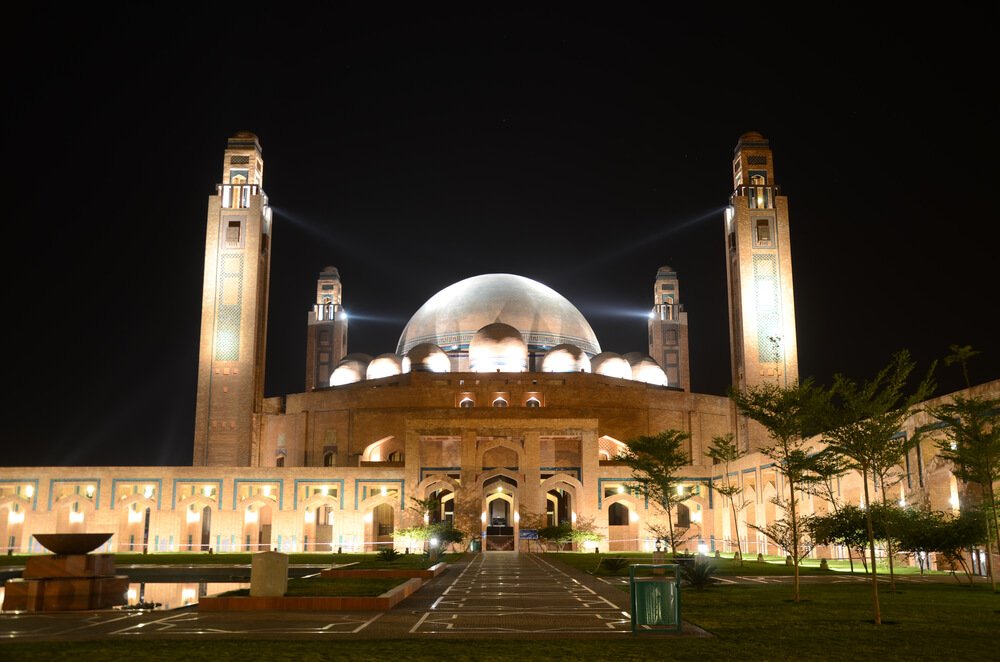
You should visit because scale like this has to be experienced in person. Photographs flatten it. Standing in a courtyard designed for hundreds of thousands of worshippers, under a central dome 75 metres high, with fountains playing and automated umbrellas shading the granite floor, you understand what the builders were reaching for: a mosque in the lineage of the Badshahi Masjid and Delhi’s Jama Masjid, but built for the 21st century. The design by renowned architect Nayyar Ali Dada weaves together Mughal, Persian and Turkish influences into something that feels both timeless and brand new.
It is also the anchor of a full day out. Bahria Town Karachi is a destination in itself — theme parks, a day-and-night zoo, replicas of world monuments, cinemas and food streets — and the mosque gives the day a soul. Families come for the rides and stay for the sunset call to prayer. Architecture students come to study the domes. And for overseas Pakistanis visiting Karachi, it has quickly become a must-see: proof of what the country can build when it dreams big.
Come at golden hour, when the Balochistan marble glows amber and the minaret stands black against the sky. Whether you are devout, curious, or simply a lover of beautiful buildings, this is one of the most impressive sights in modern Pakistan.
History of Grand Jamia Mosque, Karachi
The Grand Jamia Mosque is the younger sibling of Bahria Town’s famous Lahore mosque — and it was conceived on an even grander scale. The groundbreaking ceremony was held on 6 January 2015, and in a gesture that made headlines, the foundation stone was placed by a 73-year-old labourer rather than a dignitary. From the start, the project was presented as a mosque for the people.
The design was entrusted to Nayyar Ali Dada, Pakistan’s most celebrated living architect, who had already designed the Grand Jamia Mosque in Bahria Town Lahore. For Karachi he drew on the great Mughal mosques — Lahore’s Badshahi Masjid and Delhi’s Jama Masjid — while blending in Persian, Turkish and Central Asian influences, with interior art touching on the traditions of Sindh, Bukhara and Samarkand. The site chosen was a 50-acre (20-hectare) plateau atop an 18-metre (60-foot) hill, so the mosque would be visible from a great distance across the new township.
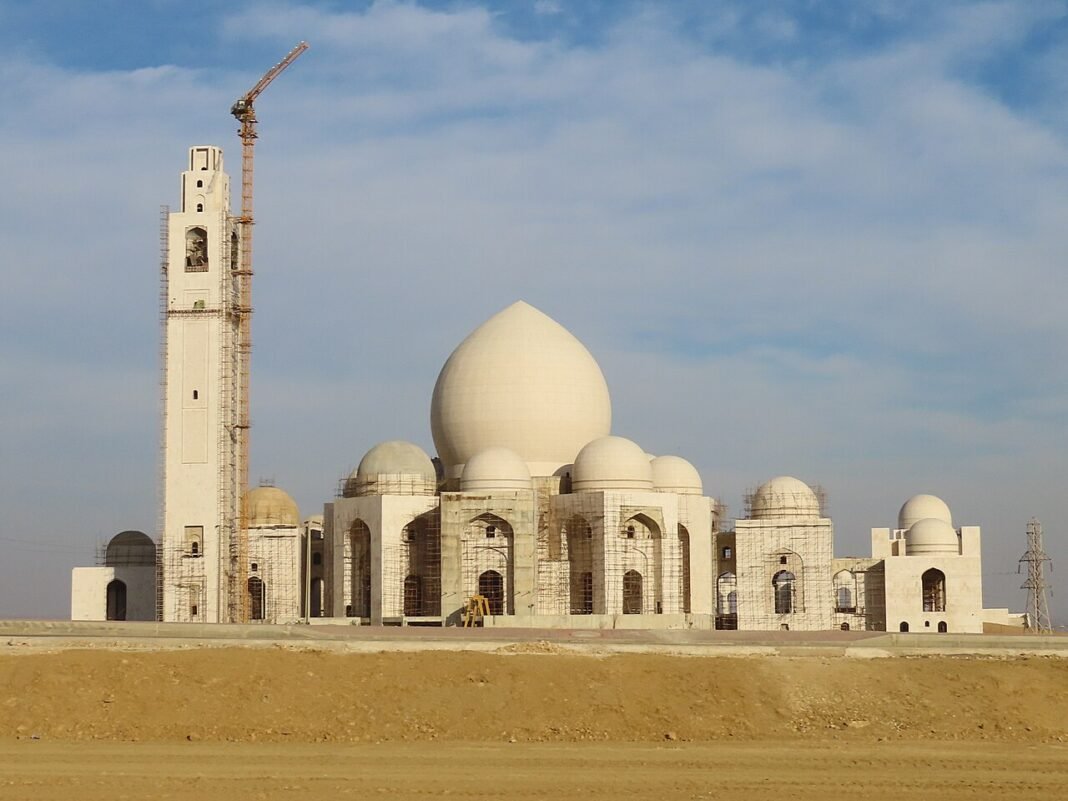
Construction ran for over a decade, interrupted and slowed like all mega-projects, but the vision never shrank: high-quality beige marble from Balochistan, 150 domes, nearly 500 arches, a single monumental minaret, and a surrounding complex of gardens, fountains and an Islamic community centre with a university, library and museum. According to recent records, the mosque was completed in February 2026 — making it one of the newest great mosques on earth.
With a total designed capacity of up to 800,000 worshippers (Bahria Town’s official figure; independent sources cite 600,000), it stands as Pakistan’s largest mosque and among the largest in the world — a landmark that has already redefined Karachi’s skyline from the Super Highway.
Top Things to Do in Grand Jamia Mosque, Karachi
Stand Under the Great Dome
Enter the main prayer hall and look up: the central dome rises 75 metres (246 feet) above you, with a diameter of 39 metres, ringed by smaller domes — 150 in total across the complex. The hall is clad in Balochistan marble with traditional Islamic calligraphy, mosaic ceramics and geometric patterns. Even outside prayer times, the sheer volume of the space is humbling. Visit in the late afternoon when sunlight angles through the hall and the marble seems to glow from within.
Walk the Courtyard of Umbrellas
The vast open courtyard is floored with imported ARLASH granite, chosen to stay cool underfoot, and shaded by automated umbrellas modelled on the famous ones at Al-Masjid an-Nabawi in Madinah. Fountains play within the courtyard, and the whole space is ringed by arch-shaped walls and gardens. It is designed to hold hundreds of thousands for Jummah and Eid prayers — walking its empty expanse on a quiet weekday gives you the true measure of the place.
See the Minaret at Sunset
The mosque’s single minaret — a square, marble-clad tower rising about 100 metres (Bahria Town cites 333 feet) — is the visual identity of the whole township, visible from distant parts of Karachi. Photographers should position themselves on Main Jinnah Avenue at sunset: the minaret and domes silhouette against the western sky, and as the lights come on, the marble turns gold. It is one of the great modern skylines of Pakistan.
Explore the Islamic Community Centre
The mosque is more than a prayer space. Its Islamic Community Centre is designed to include an Islamic university for 1,500 students, a library planned to hold 500,000 books, an Islamic museum, a cultural centre, a women’s programming centre and a 715-seat auditorium. The complex is conceived as a place where Islamic scholarship, art and education are preserved and taught with modern methods — worth exploring for anyone interested in the intellectual life of the Muslim world.
Combine It With Bahria Town’s Attractions
Make a day of it. Within a few minutes’ drive are Bahria Adventure Land (a full theme park with 25+ rides), DanZoo (Pakistan’s first international-standard day-and-night zoo), the Eiffel Tower and Taj Mahal replicas, Chirpy Park’s bird aviary, Carnival, cinemas and the Bahria Night Safari. The mosque in the morning, the theme park in the afternoon, and dinner on Jinnah Avenue is a perfect family itinerary.
Famous Places In and Around Grand Jamia Mosque, Karachi
- Bahria Adventure Land — Theme park with roller coasters and water rides, on Jinnah Avenue.
- DanZoo — Day-and-night zoo with lions, tigers, giraffes and exotic birds.
- Eiffel Tower Replica — Bahria Town’s 60+ metre tower with a viewing platform.
- Taj Mahal & Statue of Liberty Replicas — The town’s famous “Wonders of the World” monuments.
- Rafi Cricket Stadium — Pakistan’s largest cricket stadium, under development in Bahria Town.
- Chirpy Park — Bird aviary popular with children.
- Abdullah Shah Ghazi Shrine — Karachi’s revered Sufi shrine, in Clifton, for those combining the trip with the city.
- Empress Market — The historic Saddar bazaar, worth a stop on the way back into Karachi.
How to Reach Grand Jamia Mosque, Karachi
The mosque is in Bahria Town Karachi, on Main Jinnah Avenue near the town’s central precincts. Bahria Town sits about 9 km off the Super Highway (M-9) toll plaza, northeast of central Karachi.
From central Karachi (Clifton/DHA/Saddar): Drive out via the M-9 Super Highway toward Hyderabad; take the Bahria Town exit (about 9 km past the toll plaza) and follow the signs to Main Jinnah Avenue. The drive takes 45 minutes to 1.5 hours depending on traffic — leave early on weekends. Ride-hailing cars will take you there, though confirm the return trip in advance.
From Jinnah International Airport: About a 25-minute drive via the Malir Expressway link — the easiest arrival route for out-of-town visitors. Many travellers land in Karachi and head straight to Bahria Town.
From Lahore: Fly to Karachi (about 1 hour 45 minutes), then drive as above. Driving from Lahore is over 1,200 km.
From Islamabad: Fly to Karachi, then drive. There is no direct public transport to the mosque; coaches and vans serve Bahria Town’s main gate from various Karachi neighbourhoods, from where local transport or a rickshaw covers the last stretch.
Inside Bahria Town, roads are wide, signposted and well maintained. Parking near the mosque is ample, and the town’s own transport shuttles connect the precincts.
Route Details
- Karachi city centre → M-9 Super Highway: Take University Road or the Lyari Expressway corridor to the Super Highway interchange.
- Super Highway → Bahria Town exit: Drive about 9 km past the toll plaza; follow the Bahria Town Karachi signs off the motorway.
- Main gate → Grand Jamia Mosque: Enter Bahria Town, continue on Main Jinnah Avenue — the mosque’s minaret is visible from far off; follow it. The mosque sits on its hilltop plateau near the central precincts.
Friday afternoons bring heavy Jummah traffic around the mosque — visit on a weekday morning for the calmest experience. The roads are good year-round; Karachi’s weather rarely disrupts driving.
Where to Stay in Grand Jamia Mosque, Karachi
Most visitors see the mosque as a day trip from Karachi, but staying in or near Bahria Town lets you enjoy it at sunrise and sunset without the highway drive.
Inside Bahria Town: The township has hotels, serviced apartments and guesthouses catering to visitors and wedding parties. Bahria Heights and the apartment precincts offer furnished short-stay rentals, and new hotel projects — including a planned five-star property — continue to open. Booking through the town’s own channels or a reputable agent is the reliable route.
Karachi city: If you are combining the mosque with Karachi’s beaches, shrines and food streets, stay in DHA/Clifton (upscale hotels and guesthouses, 45–75 minutes from Bahria Town) or near the airport (convenient, about 25 minutes away). Karachi has Pakistan’s widest range of hotels at every price point.
Budget options: Guesthouses in Gulshan-e-Iqbal and along University Road offer simple, affordable rooms roughly halfway between the city centre and Bahria Town.
Book ahead on public holidays and Eid weekends, when Bahria Town’s attractions draw big domestic crowds.
Where to Eat: Local Foods of Grand Jamia Mosque, Karachi
You will not go hungry anywhere near this mosque. Bahria Town’s commercial avenues are lined with restaurants, and Karachi’s food culture follows you out of the city.
Jinnah Avenue & Midway Commercial: The town’s main commercial strips host everything from desi barbecue and karahi houses to fast food, Chinese and continental restaurants, plus the Bahria Food Park. Family restaurants with outdoor seating are popular on weekend evenings.
Malls and food courts: Bahria Town’s shopping destinations include large food courts — good for groups with different tastes — and the Green Valley hypermarket (Precinct 18) has a bakery and fresh food section for picnic supplies.
Karachi classics worth the detour: If you are driving back into the city, stop for Karachi’s legendary biryani, nihari, haleem, bun kebabs and fresh seafood at the Burns Road food street or Boat Basin. A dhaba meal in Bahria Town costs a few hundred rupees per person; a mid-range restaurant dinner for two is comfortably under a couple of thousand.
Near the mosque itself, eat before or after your visit rather than during — and remember that during prayer times the focus of the complex is worship.
Weather in Grand Jamia Mosque, Karachi
Karachi’s coastal climate is far milder than the interior — warm most of the year, with sea breezes and a short, pleasant winter. The mosque’s hilltop position catches the breeze nicely.
| Season | Temperature Range | Conditions |
|---|---|---|
| Winter (Dec–Feb) | 12°C – 28°C | Mild and pleasant; cool evenings. The ideal season for sightseeing. |
| Spring (Mar–Apr) | 20°C – 34°C | warming up; still comfortable for morning and evening visits. |
| Summer (May–Jun) | 30°C – 40°C | Hot with sea humidity; visit early morning or after sunset. The courtyard umbrellas help at midday. |
| Monsoon (Jul–Sep) | 28°C – 36°C | Humid with occasional heavy showers; brief downpours can flood city roads — check traffic before driving out. |
| Autumn (Oct–Nov) | 24°C – 34°C | Cooling and clear; an excellent time to visit. |
Language and Culture of Grand Jamia Mosque, Karachi
Urdu is the lingua franca here, with Sindhi, English and a dozen other Pakistani languages in daily use — Karachi is the country’s great melting pot, and Bahria Town reflects it. Staff at the mosque and town facilities generally speak Urdu and English.
The mosque welcomes all respectful visitors, Muslim and non-Muslim alike, outside the five daily prayer times. Etiquette: dress modestly — long trousers or a shalwar kameez for men; women should cover their heads, arms and legs (carry a scarf; abayas are ideal). Remove shoes before entering carpeted prayer areas and leave them at the designated racks. Perform or at least respect ablution areas; do not walk in front of someone praying; keep your voice low; and ask before photographing worshippers. During Jummah (Friday midday) and the five daily prayers, the halls are for worship — explore the exterior, courtyard and gardens at those times instead.
Bahria Town itself is a private, planned community with its own security and rules — drive carefully, follow the town’s traffic regulations, and note that the atmosphere is more regulated than the old city. It is also worth remembering that this is a brand-new community rising on what was open land: the mosque is its spiritual and architectural crown.
Shopping in Grand Jamia Mosque, Karachi
Green Valley Hypermarket (Precinct 18) is Bahria Town’s flagship shopping destination — a large hypermarket with clothing, cosmetics, home goods, toys, a bakery and an organic fruit and vegetable section. Midway Commercial and the Jinnah Avenue strips are lined with brand outlets, electronics shops and boutiques.
For souvenirs with a spiritual touch, look for prayer mats, tasbih (prayer beads), attar (perfume oils), Islamic calligraphy art and books from the shops around the mosque precinct and town bookstores. For serious retail therapy, the town’s large malls (Bahria Town promotes some of the country’s biggest) offer local and international brands. Prices are standard retail; the real bargains are back in Karachi’s old bazaars like Empress Market and Zainab Market, where haggling is expected.
Local Events and Festivals
The Grand Jamia Mosque’s calendar follows the Islamic year. Eid al-Fitr and Eid al-Adha (dates vary each year with the lunar calendar) bring the mosque’s most spectacular gatherings — hundreds of thousands of worshippers filling the courtyard and open grounds for the Eid prayers, a sight that has to be seen to be believed. Arrive very early; roads around Bahria Town get extremely busy.
Ramadan transforms the complex: taraweeh prayers each night, iftar gatherings, and a deeply spiritual atmosphere in the last ten nights. The mosque’s scale makes the Ramadan night prayers here uniquely moving. Shab-e-Barat and Shab-e-Meraj also draw large night congregations.
Beyond the religious calendar, Bahria Town hosts fairs, food festivals and national-day events in its public spaces through the year — check the town’s announcements before your visit. Note that the mosque visit pairs naturally with Karachi’s own festival calendar, from Eid bazaars to the winter food festivals in DHA and Clifton.
Travel Tips for Grand Jamia Mosque, Karachi
Packing Essentials
Modest clothing is essential — women should bring a headscarf and an abaya or long coat; men should avoid shorts and sleeveless shirts. Sunglasses and sunscreen for the bright courtyard; comfortable slip-on shoes (you will remove them often). A water bottle, especially in summer. A camera or phone for the architecture — photography of the building is welcome, but be discreet around worshippers.
Safety Tips
Bahria Town is a gated, privately secured community and is considered very safe for visitors, including families and foreign tourists. Standard Karachi travel sense still applies on the drive in: use registered transport, keep valuables out of sight, and avoid travelling the Super Highway very late at night. Inside the mosque complex, follow staff instructions and stay in visitor areas during prayers.
Money & Connectivity
ATMs are available in Bahria Town’s commercial areas, and cards and mobile payments are widely accepted. Mobile coverage from all major networks is excellent across the township, and most restaurants and hotels offer Wi-Fi. Carry some cash for small vendors and parking. If you are combining the trip with Karachi’s old bazaars, cash is still king there.
Best Time to Visit Grand Jamia Mosque, Karachi
Winter (December–February) — The Perfect Season
Karachi’s winter is made for sightseeing: mild days, cool evenings, clear skies. The marble glows in the soft light, the courtyard is comfortable at any hour, and you can easily combine the mosque with Bahria Adventure Land, DanZoo and an evening food street run. This is peak domestic tourism season — weekends get busy, so prefer weekdays.
Autumn and Spring (October–November, March–April) — Excellent Alternatives
Shoulder seasons offer near-winter comfort with thinner crowds. Ramadan often falls in these months — visiting during Ramadan offers a uniquely spiritual experience, with taraweeh prayers and iftar in the air, but plan around prayer times.
Summer (May–June) — Visit at the Edges of the Day
Karachi’s heat plus humidity makes midday visits uncomfortable, though the sea breeze on the hilltop helps. Go at sunrise or after Asr (late afternoon); the sunset views from the courtyard are spectacular. The automated umbrellas shade the courtyard, but the marble halls still hold the day’s heat.
Monsoon (July–September) — Check the Skies
Karachi’s monsoon is short but intense — a single downpour can flood roads and snarl the Super Highway. The mosque itself is magnificent in dramatic monsoon light, but check the weather and traffic before driving out, and avoid the highway during active rain.
Final Thoughts
The Grand Jamia Mosque in Bahria Town Karachi is a statement — about faith, about ambition, and about what Pakistan is building in the 21st century. It takes the architectural language of the Badshahi Masjid and writes it at a scale the Mughals could never have imagined: 150 domes, a 100-metre minaret, room for hundreds of thousands of worshippers, all in gleaming Balochistan marble on a Karachi hilltop.
Whether you come for the architecture, the photography, the spiritual atmosphere of a Friday congregation, or simply as the centrepiece of a Bahria Town family day out, it earns its place on your Karachi itinerary. If this grand jamia mosque karachi travel guide has convinced you, plan for winter, arrive before sunset, and let the call to prayer roll over the courtyard as the lights come on. For more of the country’s great religious and heritage sites, explore our Explore Pakistan series — from the Abdullah Shah Ghazi Shrine to the ancient city of Banbhore.
FAQs
Where is Grand Jamia Mosque, Karachi located?
In Bahria Town Karachi, Sindh — on Main Jinnah Avenue atop a 60-foot hill, about 9 km from the Super Highway (M-9) toll plaza and roughly 25 minutes from Jinnah International Airport.
What is the best time to visit Grand Jamia Mosque, Karachi?
December to February for the mildest weather. October–November and March–April are also excellent. In summer (May–June), visit early morning or late afternoon to avoid the heat.
How do I reach Grand Jamia Mosque, Karachi?
Drive from central Karachi via the M-9 Super Highway (45–90 minutes depending on traffic), or from the airport via the Malir Expressway (about 25 minutes). From Lahore or Islamabad, fly to Karachi first. Ride-hailing cars serve Bahria Town.
Is Grand Jamia Mosque, Karachi open to tourists and non-Muslims?
Yes — respectful visitors of all faiths are welcome outside the five daily prayer times. Dress modestly (women should cover their heads), remove shoes in prayer areas, keep voices low, and avoid the halls during congregational prayers.
Is Grand Jamia Mosque, Karachi suitable for families?
Very much so. The complex is spacious, safe and stroller-friendly, and it pairs perfectly with Bahria Town’s family attractions — Adventure Land, DanZoo, the Eiffel Tower replica and cinemas.
Where can I stay near Grand Jamia Mosque, Karachi?
Hotels, serviced apartments and guesthouses inside Bahria Town, or — for a combined city trip — hotels in DHA/Clifton or near the airport in Karachi (25–75 minutes away).
What food is available near the mosque?
Restaurants line Jinnah Avenue and Midway Commercial (desi, barbecue, fast food, Chinese), plus mall food courts and the Bahria Food Park. Karachi’s famous biryani, nihari and Burns Road food street are worth the drive back into the city.
Why is Grand Jamia Mosque, Karachi historically important?
Designed by Nayyar Ali Dada and completed in early 2026 after a 2015 groundbreaking, it is Pakistan’s largest mosque (designed for up to 800,000 worshippers), with 150 domes, a 100-metre minaret and Balochistan marble — a modern architectural landmark blending Mughal, Persian and Turkish styles.