


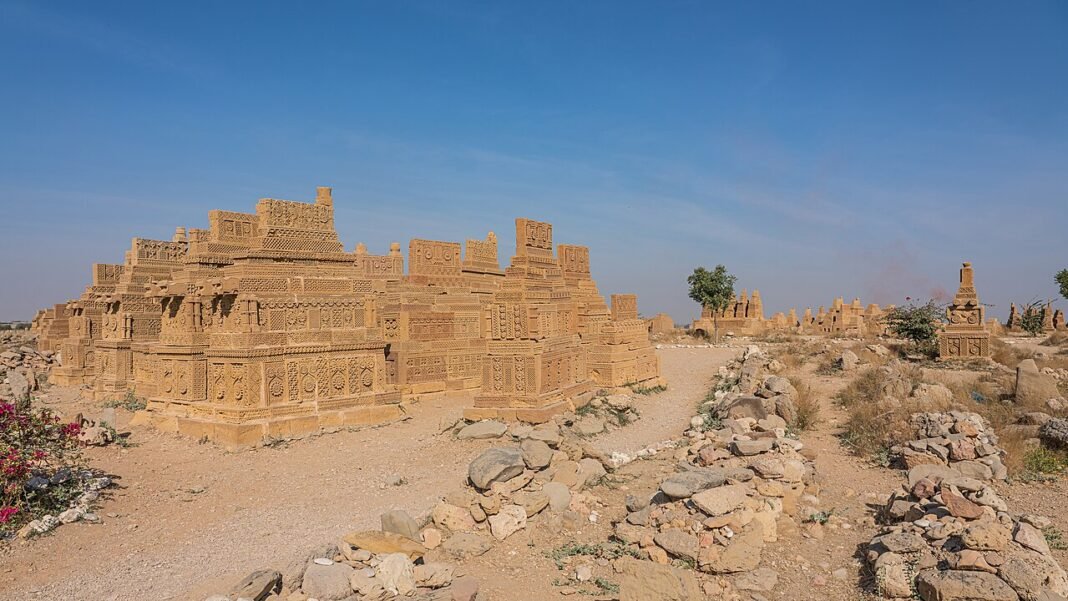
Not far from Karachi’s northern edge, on the road that runs toward Lasbela, sits one of Pakistan’s strangest and least-visited heritage sites: a cluster of ancient stepped, pyramid-like graves that the official archaeology records of Pakistan call the “Greek (Rommis) Graves” of Bhawani Sarai. Nobody knows exactly why they are called Greek. The Department of Archaeology and Museums lists them under that name, and the style of the tombs — nothing like ordinary graves — has puzzled scholars for generations. If you are the kind of traveller who would rather puzzle over a 2,000-year-old mystery than stand in a queue, this greek (rommis) grave travel guide is for you.
Quick Facts
- Location: Bhawani Sarai, Lasbela District, Balochistan — north of Karachi on the Karachi–Lasbela road
- Famous For: A Chaukhandi-type necropolis of stepped, pyramidal graves, officially listed as “Greek (Rommis) Graves”
- Nearest City: Hub (about 8 km away) and Karachi (roughly 60–70 km to the southeast)
- Accessibility: Roadside stop on the Karachi–Bela highway (N-25); reachable by car or hired vehicle; final approach is on foot over raised ground
- Known Landmarks: The Bhawani Sarai graveyard itself — pyramidal vault-chamber tombs of yellow sandstone, with one grave still standing intact
- Best For: History lovers, archaeology enthusiasts, photographers, off-the-beaten-path explorers, day-trippers from Karachi
Why Visit Greek (Rommis) Grave
Pakistan’s archaeology is famous for Mohenjo-daro and Taxila — the headline sites everyone visits. The Greek (Rommis) Grave belongs to a different, quieter category: the protected monuments that almost nobody sees. It is listed by the Department of Archaeology and Museums as a Monument-Tomb of Lasbela District, protected under the Antiquities Act of 1975, yet it sits in the open countryside with thorny cactus bushes growing between the stones. Visiting it feels less like tourism and more like discovery.
The attraction is the strangeness. These are not the flat rectangular graves you know, nor the domed shrines of the saints. They are hollow, oblong, vault-like chambers of yellow sandstone, built up in stepped, pyramidal tiers in exactly the Chaukhandi style — the famous style of the Chaukhandi tombs near Karachi — yet set far out in the Lasbela plains. In this whole necropolis, only one grave still stands fully intact with the boss-shaped stone on top that marks a male burial. Seeing it, you understand why scholars have debated these graves’ history and art for over a century: the architectural style is quite different from common graves, and it clearly belonged to people of consequence.
Then there is the name. Why “Greek”? The honest answer is that nobody has proven the connection. Local tradition and the official listing both use the name, and one theory is that the graves’ unfamiliar, ancient look earned them the label of something foreign and old. The archaeology records place their relative chronology anywhere between the 6th century BCE and the 11th century CE — a huge window that tells you how much remains unknown. For a traveller who loves a genuine mystery rather than a polished story, that uncertainty is the whole point.
And practically, it is easy. The site is a natural stop on the Karachi–Hub–Bela road, reachable as a half-day trip from Karachi. Combine it with the coastline at Gadani or Sonmiani, and you have one of the most rewarding short road trips in southern Pakistan.
History of Greek (Rommis) Grave
The graves at Bhawani Sarai belong to the Chaukhandi family of tombs — the stepped, pyramidal necropolis style reported across Balochistan and Sindh. In Balochistan, groups of this type are documented at Hindian, Ras Malan, Agore on the Hingol River, and Kandiwari in Lasbela; in Sindh, the groups near Karachi are commonly known as the Chaukhandi and Baluch tombs. The Bhawani Sarai group is Lasbela’s contribution to this ancient funerary tradition.
The official record comes from the Federal Department of Archaeology and Museums, published in “Archaeological Sites and Historical Monuments Protected Under the Antiquities Act, 1975” (1987), with the field description drawing on the scholarship of Ahmad Nabi Khan. It describes the Bhawani Sarai graveyard as standing north of Karachi on the Karachi–Lasbela road, about 8 km from Hub Chauki near milestone 20, on the right side of the road toward Bela. The graves occupy a raised mound about 3 metres high, covering an area of roughly 107 metres north–south by 73.1 metres east–west.
What makes scholars take these graves seriously is the construction. They are not simple earth burials: each tomb is a hollow, oblong, vault-like chamber of yellow sandstone, raised in the stepped pyramidal form of the Chaukhandi tombs. In this necropolis the male grave could be identified by a boss-shaped stone placed on top — and today only one grave still stands intact with that feature. Most of the rest are in ruins, with dislocated stones lying scattered at certain points and the whole ground covered in thorny cactus bushes.
The dating is deliberately cautious. The Department of Archaeology assigns a relative chronology of the 6th century BCE to the 11th century CE — in other words, these tombs could be anywhere from the Achaemenid era to the early medieval period. Because the architectural style differs so sharply from ordinary graves, it has drawn the interest of many scholars regarding their history and art, though no single definitive account has emerged. The “Greek” name appears in the official listing itself, and the “Rommis” in parentheses is part of that official nomenclature. One plausible reading is that “Greek” was a local label for anything ancient and foreign-looking, applied long before modern archaeology. Whatever the origin, the name has stuck in the national register.
Legally, the site is protected under the Antiquities Act 1975 (as amended in 1992), even though the land itself is privately owned — a common arrangement for Pakistan’s heritage sites. That protected status is the reason the graves, ruinous as they are, have survived the quarrying and development that has claimed other ancient sites along this corridor.
Top Things to Do in Greek (Rommis) Grave
Study the pyramidal tomb architecture
Walk slowly around the mound and compare the stepped, tiered profiles of the tombs with photographs of the Chaukhandi tombs near Karachi. The family resemblance is unmistakable — the same hollow oblong chambers, the same pyramidal build — yet here they stand in the open Lasbela landscape with the hills behind them. Bring a camera with a decent zoom: the tiering reads best in side light, morning or late afternoon.
Find the one intact male grave
According to the archaeology records, only one grave in the whole necropolis still stands intact with the boss-shaped stone on top that marks a male burial. Finding it among the ruins is half the fun of the visit. Look for the complete vault chamber rather than the collapsed sections, and photograph it for the record — every image helps document a protected monument.
Read the landscape: milestone 20 and the Bela road
Stand at the raised ground, 3 metres above the plain, and look along the old Karachi–Bela route. The graves were deliberately placed on this elevation beside the road — a landmark for travellers for perhaps two millennia. The same corridor today carries the N-25 highway, and you can still feel why this spot commanded attention.
Photograph the contrast of ruin and desert
Yellow sandstone against thorny green cactus, collapsed vaults against wide sky — the Bhawani Sarai graveyard is a photographer’s study in texture. Golden hour, just after sunrise or before sunset, flatters the stonework best. Drones are usable in principle, but fly considerately: this is a protected monument and private land.
Famous Places In and Around Greek (Rommis) Grave
- Chaukhandi Tombs (near Karachi): The famous Sindh counterpart of this necropolis style — visit both to compare the tomb traditions. See also our Ancestral Graveyard of Jam of Lasbela travel guide for another Lasbela funerary site.
- Gadani Beach: About an hour’s drive southwest — one of Pakistan’s longest beaches and home to the famous ship-breaking yard.
- Sonmiani Bay: Further along the coast; calm waters and fishing boats, good for a seaside extension.
- Hub Dam: Northeast of Hub town; a reservoir in the hills that supplies water to Karachi, with scenic surroundings.
- Hingol National Park: A longer drive west along the Makran Coastal Highway — mud volcanoes, the Hinglaj temple and dramatic canyon landscapes.
How to Reach Greek (Rommis) Grave
The site sits on the Karachi–Lasbela road (N-25, the RCD Highway) near milestone 20, about 8 km from Hub Chauki, on the right side of the road as you travel toward Bela. From Karachi it is roughly 60–70 km to Hub, about 1–1.5 hours by car depending on traffic leaving the city. The most practical approach is a hired car or your own vehicle from Karachi — there is no tourist transport to the site, though public vans and buses run the Karachi–Hub–Bela corridor and can drop you near Hub Chauki, from where you would need a local rickshaw or taxi.
From Islamabad: Fly to Karachi (about 2 hours), then drive north on the N-25. From Lahore: Fly to Karachi (about 1.5–2 hours), then drive. From Karachi: Take the Northern Bypass or University Road out to the N-25 toward Hub; pass Hub town and continue to milestone 20 near Bahawani Sarai. The nearest airport is Jinnah International Airport, Karachi.
Road conditions on the N-25 are generally good — it is a major national highway — but the final approach to the graveyard is on foot over rough, raised ground covered in thorny bushes. Wear closed shoes and long trousers. There are no facilities at the site: no ticket office, no water, no shade. Plan it as a stop on a wider Hub/Lasbela day trip, not a standalone destination with services.
Route Details
- Leave Karachi on the N-25 (RCD Highway) toward Hub and Quetta.
- Pass through Hub town and cross Hub Chauki; continue about 8 km toward Bela.
- Watch for milestone 20 near Bahawani Sarai; the graveyard stands on the right side of the road, on a raised mound about 3 metres high.
- Park safely off the highway shoulder and walk up to the necropolis.
- Respect the site: do not climb on the vaults, move stones, or take anything. It is a protected monument on private land.
Where to Stay in Greek (Rommis) Grave
There is no accommodation at the site — it is an open roadside monument. The sensible options are Hub town, about 8 km back toward Karachi, which has basic budget hotels and guesthouses used by highway travellers and traders, or Karachi itself, where the full range of luxury, mid-range and budget hotels is available. Most visitors treat Bhawani Sarai as a day trip from Karachi: leave in the morning, visit the graves, continue to Gadani beach for lunch by the sea, and return by evening.
If you are travelling the full Karachi–Bela–Khuzdar corridor, Hub also works as an overnight base before heading deeper into Lasbela. Book nothing fancy here — Hub’s hotels are functional rather than comfortable. For a more rewarding stay, base yourself in Karachi and hire a driver for the day.
Where to Eat: Local Foods of Greek (Rommis) Grave
Bring your own food and water — there is nothing at the graveyard itself. Hub town, a few minutes back down the road, has roadside dhabas serving the standard highway fare: dal, sabzi, roti, chicken karahi and chai, all budget-friendly and freshly cooked. Balochistan’s beloved sajji (whole roasted lamb or chicken) is widely available in the region and worth seeking out if you continue toward Bela.
For a proper meal, most day-trippers eat in Karachi before leaving or at Gadani’s beachside eateries on the way back — fresh fried fish is the local specialty along this coast. Carry at least two litres of water per person; the Lasbela plain is hot and there is no shade at the site.
Weather in Greek (Rommis) Grave
The Bhawani Sarai area shares Karachi’s coastal-arid climate, slightly hotter and drier inland. The comfortable window is short: late autumn through early spring. Summer visits are possible only in the early morning.
| Season | Temperature Range | Conditions |
|---|---|---|
| Winter (Dec–Feb) | 10–25°C | Mild and pleasant; the best season for the site and for coastal extensions |
| Spring (Mar–Apr) | 20–35°C | Warming up; mornings still comfortable for exploring |
| Summer (May–Jul) | 35–45°C | Extreme heat and dust; visit only at dawn, carry extra water |
| Monsoon (Jul–Sep) | 30–38°C | Humid with occasional downpours; the N-25 can flood in heavy rain |
| Autumn (Oct–Nov) | 22–33°C | Cooling down; second-best window after winter |
Language and Culture of Greek (Rommis) Grave
Lasbela is a Baloch-majority district with Brahui also spoken; Urdu works for basic communication with drivers and shopkeepers, and English is understood in Karachi’s travel services. The graveyard stands on private land, so the key cultural rule is respect: greet any locals you meet, explain you have come to see the old graves, and ask before crossing cultivated or enclosed ground.
Do not treat the tombs as a climbing frame. These are protected antiquities and, for local people, the resting places of the dead — walk around them, not over them, take photographs but leave every stone where it lies. Dress modestly (covered shoulders and knees), as you would anywhere in rural Balochistan. If you visit during Friday prayer times, keep noise low near any settlement.
Shopping in Greek (Rommis) Grave
There is nothing to buy at the site, and no souvenir stalls — which, for an authentic experience, is part of the charm. Hub town’s bazaar covers daily needs: dry fruits, dates and basic supplies for the road. Karachi’s Empress Market or the handicraft shops of Clifton offer Balochi embroidery, camel-skin crafts and onyx work if you want a keepsake of the region. Do not expect — or ask for — any “souvenir” from the graveyard itself; removing stones from a protected monument is illegal as well as wrong.
Travel Tips for Greek (Rommis) Grave
Packing Essentials
Closed walking shoes (the ground is thorny), long trousers, a hat, sunscreen, at least two litres of water per person, and snacks. A camera with zoom, a fully charged phone, and a power bank — there is no electricity at the site. A small first-aid kit is wise for thorn scratches.
Safety Tips
The N-25 is a busy truck route: park well off the carriageway and watch for traffic when crossing. The site itself is remote — travel in daylight, ideally with a companion or a hired driver who waits for you. Keep valuables out of sight in the car. Check the security situation in Lasbela through local contacts before setting out, as conditions can change.
Money & Connectivity
Carry cash in Pakistani rupees — there are no card facilities anywhere near the site. ATMs are available in Hub town. Mobile coverage (Jazz, Telenor, Zong, Ufone) is generally available along the N-25 corridor, though it can dip between settlements.
Best Time to Visit Greek (Rommis) Grave
Winter (December–February): Ideal
Mild temperatures, clear light and comfortable walking conditions. This is when the stonework photographs best and the coastal extension to Gadani is most pleasant.
Spring and Autumn (March–April, October–November): Good
Warmer but manageable if you arrive before 10 AM. Combine with the early-morning light for the best tomb photography.
Summer and Monsoon (May–September): Avoid If Possible
Extreme heat, dust and the risk of highway flooding make this the wrong season for a ruin with no shade and no water. If you must go, make it a dawn visit only.
Final Thoughts
The Greek (Rommis) Grave will never be a mass-tourism site, and that is precisely its value. In an hour on that raised mound — reading the stepped tiers of yellow sandstone, finding the single intact grave with its boss-shaped stone, wondering why the official records call them “Greek” — you will have an experience that no crowded monument can offer. Pair it with Gadani’s shoreline or a night in Karachi, and it becomes one of the most memorable half-days in southern Pakistan.
If ancient mysteries are your kind of travel, keep exploring our Explore Pakistan guides — from the mountain fortresses of Malam Jabba to the valleys of the north, the country’s hidden heritage rewards those who look for it.
FAQs
1. Where is the Greek (Rommis) Grave located?
At Bhawani Sarai in Lasbela District, Balochistan — north of Karachi on the Karachi–Lasbela road (N-25), about 8 km from Hub Chauki near milestone 20, on the right side of the road toward Bela.
2. Why is it called the “Greek” grave?
The name appears in the official records of Pakistan’s Department of Archaeology and Museums. No proven Greek connection exists; it is likely a traditional label for the tombs’ ancient, unfamiliar appearance. Their relative dating spans the 6th century BCE to the 11th century CE.
3. What is the best time to visit?
Winter (December–February) is ideal, with mild 10–25°C weather. Spring and autumn mornings are also good. Avoid the summer heat.
4. How do I reach it from Karachi?
Drive north on the N-25 toward Hub and Bela — roughly 60–70 km, 1–1.5 hours. The graveyard is a roadside stop near milestone 20; there is no public tourist transport, so hire a car or take a Karachi–Hub van and arrange local transport from Hub Chauki.
5. Is it safe to visit?
As a daytime roadside stop with a driver, it is generally fine, but the site is remote with no facilities. Travel in daylight, keep valuables secured, and check current local conditions before going.
6. Is there an entry fee?
There is no ticket office or formal entry fee. The site is a protected monument on private land — visit respectfully and leave everything undisturbed.
7. What should I bring?
Water, snacks, sun protection, closed shoes and a camera. There are no shops, shade or washrooms at the site.
8. What else can I see nearby?
Combine it with Gadani Beach, Sonmiani Bay, Hub Dam, or the Chaukhandi Tombs near Karachi for comparison — and see our Ancestral Graveyard of Jam of Lasbela guide for another Lasbela heritage stop.
 Grave, Pakistan? Discover why it deserves your visit, the best time to go, top things to do and how to reach.)