In the pounding heart of Saddar, Karachi’s oldest commercial quarter, traffic swirls around Zainab Market, hawkers call out their prices. Also, the city moves at its famous frantic pace. Then you step through a gate on Fatima Jinnah Road, and the noise falls away. Before you stands Holy Trinity Cathedral. A great buff-stone church consecrated in 1855, its tower rising over gardens of privet hedges and rose beds, its walls holding the memorials of British soldiers, its stained glass glowing with 170 years of Karachi history. It is one of the first major churches ever built in the city.
It remains the seat of the Church of Pakistan’s Diocese of Karachi.
You don’t need to be Christian to be moved by this place. Holy Trinity is a time machine: a garrison church built when Karachi was a dusty colonial port, whose tower once guided ships into the harbour, and whose stones have witnessed the entire transformation of a fishing village into one of the world’s great megacities. Also, this holy trinity cathedral karachi travel guide will help you plan a visit — what to see. To go, and how to fold it into a day exploring old Karachi.
Quick Facts
- Location: Fatima Jinnah Road, near Zainab Market, Saddar, Karachi, Sindh.
- Founded: 1844; built and consecrated 1855 — one of the first major churches in Karachi.
- Famous For: Its 170-year history as a British garrison church; a tower that once served as a lighthouse for ships entering Karachi Harbour; memorials to colonial-era soldiers; stained-glass windows including a 130-year-old window damaged in a 2004 blast.
- Nearest City: It is in central Karachi itself — Saddar is the city’s historic downtown.
- Accessibility: Very easy — central location, reachable by taxi, ride-hailing, or bus from anywhere in Karachi. Visitors are welcome outside service times; dress modestly and respectfully.
- Known Landmarks: The 115-foot tower, the Romanesque entrance arch, the nave memorials, the stained-glass windows, the walled gardens.
- Best For: History lovers, architecture enthusiasts, photographers, and anyone exploring colonial-era Karachi.
Why Visit Holy Trinity Cathedral, Karachi
Karachi is often experienced as a blur of traffic and commerce. Also, the city’s soul lives in its old stones. In fact, And Holy Trinity is among the oldest and most eloquent of them. Captain John Hill of the Bombay Engineers designed the church, and builders raised it from local buff-coloured Gizri stone in a style that stood out dramatically from everything around it. Its nave stretched 115 feet. Its tower soared to 150 feet — so tall, and so visible from the sea, that beacons were placed at its top to guide ships into Karachi Harbour in the days before the city had a lighthouse.
Imagine that: a church tower doing the work of a lighthouse, its lights a promise of safe harbour.
Inside, the cathedral is a museum of empire and faith intertwined. Also, the walls of the somber nave carry memorial plaques to British servicemen who died in various 19th-century campaigns. In fact, the church was built as a garrison church to hold 800 worshippers, and it wears that military history openly. In addition, the stained glass includes work of real beauty. A bomb blast in 2004 buckled one 130-year-old window, and painstaking care holds it together today. A quiet testament to both the violence the city has endured and the determination to preserve. During the First World War, the tower served as a signalling station.
Every corner of the building has a story.
A Living Church, Not a Relic
But Holy Trinity is not a relic — it is a living church. It remains the seat of the Church of Pakistan, Diocese of Karachi. An active place of worship for the city’s Protestant Christian community, with services in English on Sunday mornings. Visiting during a service (sitting quietly at the back) lets you experience the building as it was meant to be experienced: filled with voices, with light moving through the glass, with a congregation that has worshipped here across centuries.
Finally, the cathedral is the perfect anchor for a heritage day in Saddar. Within walking distance or a short drive are Empress Market, Frere Hall, Denso Hall. The chaos and colour of Burns Road’s food street. Few city blocks in Pakistan pack so much history into so little space. Come for the cathedral; stay for old Karachi.
History of Holy Trinity Cathedral, Karachi
The story begins in 1844, just a year after the British annexed Sindh. Karachi was then a small fortified town. The British military needed a garrison church for its troops — and so Holy Trinity was founded, with the building itself completed and consecrated in 1855. Designed by Captain John Hill of the Bombay Engineers, it was one of the first major churches built in the area, constructed from buff-coloured Gizri stone quarried locally. Its Romanesque layout and soaring tower made it a landmark visible for miles — including from the sea, where its beacon lights guided ships into Karachi Harbour.
The 19th century was the cathedral’s golden age. Also, As Karachi grew from a garrison town into the subcontinent’s great western port, Holy Trinity grew with it. The spiritual home of the city’s British community, its walls accumulating the memorials of soldiers and officials who died in the campaigns of empire. A 19th-century observer likened the five-storey tower to a giraffe. The writer Jan Morris later and less kindly called it “a grotesque campanile.” Either way, nobody ignored it.
The Tower That Lost Its Top
The 20th century brought change and challenge. Also, In 1904, Captain John Hill himself returned with Chief Engineer John Brunton to inspect the building — and found the foundations showing signs of weakness. The tower lost its top two storeys, bringing it down to its present 115 feet. During the First World War, the tower did duty as a signalling station. In the 1970s, termites had badly damaged the original pitched roof, so builders replaced it with a concrete barrel vault, giving the interior its present form.
The church has also known sorrow. In 2004, a bomb blast buckled a 130-year-old stained-glass window, a reminder of the insecurities Pakistan’s Christian community has faced. Yet the cathedral endures: still consecrated, still served, still the seat of the Diocese of Karachi — 170 years after its dedication, a survivor in stone.
Top Things to Do in Holy Trinity Cathedral, Karachi
Admire the Tower and Exterior
Start outside. Also, the buff Gizri stone glows warm in the morning light. The 115-foot tower — once 150 feet before the top two storeys were removed in 1904 — dominates the compound. Look for the elegant Romanesque entrance arch, and remember that this tower once carried beacon lights guiding ships into Karachi Harbour. A 1904 postcard view of the cathedral shows the tower in its original five-storey glory.
Walk the Nave and Read the Memorials
Inside, the long nave holds the cathedral’s most moving feature: wall memorials to British servicemen and colonial officials of the 19th century. Also, read a few — each is a small biography of empire, of young men who died far from home in campaigns whose names are now footnotes. In fact, it is history at its most human scale.
Study the Stained Glass
The cathedral’s stained-glass windows include beautiful 19th-century work. Also, ask about the 130-year-old window damaged in the 2004 blast — its careful preservation tells a story of resilience. Visit on a bright morning when sunlight streams through the glass and the colours fall across the stone floor.
Attend a Sunday Service
Holy Trinity remains an active church with English-language services on Sunday mornings. Visitors are welcome; sit quietly, dress modestly, and experience the building alive with worship as it has been for 170 years. Check service times before you go.
Wander the Gardens
The cathedral sits within walled gardens bordered with privet hedges and rose beds — an oasis of calm in the middle of Saddar’s beautiful chaos. Also, take ten unhurried minutes here. In fact, the contrast with Fatima Jinnah Road outside the gates is one of Karachi’s great small pleasures.
Famous Places In and Around Holy Trinity Cathedral, Karachi
- Zainab Market: Right beside the cathedral — Karachi’s famous market for clothes, fabrics, and handicrafts.
- Empress Market: The great 1889 colonial market hall, a short drive away — spices, produce, and atmosphere.
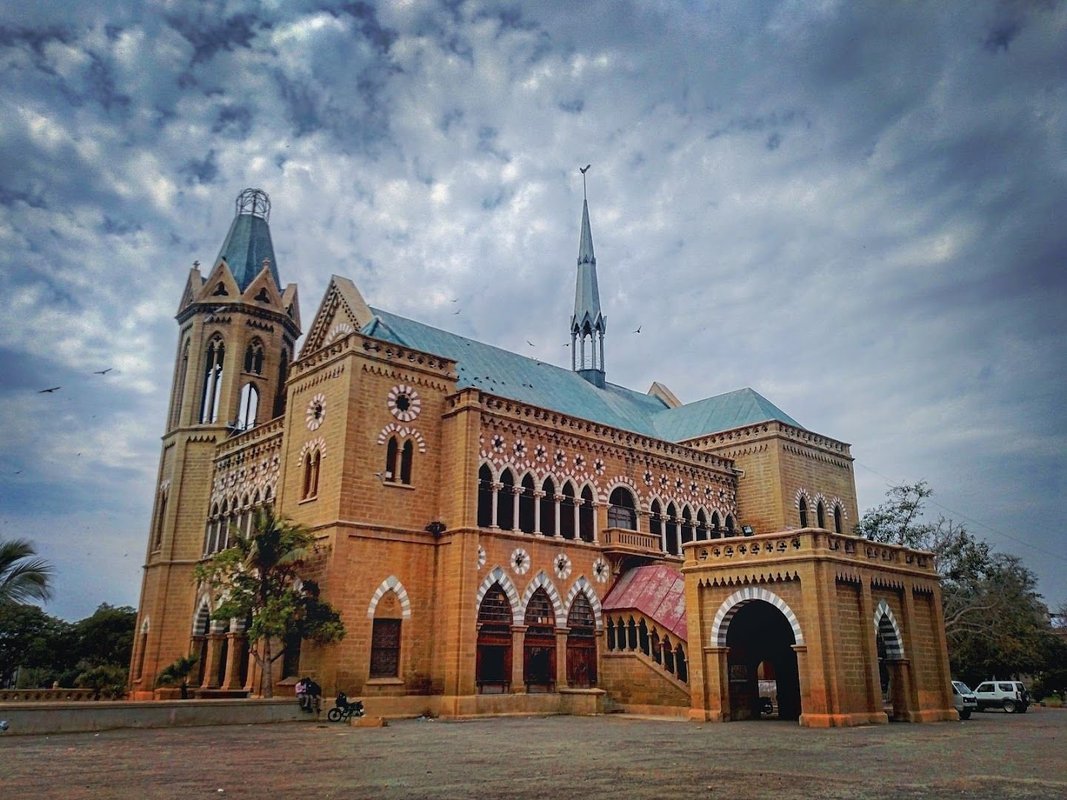
- Frere Hall: The iconic 1865 Venetian-Gothic public hall with its gardens, a few minutes away.
- Denso Hall: Another colonial-era Saddar landmark, built as a public library and hall.
- Burns Road: Karachi’s legendary food street — nihari, biryani, kebabs, and desserts, at its liveliest after dark.
- St. Patrick’s Cathedral: Karachi’s great Catholic cathedral, the city’s other historic church worth visiting for comparison.
How to Reach Holy Trinity Cathedral, Karachi
The cathedral sits on Fatima Jinnah Road in Saddar — about as central as Karachi gets. Also, reaching it is easy from anywhere in the city.
Within Karachi: From Jinnah International Airport it is roughly 15–20 km (30–50 minutes depending on traffic) by taxi or ride-hailing (Careem, inDrive. Also, uber-style services all operate). From Clifton/Defence, allow 30–45 minutes; from Gulshan or North Karachi, up to an hour in peak traffic. Saddar is also served by Karachi’s bus network. Parking near the cathedral is limited — ride-hailing is the least stressful option.
From Islamabad: Fly to Karachi (around 2 hours, frequent daily flights), then taxi to Saddar. By road, the N-5/M-9 route is roughly 1,400 km — a very long drive best broken overnight; most visitors fly.
From Lahore: Fly to Karachi (around 1 hour 45 minutes), then taxi to Saddar. The road journey is similarly long (around 1,200 km); flying is the sensible choice.
Nearest airport: Jinnah International Airport, Karachi.
Road conditions by season: Karachi’s roads are usable year-round. Also, the monsoon (July–August) can cause localised flooding and worse traffic — plan extra time.
Transport options: Ride-hailing apps are the easiest for visitors; metered taxis and auto-rickshaws are plentiful in Saddar. Also, for a heritage day covering the cathedral, Empress Market, Frere Hall. In fact, Burns Road, hire a car with driver for the day — inexpensive and far more comfortable.
Route Details
- Fly into Jinnah International Airport, Karachi (from Islamabad ~2 hrs, Lahore ~1 hr 45 min).
- Take a taxi/ride-hailing car to Saddar — ask for Fatima Jinnah Road near Zainab Market.
- Visit the cathedral (mornings are best for light and calm); allow 1–2 hours.
- Walk or drive to nearby Zainab Market, Empress Market, and Frere Hall.
- End the day with dinner on Burns Road food street, at its best after sunset.
Where to Stay in Holy Trinity Cathedral, Karachi
Saddar and its surroundings offer Karachi’s widest range of accommodation, from grand to basic — all within minutes of the cathedral.
Upscale: Karachi’s major five-star hotels are a 10–20-minute drive from Saddar (toward Clifton and the airport road), offering full-service comfort for heritage travellers who want a calm base.
Mid-range: Saddar itself and nearby areas have numerous mid-range hotels and serviced apartments — convenient for walking to the cathedral, Zainab Market, and Burns Road. Also, choose well-reviewed options; standards vary.
Budget: Simple guesthouses and budget hotels cluster around Saddar and Karachi Cantt station — inexpensive and central, though basic. Fine for travellers who spend their days out exploring.
Where to Eat: Local Foods of Holy Trinity Cathedral, Karachi
You are in the middle of one of Pakistan’s great food districts. For example, this is a genuine highlight of the visit. Burns Road, minutes from the cathedral, is Karachi’s legendary food street: beef nihari simmered overnight, chicken tikka and seekh kebabs, biryani, haleem, lassi, and traditional desserts like rabri and gulab jamun. Meanwhile, it comes alive after dark and is at its best late in the evening.
Saddar itself is full of old-school cafes and restaurants. Parsi cafes, barbecue houses, and bakeries (Karachi’s bakery culture, including the famous hot cross buns tradition of the old Goan bakeries, is part of the Christian community’s delicious legacy in this neighbourhood). Also, Zainab Market’s surroundings have excellent, inexpensive street food: bun kebabs, chaat, fresh juices, and chai dhabas.
A full Burns Road dinner is very budget-friendly; mid-range restaurants in Saddar are modestly priced. Also, eat where the locals queue — it’s never wrong.
Weather in Holy Trinity Cathedral, Karachi
Karachi is warm to hot for most of the year, with humidity peaking in the monsoon. Also, winters are the city’s beloved season — mild, dry, and perfect for walking heritage Saddar. In fact, the cathedral’s stone interior stays noticeably cool even on hot days.
| Season | Temperature Range | Conditions |
|---|---|---|
| Winter (Dec–Feb) | 12 to 28°C | The best season — cool mornings, warm afternoons, ideal for sightseeing on foot. |
| Spring (Mar–Apr) | 22 to 36°C | Warming up; still good for morning visits. |
| Summer (May–Jun) | 30 to 40°C | Hot and humid; visit early morning, then retreat to air conditioning. |
| Monsoon/Autumn (Jul–Nov) | 28 to 36°C | Humid with monsoon rains Jul–Aug; autumn dries out and improves steadily. |
Language and Culture of Holy Trinity Cathedral, Karachi
Karachi is Pakistan’s great melting pot, and the cathedral reflects it. Also, services are held in English. In fact, the congregation includes Urdu, Punjabi. In addition, Goan Christians among others — descendants of communities that came to Karachi with the British in the 19th century from Goa and settled in Saddar, Keamari, and Ghari Khatta. Urdu is the city’s lingua franca, English is widely spoken, and you’ll hear Sindhi, Punjabi, Pashto. Balochi in the bazaars outside.
As a visitor to an active place of worship: dress modestly (covered shoulders and knees. Women may wish to carry a scarf), speak quietly, switch your phone to silent, and don’t walk around during prayers or the sermon. Photography inside is usually tolerated but ask first — and never use flash near the stained glass or during services. The church community is welcoming; a polite greeting and genuine interest go a long way.
Shopping in Holy Trinity Cathedral, Karachi
Step out of the cathedral gates and you’re in shopping territory. Zainab Market, right beside the church, is famous for fabrics, ready-made clothes, and handicrafts at bargain prices — haggle cheerfully. Empress Market is the place for spices, dry fruits. Also, the sensory overload of a 19th-century market hall. Saddar’s side streets hide bookshops, electronics, and old tailors. This is street-and-bazaar shopping at its most authentic. Karachi’s actual shopping malls (Dolmen, Lucky One) are out toward Clifton and Gulshan, a drive away — but for the heritage day around the cathedral, the bazaars are the point.
Local Events and Festivals
As an active cathedral, Holy Trinity’s year turns on the Christian calendar. Christmas is the great celebration — midnight mass on Christmas Eve and services on Christmas Day draw large congregations. The church is decorated beautifully. Easter services are similarly significant. These are genuine community occasions rather than tourist events; respectful visitors are welcome at public services. If you’re in Karachi in December, an evening visit to see the church dressed for Christmas, followed by the Saddar bazaars in their festive bustle, is magical. (Note: security arrangements around churches can be heightened during major festivals — carry ID and allow extra time.)
Travel Tips for Holy Trinity Cathedral, Karachi
Packing Essentials
Modest clothing (essential for the church), comfortable walking shoes for Saddar’s pavements, sun protection, and a water bottle. Also, carry a scarf. In fact, keep valuables minimal and secure — Saddar is crowded.
Safety Tips
Saddar is busy and generally safe in daylight for alert visitors, but keep phones and wallets secure in crowds, use ride-hailing rather than hailing unknown taxis at night, and avoid flashing expensive gear. Check the church’s visiting arrangements before going — as an active place of worship with security considerations, it’s wise to visit in the morning and confirm access.
Money & Connectivity
ATMs are plentiful in Saddar; carry some cash in rupees for bazaars and street food. Also, all major mobile networks (Jazz, Telenor, Zong, Ufone) have strong 4G coverage throughout central Karachi.
Best Time to Visit Holy Trinity Cathedral, Karachi
December to February — Perfect
Karachi’s winter is made for heritage walks: cool, dry, golden light. Also, combine the cathedral with Empress Market, Frere Hall, and Burns Road in a single glorious day. In fact, Christmas-season visits add festive atmosphere.
March to April and October to November — Good
Warm but manageable, especially in the mornings. The gardens are at their greenest after any rain.
May to September — Hot
Visit early in the morning (the stone interior stays cool), then plan indoor or air-conditioned activities for midday. Monsoon rains in July–August can disrupt plans — check the forecast.
Final Thoughts
Holy Trinity Cathedral is proof that Karachi’s history isn’t lost — it’s just waiting behind gates most people hurry past. In a city that reinvents itself daily, this buff-stone church has stood for 170 years: through empire and independence, through war and turbulence, still holding services, still keeping its gardens, still watching over Saddar. To visit is to meet the Karachi that existed before the megacity — and to understand the one that exists now a little better.
Go on a winter morning. The light comes through the stained glass and the rose beds are in order and the city outside hasn’t yet reached full roar. Stand in the nave, read a memorial or two, and listen. Old buildings speak, if you give them a quiet hour. Holy Trinity has more to say than most.
FAQs
Where is Holy Trinity Cathedral located?
On Fatima Jinnah Road, near Zainab Market in Saddar, central Karachi, Sindh.
When was Holy Trinity Cathedral built?
Founded in 1844 and built/consecrated in 1855, it is one of the first major churches ever built in Karachi. Captain John Hill of the Bombay Engineers designed it.
What is the best time to visit?
December to February. Also, Karachi’s mild, dry winter is ideal for exploring Saddar on foot. In fact, mornings offer the best light inside the church.
How do I reach Holy Trinity Cathedral?
It’s in central Saddar — 30–50 minutes by taxi or ride-hailing from Jinnah International Airport. Also, a short ride from anywhere in central Karachi. Meanwhile, From Islamabad or Lahore, fly to Karachi first.
Is Holy Trinity Cathedral safe to visit?
Yes — visit in daylight, dress modestly, and respect that it’s an active place of worship. Also, take normal big-city precautions in the surrounding bazaars.
Planning Your Visit
Is it suitable for families?
Yes. Also, children interested in history enjoy the tower, the gardens, and the memorials. In fact, combine with Empress Market and Frere Hall for a full family heritage day.
Where can I stay nearby?
Saddar has mid-range and budget hotels within walking distance. Also, Karachi’s upscale five-star hotels are a 10–20-minute drive away.
What food is nearby?
Burns Road food street (nihari, kebabs, biryani, desserts) is minutes away and legendary. Also, Saddar’s cafes and Zainab Market street food are excellent and inexpensive.
Can non-Christians visit the cathedral?
Yes — respectful visitors of all faiths are welcome outside service times. Also, it may attend public Sunday services quietly. Dress modestly and ask before photographing inside.
For Karachi’s other great historic church, read our Christ Church, Karachi guide, pair your visit with Frere Hall and Empress Market, or browse the full Explore Pakistan collection.