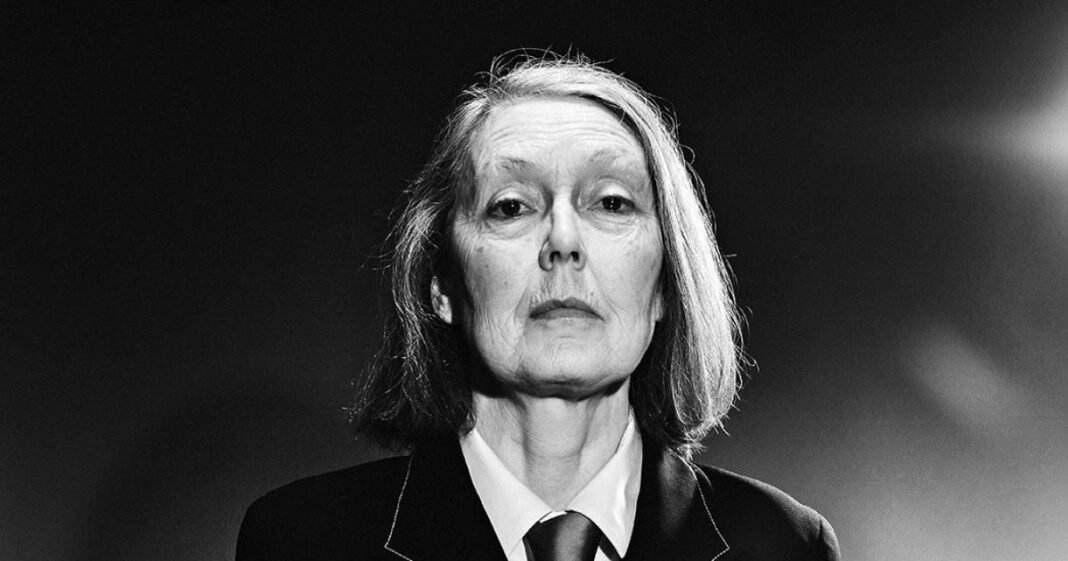
Anne Carson Nobel Prize: Canadian poet wins 2026 literature award
The Anne Carson Nobel Prize announcement came from Stockholm on Thursday: the Canadian poet, essayist and classicist has won the 2026 Nobel Prize in Literature for her bold and inventive body of work, the Swedish Academy said, honouring an oeuvre that blends verse, prose, dialogue and translation in a genre-defying mix.
The 76-year-old, who was born in Toronto and keeps a home in Iceland, was on the Arctic island when the Academy called with the news. “Crazy, I think they’re all crazy,” Carson told Icelandic broadcaster RUV when asked how she felt. “I’ll get a sticker on the front of my book.”
Ingrid Carlberg, permanent secretary of the Academy, said Carson had been taken completely by surprise. “All she had time to tell me was that she is for the moment in Iceland, where she’s listening to the wind,” Carlberg told the press conference in Stockholm.
What the Academy said about Anne Carson’s work
The citation recognises Carson “for her bold and inventive oeuvre that, in playful dialogue with the classical tradition, has created new forms for contemporary literature”. The prize is worth 12 million Swedish crowns (about $1.2 million).
“Almost all her literary production has centred upon the intersection between the philologist’s obsession with words and the poet’s desire for new meaning,” the Academy said. “She has herself identified the etymology of words as the starting point for all her work. Her translations from Classical Greek may be regarded as independent works in their own right.”
Carson began her career as a scholar of ancient Greek, earning her doctorate from the University of Toronto and teaching at McGill, the University of Michigan and Princeton. Her translations of Sappho, Euripides and other classical writers heavily influence her own writing, which ranges from opera libretti and literary criticism to verse novels.
Autobiography of Red and a glittering list of awards
Her best-known work, the 1998 verse novel Autobiography of Red, retells the Greek myth of the monster Geryon, recasting him as a tender young hero in a modern love story. Other landmarks include Eros the Bittersweet (1986), The Beauty of the Husband (2001) and the 2019 performance piece Norma Jeane Baker of Troy, which mixes Euripides’ Helen of Troy with the story of Marilyn Monroe.
Long before Stockholm called, Carson had accumulated almost every major literary honour: the Lannan Literary Award, a MacArthur Fellowship, two Griffin Poetry Prizes, the T.S. Eliot Prize, the Princess of Asturias Award, the Governor General’s Award and the PEN/Nabokov Award. She was appointed a Member of the Order of Canada in 2005.
Second Canadian laureate
Carson becomes the second Canadian to win the Nobel Prize in Literature, thirteen years after Alice Munro received it. Two English-speaking Canadians had been among the most discussed names ahead of Thursday’s announcement: Margaret Atwood, internationally famous, and Carson, whose work remains less familiar to some foreign audiences despite her towering reputation among poets.
For many writers she has long been a lodestar. The critic Harold Bloom once compared her to Geoffrey Hill and John Ashbery as a writer of “palpable genius”, and poets from Ocean Vuong to Karen Solie count her as a key influence.
FAQ
Who is Anne Carson?
Anne Patricia Carson, 76, is a Canadian poet, essayist, translator and classicist born in Toronto. She taught classics at several North American universities and has written more than twenty books, including Autobiography of Red, Nox and Eros the Bittersweet.
Why did she win the Nobel Prize in Literature?
The Swedish Academy cited her “bold and inventive oeuvre that, in playful dialogue with the classical tradition, has created new forms for contemporary literature”. It praised her blend of scholarship and poetry and her habit of making the literary sketch a central form.
How much is the Nobel Prize in Literature worth?
The 2026 prize carries a cash award of 12 million Swedish crowns, roughly $1.2 million.
Who won the Nobel Prize in Literature before her?
The 2025 literature prize went to Hungarian novelist Laszlo Krasznahorkai. The previous Canadian winner was short-story writer Alice Munro in 2013.