Pakistan pushes G-24 global finance overhaul at Bangkok meetings
BANGKOK: Pakistan has called for a G-24 global finance overhaul as it prepares to take over as chair of the group of developing nations. Finance Minister Muhammad Aurangzeb made the case for reforming the international financial architecture to keep pace with fragmentation disrupting trade and investment, climate shocks eroding development gains, restrictive financial conditions and widening financing gaps.
Speaking as first vice-chair of the G-24 at the finance ministers and central bank governors’ meeting on the sidelines of the International Monetary Fund (IMF) and World Bank annual meetings in Bangkok, Aurangzeb set out three priorities: restoring development as the central objective of the international financial system, making the Bretton Woods institutions more representative and responsive, and building a development-oriented architecture.
He stressed that reform must ensure timely support for countries undertaking difficult reforms while facing external shocks beyond their control. He also reaffirmed Pakistan’s commitment as incoming chair to strengthen the G-24’s collective influence so the Global South’s voice translates into concrete outcomes, and appreciated Nigeria’s leadership of the group.
G-24 global finance overhaul: Pakistan’s three priorities
Aurangzeb told the ministers and governors that a credible overhaul must put development back at the centre of the financial system, give developing countries a real voice in the institutions created at Bretton Woods, and design an architecture that serves growth rather than constrains it.
The pitch comes as Pakistan prepares to chair the G-24, whose membership has expanded to 28 developing nations, as Feature Pakistan reported.
Funding diversification tops Pakistan’s agenda
At investor roundtables run by Jefferies International and Barclays, Aurangzeb highlighted improving fiscal and external balances, consecutive primary surpluses, stronger reserves, rating upgrades and renewed access to capital markets.
The discussions covered the IMF-supported programme, debt management and financing instruments including Sukuk, further Panda bond issuance and tokenisation. Privatisation, tax-base broadening, agricultural income tax, digital enforcement and federal-provincial fiscal coordination also featured.
On funding diversification, the minister told Nikkei Asia that Pakistan would continue to “diversify its funding sources”, hinting at more yuan-based bonds and possible yen-denominated samurai bonds. He said the recent Panda bond would not be a “one-time issuance” and that Pakistan intends to “keep going back and be a repeat issuer”, given that China is the “second largest and deepest capital market in the world”.
Pakistan issued its first Panda bond worth 1.75 billion yuan ($261 million) in mid-May as part of a 7.2 billion yuan programme, with the Asian Development Bank and the Asian Infrastructure Investment Bank providing partial guarantees. He was clear, though, that Pakistan does not want to increase the overall quantum of its external debt.
The delegation also fielded questions on regional geopolitical risks, energy security and liquefied natural gas obligations, as well as economic engagement with the United States and Saudi Arabia. Aurangzeb told Reuters earlier that he expects the economy to grow above 4 per cent this fiscal year and that a privatisation push could raise more than $1 billion.
Meetings on the sidelines
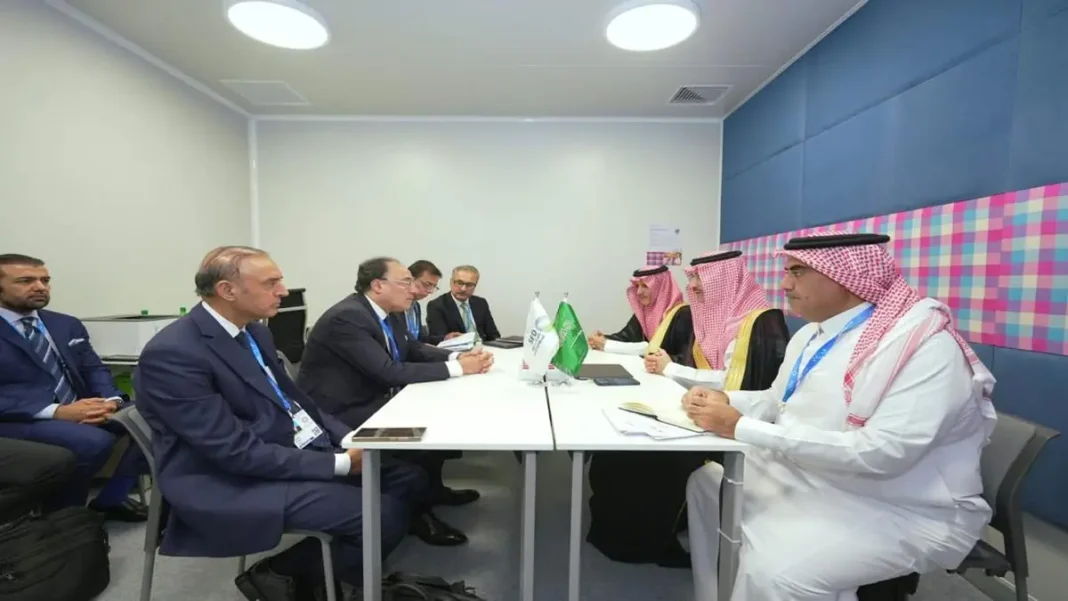
In a meeting with Saudi Fund for Development chief executive Sultan Abdulrahman Al-Marshad, the two sides discussed trade and investment, private-sector engagement, the bilateral investment protection agreement and refinery upgrades. Aurangzeb noted satisfactory progress on SFD-supported projects and sought continued support within the fund’s mandate.
Talks with International Finance Corporation regional vice-president Imad Fakhoury covered small-business financing, capital markets, green and digital bonds, and mining infrastructure and value addition. The minister reaffirmed Pakistan’s commitment to Reko Diq. A separate meeting with Mashreq Bank’s senior management covered digital banking, financial inclusion and digital accounts for overseas Pakistanis, along with tokenisation and digital assets within Pakistan’s evolving regulatory framework.
What it means for Pakistan
Pakistan has been an IMF member since 1950 and is in its 25th arrangement, owing the fund about $10.5 billion. The minister said the programme’s structural reform agenda would lead to sustainability, and that Pakistan would graduate once “the rest of the world becomes convinced that we don’t need the lender of last resort.”
The broader backdrop is familiar to Pakistani readers: the IMF raised the country’s inflation forecast to 9.9 per cent for FY27 while holding growth at 3.5 per cent, and Islamabad is pursuing a parallel funding-diversification drive — including Sukuk, tokenisation and chairmanship of the Borrowers’ Platform council — to reduce dependence on any single lender.
FAQ
Why does Pakistan want a global finance overhaul?
Aurangzeb argues the current financial architecture has not kept pace with fragmentation in trade and investment, climate shocks, tight financial conditions and widening financing gaps faced by developing countries.
What are Pakistan’s three G-24 priorities?
Restoring development as the central objective of the international financial system, making the Bretton Woods institutions more representative and responsive, and building a development-oriented financial architecture.