Quick Facts
- Location: In the heart of Peshawar, Khyber Pakhtunkhwa, on elevated ground near the old city.
- Altitude: The fort rises around 90 feet above the surrounding ground, on a natural mound.
- Famous For: Its Persian name meaning “high fortress”; being the royal residence of Durrani kings, a Sikh-era stronghold, a British garrison, and the headquarters of Pakistan’s Frontier Corps since 1948; the flag hoisting on 14 August 1947.
- Nearest City: Peshawar itself; the fort is inside the city.
- Accessibility: Open to Pakistani visitors on weekends (Saturdays for families, Sundays for all) with CNIC; foreign tourists need prior permission arranged through the Frontier Corps. The fort is a working military headquarters, so entry rules are strict.
- Known Landmarks: The red-brick ramparts, the Sikh-era marble inscription, the Frontier Corps museum, and the rampart-top views over Peshawar.
- Best For: History lovers, military-heritage enthusiasts, photographers, and families looking for a weekend outing in Peshawar.
Why Visit Bala Hisar Fort
Few forts in Pakistan have been at the centre of history for as long as Bala Hisar. The name itself — Persian for “high fortress” — tells you what this place has always been: the strong point of Peshawar, the city that guards the eastern mouth of the Khyber Pass. A fort on this spot was already a royal residence when the Chinese pilgrim Xuanzang visited in the 7th century. Mughals, Durranis, Sikhs and the British each held it, rebuilt it and left their mark on its walls. This Bala Hisar Fort travel guide will walk you through that long story and show you how to visit one of the most historically layered places in the country.
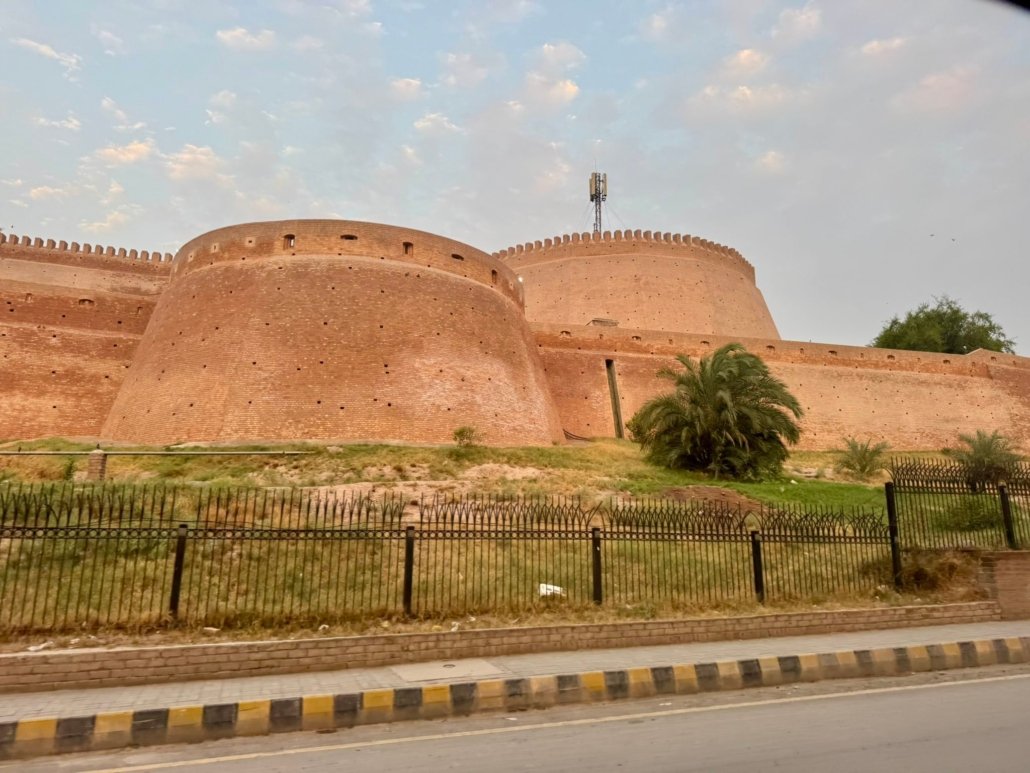
What makes Bala Hisar unusual among Pakistan’s great forts is that it is still a working military headquarters. Since 1948 it has housed the Frontier Corps, and the fort’s courtyards, ramparts and museum are maintained by the force that guards the western frontier. Visiting on a weekend, you walk through a place that is simultaneously a monument and an institution: the red-brick walls the British raised in 1902, the Sikh-period marble inscription on the main courtyard gate, and the museum’s collection of Frontier Corps uniforms and weaponry all sit within an active military environment. It gives the visit a gravity that a purely tourist fort cannot match.
Then there is the view. From the top of the ramparts, Peshawar spreads out below you — the old city’s domes and minarets, the cantonment’s green avenues, and on a clear day the hills that ring the valley. The fort museum adds a dimension most visitors do not expect: alongside the military history there is a section on the culture of Khyber Pakhtunkhwa, with the clothes, weapons and utensils of the tribes of the province, Kohistan and Chitral. For anyone trying to understand Peshawar — not just as a city but as a crossroads of empires — Bala Hisar is where to start.
History of Bala Hisar Fort
The history of Bala Hisar is as old as Peshawar itself, which is to say some two thousand years or more. The Chinese Buddhist pilgrim Xuanzang, who visited the region around 630 CE, described the fort as a royal residence of the city. The settlement here was a seat of the Gandhara civilisation, and the mound on which the fort stands has been occupied since antiquity. Through the early medieval centuries the fort passed through the hands of Hindu rulers, Ghaznavids, Ghauris and Tughlaqs, each of whom valued Peshawar as the gateway between Central Asia and the Indian plains.
Under the Mughals the fort was known as Bagram Fort, after an older name of Peshawar. It saw violence as well as ceremony: the Tabaqat-e-Akbari records that in 1585 a fire broke out in the fort and destroyed merchandise loaded on a thousand camels. In the Mughal emperor Humayun’s time, Sher Shah Suri destroyed the fort during his wars with the Mughals, and Humayun rebuilt it before crossing into Kabul. The Afghan king Nadir Shah later made it his residence and court when he was appointed governor of Peshawar, and it remained the seat of power when Ahmad Shah Durrani took Peshawar from the Mughals and made the fort a royal palace.
The name “Bala Hisar” itself dates to the Durrani period. Ahmad Shah Durrani’s son Timur Shah Durrani made Peshawar his capital in 1772 and used the fort as his winter palace, and the Persian name — “high fortress” — is credited to him. After Timur Shah’s death in 1793, Durrani power weakened, and the Sikhs rose in the Punjab. Following the Battle of Nowshera, the Sikhs captured Peshawar and the fort in 1834. They first destroyed a large part of it, then regretted the damage: on the orders of Ranjit Singh, his son Sher Singh rebuilt the fort with unbaked bricks. The Sikhs renamed it Samir Garh (or Samar Garh), after a sacred mountain, but the name never caught on — and the marble slab on the main courtyard gate, reading “Victory to Porak. This was built by Raja Bikramajit and was named Samir or Samar Garh,” is the only inscription surviving in the fort today.
When the British annexed the Punjab in 1849 after the Anglo-Sikh wars, they took Peshawar and its fort as well. At the time Bala Hisar was a mud-brick structure; from 1902 the British rebuilt it in red brick in something close to its present form and kept troops there until the Peshawar cantonment was laid out. The fort’s guns spoke in anger in 1930, when Afridi tribesmen attacked Peshawar city and British artillery fired on them from Bala Hisar. On the morning of 14 August 1947, the flag of Pakistan was hoisted over the fort, and in 1948 the headquarters of the Frontier Corps moved in — where it remains to this day. In recent years the fort has been opened to the public on weekends, and conservation work has continued to restore its exterior.
Top Things to Do in Bala Hisar Fort
Walk the Ramparts
The great red-brick walls are the fort’s signature, and the walkways along the top of the ramparts are the highlight of any visit. From up here you get a panoramic view of Peshawar in every direction — the dense old city to one side, the ordered cantonment to the other, and the valley’s hills beyond. The walls themselves are a lesson in military architecture, with massive bastions and battlements that show the Mughal, Sikh and British layers of construction. Allow unhurried time here; the view repays it.
Visit the Frontier Corps Museum
Inside the fort, the Frontier Corps museum is the most rewarding indoor stop. It traces the history of the FC through uniforms from different eras, regimental artefacts, weapons used by local units, and documents from the colonial period. A smaller section is devoted to the cultural history of Khyber Pakhtunkhwa, displaying the clothing, weapons and everyday utensils of the tribes of the province as well as Kohistan and Chitral. It is a compact museum, but it connects the fort’s military story to the human story of the frontier.
See the Sikh-Era Inscription
On the arch gate at the entrance of the main courtyard, look for the marble slab from the Sikh period — the only inscription in the fort. Its text, recording the Sikh name Samir Garh, is a small, tangible survivor of the fort’s most turbulent century. Guides at the fort can point it out and explain its context; it is easy to walk past if you do not know to look.
Explore the Courtyards and Dungeons
The fort’s inner courtyards, gateways and old dungeons are open to weekend visitors. The dungeons in particular give a sense of the fort’s harder history — these were working military spaces for centuries, not palace rooms. The mix of Mughal-era inner sections and British-era outer fortifications is visible in the masonry if you look closely, and the contrast between the two tells the story of how the fort’s purpose changed from royal residence to colonial garrison.
Photograph the Fort at Golden Hour
The red-brick walls photograph beautifully in the low light of morning and late afternoon. The fort is at its most photogenic from the approaches below, where the full height of the bastions is visible, and from the ramparts looking down over the city. Note that photography rules inside a working military headquarters can be strict — professional equipment may be restricted, and some areas may be off-limits for cameras. Follow the instructions of the FC staff on duty.
Famous Places In and Around Bala Hisar Fort
- Peshawar Museum: One of Pakistan’s great museums, with the world’s finest collection of Gandhara art.
- Sethi House (Sethi Mohallah): The beautifully restored merchant mansions of Peshawar’s old city.
- Gor Khatri: The ancient archaeological complex in the old city, once a Mughal caravanserai.
- Qissa Khwani Bazaar: The legendary “bazaar of storytellers,” the historic commercial heart of Peshawar.
- Islamia College University: The iconic colonial-era campus, a landmark of Peshawar’s educational history.
- Mahabat Khan Mosque: The great 17th-century Mughal mosque of the old city.
- Bala Hisar Mound, Charsadda: The ancient Gandharan mound — a different Bala Hisar, and a fine day trip from Peshawar.
- Khyber Pass: The historic pass west of the city, the reason Peshawar has always mattered.
How to Reach Bala Hisar Fort
Bala Hisar Fort is inside Peshawar, so reaching it is straightforward once you are in the city. The important thing to plan around is not the route but the timing: the fort is a working Frontier Corps headquarters and opens to the public only on weekends, with Saturday generally reserved for families and Sunday open to everyone. If you are working out how to reach Bala Hisar Fort, build your trip around a Saturday or Sunday visit, carry your CNIC (or passport for foreign visitors), and confirm the current opening arrangements before you go, since timings can change with military requirements.
From Islamabad: Peshawar is around 180 kilometres from Islamabad via the M-1 motorway, a drive of roughly 2.5 to 3 hours. This is the easiest of the three routes and makes Bala Hisar a comfortable day trip or weekend trip from the capital. Daewoo and other bus services run constantly between the two cities, and ride-hailing and rental cars are readily available in Islamabad.
From Lahore: The distance from Lahore to Peshawar is around 480 kilometres via the M-2 and M-1 motorways, roughly 5 to 6 hours of driving. Overnight and daytime buses connect the cities, and the motorway route is in excellent condition. Many Lahore travellers combine Bala Hisar with a longer Peshawar weekend taking in the museum, the old city and the Khyber Pass.
From Karachi: Karachi to Peshawar is around 1,450 kilometres — a very long road or rail journey. Flying is the sensible option: Bacha Khan International Airport in Peshawar receives regular domestic flights from Karachi (about two hours in the air). From the airport, the fort is a short drive into the city.
Route Details
Step 1: Arrive in Peshawar by road, rail or air. The M-1 motorway brings you in from Islamabad; the railway station and airport are both close to the city centre.
Step 2: Plan your visit for a Saturday or Sunday. Pakistani visitors should carry their CNIC; foreign tourists need prior permission arranged through the Frontier Corps or local authorities, ideally well in advance.
Step 3: Take a taxi or ride-hailing car to the fort. Expect security screening at the entrance, and follow the staff’s guidance on photography and restricted areas.
Step 4: Combine the fort with the Peshawar Museum, Sethi House and Qissa Khwani Bazaar, all within the city, for a full heritage day.
Road conditions into Peshawar are good in all seasons. The M-1 is a modern motorway; winter fog can slow early-morning driving between December and February, so plan daylight travel in those months.
Where to Stay in Bala Hisar Fort
Peshawar is a major city with accommodation at every level, and you will stay in the city rather than at the fort itself. The cantonment area has the most comfortable mid-range and upper mid-range hotels, many of them in quiet, green surroundings with restaurants and secure parking. These are the best base for most visitors: central, well-run, and close to both the fort and the museum.
Budget travellers have plenty of choice around the old city and near the bus terminals, where simple hotels and guesthouses offer basic rooms at very low prices. The trade-off is noise and simpler facilities, but the locations put you within walking distance of Qissa Khwani Bazaar and the old city’s food streets. For longer stays or family trips, serviced apartments and guesthouses in the University Town and Hayatabad areas offer more space and a residential feel.
Book ahead if you are visiting on a public holiday or during the winter tourist season, when Peshawar fills up. As with any large Pakistani city, check recent reviews, confirm hot water and heating in winter (Peshawar gets cold), and use reputable transport to and from your hotel after dark.
Where to Eat: Local Foods of Bala Hisar Fort
Peshawar is one of Pakistan’s great food cities, and eating here is a highlight of any Bala Hisar trip. The dish the city is famous for is chapli kebab — the flat, spiced minced-meat kebab studded with pomegranate seeds and tomatoes, best eaten fresh from the pan at the old city’s kebab houses. Seekh kebabs, mutton karahi and namkeen gosht (meat cooked with minimal spices to let the flavour of the meat speak) are the other pillars of Peshawari cuisine, and the Namak Mandi area is the traditional quarter for meat lovers.
For a full Peshawari meal, order Kabuli pulao — rice with carrots, raisins and tender meat — or a slow-cooked paye breakfast if you are an early riser. Qehwa, the light green tea of the frontier, is the drink of the bazaars, served in small cups at every chai khana; in winter, switch to doodh patti or Kashmiri chai. The old city’s kulfi and falooda sellers around Qissa Khwani make a fine end to an evening of sightseeing.
Food in Peshawar is very affordable: a generous kebab meal at a traditional restaurant costs a few hundred rupees per person, and even the better-known restaurants are reasonably priced by big-city standards. Eat where the locals eat, drink bottled water, and save room — Peshawar rewards the hungry traveller.
Weather in Bala Hisar Fort
Peshawar sits in a broad valley with a semi-arid climate: hot summers, a real monsoon influence in July and August, and cool, pleasant winters. Bala Hisar Fort weather matters for your visit because the best parts — the rampart walk and the courtyards — are outdoors, and the fort’s weekend-only opening means you cannot simply shift a washed-out visit to the next day. The good news is that the best weather coincides with the most comfortable sightseeing season.
| Season | Temperature Range | Conditions |
|---|---|---|
| Winter (Dec–Feb) | 4°C to 20°C | Cool, dry and sunny; crisp mornings, pleasant afternoons. Ideal for the fort. |
| Spring (Mar–Apr) | 14°C to 31°C | Warming up; green and pleasant, especially March. |
| Summer (May–Jun) | 25°C to 42°C | Very hot and dry; outdoor sightseeing is best limited to mornings. |
| Monsoon (Jul–Sep) | 26°C to 39°C | Hot and humid with the year’s heaviest rain; occasional downpours. |
| Autumn (Oct–Nov) | 15°C to 31°C | Dry and comfortable; one of the best seasons to visit. |
October to March is the prime window, with November through February the sweet spot of cool, clear days. Summer highs regularly exceed 40°C, and the monsoon months of July and August bring the year’s heaviest rainfall. Winter mornings can be foggy, which occasionally affects early road travel but usually burns off by mid-morning.
Language and Culture of Bala Hisar Fort
Peshawar is a Pashtun-majority city, and Pashto is the language of the bazaars and the streets. Hindko is widely spoken in the old city, a legacy of Peshawar’s historic trading communities, and Urdu works everywhere as the common language. English is understood in hotels, museums and by guides. Learning a Pashto greeting like “starray mashay” (a respectful hello) will earn you immediate warmth.
The cultural code of the region is shaped by Pashtunwali, the traditional Pashtun way of life, whose central values are hospitality (melmastia), honour and the protection of guests. In practice this means visitors to Peshawar are treated with remarkable generosity — it is genuinely common for a shopkeeper to refuse payment for a cup of tea. The city’s culture is also deeply mercantile: Qissa Khwani Bazaar has been a meeting point of caravans from Central Asia for centuries, and that trading spirit is still alive in every market lane.
For visitors, modest dress is appreciated, particularly in the old city and at religious sites. Photography of people should always be by permission — many Peshawaris are happy to pose, but asking first is essential. The fort itself, as a military headquarters, has its own rules: follow the FC staff’s instructions on photography and movement without argument. Friday afternoons are quiet, and during Ramadan the city’s rhythm shifts to the night.
Shopping in Bala Hisar Fort
The bazaars around the old city are the shopping highlight of a Peshawar trip. Qissa Khwani Bazaar and its surrounding lanes are famous for Peshawari chappals — the hand-stitched leather sandals that are the city’s signature product — as well as brass and copper ware, traditional shawls, and carpets from the tribal areas and Afghanistan. Dry fruits — almonds, pistachios, pine nuts (chilgoza) in winter — are sold in abundance and at good prices.
Gemstone dealers in the old city sell emeralds, rubies and lapis from the mines of the north and Afghanistan; buy only from established dealers and get a certificate for anything expensive. Namak Mandi is as much a shopping street as a food street, with spice sellers and traditional goods. For modern retail, Peshawar has contemporary shopping plazas in University Town and Hayatabad, but the old bazaars are where the city’s character — and the best souvenirs — are found. Bargaining is the norm in the traditional markets; start at roughly two-thirds of the asking price and settle with good humour.
Travel Tips for Bala Hisar Fort
Packing Essentials
Your CNIC (or passport for foreign visitors) is the single most important thing to carry — you will not get in without identification. Beyond that, pack for the season: sun protection and water in summer, a warm layer for winter mornings. Comfortable walking shoes are essential for the ramparts and courtyards. A camera is worthwhile, but leave professional gear behind unless you have confirmed it is allowed; a phone camera is the safest option inside a military headquarters.
Safety Tips
Peshawar is a large city where normal urban precautions apply: keep valuables discreet, use reputable transport, and avoid poorly lit areas late at night. Inside the fort, the rules are the safety system — stay with the permitted routes, do not enter restricted areas, and follow the instructions of the Frontier Corps staff exactly. Foreign visitors should keep their permission documents and passport on them throughout the visit. The fort visit itself, on an organised weekend opening, is a controlled and safe experience.
Money & Connectivity
ATMs are everywhere in Peshawar, and cards are accepted at mid-range hotels and larger restaurants, but the old bazaars and food streets run on cash — carry rupees. All major mobile networks (Jazz, Telenor, Zong, Ufone) have strong coverage in the city with 4G data. You will have no connectivity problems planning routes, booking rides or sharing photographs from the ramparts.
Best Time to Visit Bala Hisar Fort
Winter (November to February) — The Best Season
Cool, dry and sunny days between 10°C and 20°C make winter the ideal season for Bala Hisar. The rampart walk is comfortable at any hour, the museum is pleasant, and the clear air gives the best views over the city and the surrounding hills. This is also Peshawar’s liveliest season for food and bazaars. Weekend fort visits in winter are popular, so arrive early on your chosen day.
Spring (March to April) — Very Good
Spring brings mild temperatures and a green valley, and March in particular is a lovely month for sightseeing. By late April the heat begins to build, so schedule the fort for the morning and the museum and bazaars for the cooler parts of the day.
Summer and Monsoon (May to September) — The Hard Season
Peshawar’s summer is long and hot, with highs above 40°C, and July and August add heavy monsoon rain. The fort’s outdoor areas are punishing at midday. If you must visit in this season, go on a Sunday morning as early as the gates allow, and plan indoor stops — the museum, Sethi House — for the hotter hours.
Autumn (October) — The Sweet Spot
October combines the end of the rains with cooling temperatures and clear skies. It is arguably the single best month for this Bala Hisar Fort travel guide’s recommended trip: comfortable weather, good light for photography, and fewer visitors than the deep-winter peak.
Final Thoughts
Bala Hisar Fort is not the prettiest fort in Pakistan, and it does not try to be. Its beauty is the beauty of endurance: two thousand years of armies, kings, merchants and soldiers passing through one high mound at the mouth of the Khyber Pass. The weekend visit — the ramparts, the museum, the Sikh inscription, the view over Peshawar — gives you the whole story in a few hours, and it is a story no other fort in the country can tell in quite the same way.
Go on a winter Sunday morning, carry your CNIC, walk the walls slowly, and spend the afternoon in the old city below — the museum, Sethi House, Qissa Khwani and a plate of chapli kebabs. That is Peshawar at its best, and Bala Hisar is where its history begins. For more journeys across the country, explore our Explore Pakistan collection, and if the capital region is on your route, our guide to places to visit in Islamabad pairs well with a Peshawar weekend.
FAQs
Where is Bala Hisar Fort located?
Bala Hisar Fort is in Peshawar, Khyber Pakhtunkhwa, on elevated ground near the old city. Its name is Persian for “high fortress,” and it has served as the headquarters of the Frontier Corps since 1948.
When is Bala Hisar Fort open to visitors?
The fort opens to the public on weekends — generally Saturdays for families and Sundays for everyone — typically from morning to late afternoon. Timings can change with military requirements, so confirm before your visit. Pakistani visitors need their CNIC; foreign tourists need prior permission.
What is the best time to visit Bala Hisar Fort?
October to March offers the best weather, with November to February the most comfortable for walking the ramparts. Avoid the May–September heat if you can, or visit early in the morning.
How do I reach Bala Hisar Fort from Islamabad?
Peshawar is around 180 km from Islamabad via the M-1 motorway, about 2.5–3 hours by road, with constant bus services. From Peshawar city, the fort is a short taxi or ride-hailing trip.
Is there a museum inside Bala Hisar Fort?
Yes. The Frontier Corps museum displays uniforms, weapons, regimental artefacts and colonial-era documents, plus a section on the culture of Khyber Pakhtunkhwa, Kohistan and Chitral.
Can foreign tourists visit Bala Hisar Fort?
Foreign tourists can visit with prior permission arranged through the Frontier Corps or local authorities, and should carry their passport. It is wise to arrange this well in advance of a weekend visit.
Where should I stay near Bala Hisar Fort?
Stay in Peshawar city. The cantonment area has the most comfortable mid-range hotels, the old city has budget options near the bazaars, and University Town and Hayatabad offer guesthouses and serviced apartments.
What food should I try in Peshawar?
Chapli kebabs, seekh kebabs, namkeen gosht and mutton karahi are the essentials, with Kabuli pulao and qehwa (green tea) completing the Peshawari experience. The Namak Mandi and Qissa Khwani areas are the traditional food quarters.