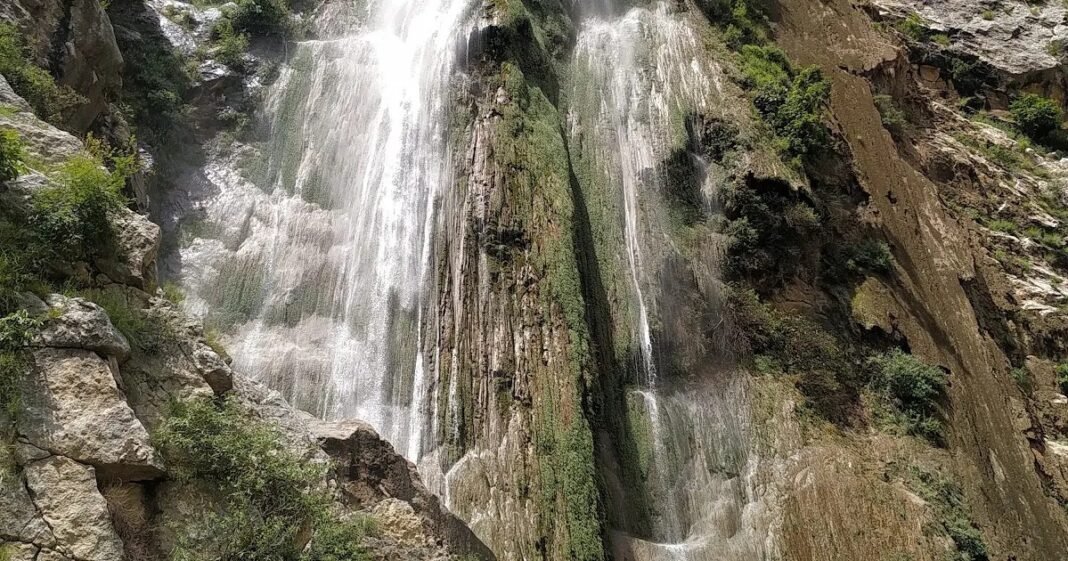
Less than a two-hour drive from Islamabad, hidden in the pine-covered hills of Haripur district, a ribbon of spring water drops some 400 feet down a green mountainside. This is the Chajjian Waterfall, the tallest waterfall in Hazara Division, and it may be the most rewarding secret in Khyber Pakhtunkhwa’s low hills. There are no ticket booths, no crowds, no food courts: just you, the pines, the district’s highest peak watching over the valley, and water that has been falling here since long before anyone thought to visit. If you want a real day out from Islamabad that does not involve the Margalla crowds, this is it. This Chajjian Waterfall travel guide covers everything: why it deserves your visit, the best time to go, what to do there, and how to reach it.
Quick Facts
- Location: Outskirts of Chhajjian village, Haripur District, Khyber Pakhtunkhwa
- Altitude: Hill country of the Hazara foothills; the falls drop about 400 feet (120 metres)
- Famous For: Being the tallest waterfall in Hazara Division, pine forests, and natural springs
- Nearest City: Haripur, about 25 kilometres away; Islamabad is the main gateway
- Accessibility: Drive to Chhajjian village, then walk or hike the final stretch; no proper road reaches the falls
- Known Landmarks: Siribang peak (the district’s highest), the Haro River downstream, traditional watermills
- Best For: Day-trippers from Islamabad, hikers, picnickers, photographers, and nature lovers
Why Visit Chajjian Waterfall
The best travel discoveries are the ones that still feel like discoveries. The Chajjian Waterfall has been known to locals for generations, and environmentalists from Haripur have been bringing their families here for years, but it has never been developed, never been marketed, and never been crowded. You will likely share it with more pine trees than people. In a country where every famous waterfall now comes with a queue, that alone makes Chajjian worth the trip.
The setting does the rest of the convincing. The waterfall sits on the outskirts of Chhajjian, a valley in the south-east of Haripur District wrapped in pine-covered mountains rich in wildlife. The falls are fed by natural springs, so the water runs fresh and clean, and the district’s highest peak, Siribang, overlooks the whole scene. About five kilometres downstream, the water joins the Haro River, and on the way it turns four traditional watermills that local families still use to grind their flour. This is a working landscape, not a theme park, and that is precisely its charm.
Then there is the sheer convenience. This is a genuine wilderness waterfall within easy reach of the capital: close enough for a day out, far enough to feel like an escape. Pair it with the Noori waterfall in the same part of the district, or with Khanpur Dam’s blue waters and water sports, and you have a full day of the Hazara foothills at their best. Come after the monsoon when the falls run strongest, bring a picnic, and remember what quiet sounds like.
History of Chajjian Waterfall
The Chajjian Waterfall has no recorded human history in the sense of rulers and battles; its history is the older story of the land itself. The falls are fed by natural springs in the pine-covered hills around Chhajjian village, and the water has carved its 400-foot descent over geological time. The village below, home to more than 3,000 people, has lived with the waterfall for generations: the spring water feeds the fields, turns the four watermills, and eventually sinks into the Haro River about five kilometres downstream.
The waterfall entered the public record in 2012, when The Express Tribune reported it as the tallest waterfall in Hazara Division and lamented that it remained inaccessible and undeveloped for lack of road links and tourism investment. The report described Chajian village as surrounded by green hills with large reserves of minerals, forests, and springs, and noted the waterfall’s year-round flow, except in winter when snowfall chokes the springs. That story of neglect has, in a way, become the waterfall’s protection: without development, it remains pristine.
In recent years, the wider Haripur waterfall country has started to get attention. The separate Hazara Waterfalls in Jab Valley, discovered in 2021, received a UK-funded eco-tourism project through WWF-Pakistan that built walking tracks and viewing platforms, completed in 2025. That project does not cover Chajjian, which remains undeveloped, but it signals a growing recognition of what these hills hold. For now, Chajjian is still the locals’ waterfall, and visiting it feels like stepping back to a time before tourism arrived.
Top Things to Do in Chajjian Waterfall
Walk to the Falls from Chhajjian
The approach is half the experience. From Chhajjian village, the path to the waterfall crosses pine forest and hill country, and the absence of a proper road means the walk is peaceful and green. Wear proper walking shoes, the terrain is uneven in places, and allow enough time to enjoy the walk rather than rush it. The moment the falls come into view through the trees is the payoff.
Picnic in the Pines
This is classic picnic country. The pine-covered hills around the falls offer endless shady spots with valley views, and local families have been picnicking here for years. Bring your own food and water, there are no shops or restaurants at the falls, and carry everything back out with you. The Leave No Trace principle matters doubly in a place this unspoiled.
Photograph the 400-Foot Drop
At 400 feet, the tallest waterfall in Hazara Division makes a superb subject. The falls run strongest after the monsoon, when rainwater swells the spring flow, and the surrounding pines frame the shot beautifully. Early morning light is kindest, and a wide-angle lens earns its keep here.
Watch the Watermills at Work
Before the water reaches the Haro River, it powers four traditional watermills that local families rely on for flour. If you walk the stream below the falls, you may see these simple, ingenious mills in action, a living piece of hill-country heritage that has barely changed in a century.
Combine It with the Noori Waterfall
The Noori waterfall lies in the same south-eastern part of Haripur District, and the two make a natural pair for a full day of waterfall hunting. Ask locals in Chhajjian for the current condition of the tracks; they know these hills better than any map.
Famous Places In and Around Chajjian Waterfall
- Khanpur Dam — The blue-water lake a short distance away, famous for boating, jet skis, parasailing, and cliff diving.
- Noori Waterfall — Another waterfall in the same part of Haripur District, ideal for pairing with Chajjian.
- Haro River — The river the waterfall feeds about five kilometres downstream.
- Taxila — The ancient Gandharan city on the route back toward Islamabad, a UNESCO World Heritage Site.
- Bhamala Stupa — The historic Buddhist stupa near Khanpur, part of the area’s heritage circuit.
- Haripur City — The district headquarters, for supplies, food, and a look at a classic Hazara town.
How to Reach Chajjian Waterfall
From Islamabad: Take the Taxila-Haripur road toward Haripur district. Chhajjian lies in the south-east of the district, a valley surrounded by pine-covered hills, a short distance from Khanpur Dam. The drive from Islamabad to the Haripur/Khanpur area takes roughly an hour to 90 minutes depending on traffic. From the main road, local roads lead to Chhajjian village; the final stretch to the waterfall itself has no road access and must be covered on foot, which is part of the adventure. Ask in the village for the current path, conditions change with the seasons.
From Lahore: Take the motorway to Islamabad/Rawalpindi (about 375 km, 4-5 hours), then continue to Haripur as above. This is best done as an overnight trip with a night in Islamabad or at Khanpur.
From Karachi: Fly to Islamabad (about 2 hours), then drive to Haripur. Plan at least two days for the trip.
Transport options: A private car or a hired car with a driver is by far the best option, as public transport does not reach Chhajjian village. Ride-hailing apps can get you from Islamabad to Khanpur or Haripur town, but for the village roads and the flexibility to explore, your own vehicle is essential. A high-clearance vehicle helps on the rougher village tracks.
Nearest airport: Islamabad International Airport.
Route Details
Step 1: Drive from Islamabad via the historic Taxila route toward Haripur district (the Taxila-Haripur road).
Step 2: Head for the Khanpur/Chhajjian area in the south-east of Haripur District; Khanpur Dam is the well-known landmark nearby.
Step 3: Follow local roads to Chhajjian village, the pine-covered valley at the foot of the falls.
Step 4: Park in the village, ask locals for the current walking path, and hike to the waterfall. Allow half a day for the whole outing.
Where to Stay in Chajjian Waterfall
There is no accommodation at the waterfall or in Chhajjian village itself: this is a day trip, not an overnight destination. The practical bases are Haripur city, the Khanpur Dam area, and Islamabad. Around Khanpur Dam there are lakeside resorts and guesthouses catering to weekend visitors, a good choice if you want to combine the waterfall with the dam’s water sports. Haripur has simple hotels and guesthouses for budget travellers. Most visitors simply day-trip from Islamabad, where the full range of the capital’s hotels, guesthouses, and guest rooms is available. If you want a quieter night, the guesthouses around Khanpur offer the sound of water instead of traffic.
Where to Eat: Local Foods of Chajjian Waterfall
Bring a picnic: there are no restaurants at the falls, and that is part of the point. Pack food and plenty of water in Islamabad or Haripur before you set out. In the wider area, the food is classic Hazara and Punjabi hill-country fare: chapli kebabs, seekh kebabs, daal, saag, and fresh tandoori roti at the roadside dhabas. If you stop at Khanpur Dam, do not miss the freshly cooked mahseer-family fish (mahasher) that the lakeside is known for, best eaten with your feet near the water. Khanpur is also famous for its orange orchards, and in season you will find vendors selling oranges along the roadside. A dhaba meal in the area is budget-friendly; the lakeside restaurants at Khanpur cost a little more.
Weather in Chajjian Waterfall
The Haripur foothills have a milder version of Punjab’s climate, cooled by altitude and the pine forests. Summers are warm but far more bearable than the plains, winters can be genuinely cold with occasional snowfall on the higher slopes, and the monsoon swells the waterfall to its most spectacular. The falls flow year-round on spring water, except in the coldest winter weeks when snowfall can choke the springs.
| Season | Temperature Range | Conditions |
|---|---|---|
| Winter (Dec-Feb) | 0-15 C | Cold, occasional frost and snow on high slopes; springs may freeze, flow reduced |
| Spring (Mar-Apr) | 15-28 C | Pleasant and green; wildflowers; excellent for hiking |
| Summer (May-Jun) | 25-38 C | Warm but comfortable in the hills; carry water; start early |
| Monsoon (Jul-Sep) | 25-33 C | Waterfall at its strongest and most beautiful; take care on slippery tracks after heavy rain |
| Autumn (Oct-Nov) | 12-25 C | Clear skies, crisp air; a lovely shoulder season for the walk |
Language and Culture of Chajjian Waterfall
The valley’s name itself, Chhajjian, comes from the Hindko language, and Hindko is the everyday tongue of these villages, alongside Urdu, which everyone understands. Haripur district sits at the meeting point of Hazara’s Hindko culture and the Pashtun areas to the west, and you will hear both influences in the bazaars. The culture is rural and conservative: dress modestly, greet elders respectfully, and ask before photographing people. The village community is closely knit, and a polite request for directions will usually earn you not just directions but a detailed briefing on the path, the water level, and the best picnic spot. Respect private and community land, keep noise down, and remember you are a guest in someone’s home valley.
Shopping in Chajjian Waterfall
There is no shopping at the waterfall, which is exactly as it should be. For souvenirs, stop in Haripur’s bazaars for local honey, desi ghee, and seasonal fruit, or buy oranges from the famous Khanpur orchards sold by roadside vendors in season. Dried fruits and nuts from the Hazara region make good take-home gifts. This is a trip for experiences, not purchases: the photographs are the souvenir.
Travel Tips for Chajjian Waterfall
Packing Essentials
Sturdy walking or hiking shoes with grip (the track can be slippery), a daypack with water and snacks, sun protection, a basic first-aid kit, and a fully charged phone. Bring a rubbish bag: there are no bins at the falls, and everything you carry in must come back out. A walking stick helps on the steeper sections.
Safety Tips
Do not swim at the base of the falls or in the plunge pools: waterfall pools are deceptively dangerous, with strong currents and hidden depths, and the district administration has at times restricted swimming in Haripur’s water bodies. Keep children close to you near the water and on the track. Take extra care after heavy rain, when paths are slippery and the flow is powerful. Tell someone your plan before you set out, and start the walk early enough to return in daylight.
Money & Connectivity
Carry cash: there are no ATMs in Chhajjian village, and the nearest reliable ATMs are in Haripur city. Mobile signals are patchy in the hills, so download offline maps before you leave Islamabad and do not rely on live navigation for the last stretch. Fuel up before leaving the main road.
Best Time to Visit Chajjian Waterfall
Monsoon and Post-Monsoon (July-October): The Falls at Their Best
This is when the Chajjian Waterfall earns its reputation. Monsoon rain swells the spring flow, and the falls thunder down at their most spectacular, framed by impossibly green pines. Go after a heavy rain for maximum drama, but take care on the wet track. October brings clear skies and the same strong flow with easier walking.
Spring (March-April): The Walker’s Season
Mild temperatures, wildflowers, and comfortable hiking make spring the best season for the walk itself. The flow is moderate but the whole valley is at its prettiest, and the pines smell wonderful after rain. Ideal for families and casual hikers.
Summer (May-June): The Escape Season
When the plains bake, the Haripur hills stay bearable, and the waterfall’s spray is deliciously cool. Start early to beat the heat on the walk, carry plenty of water, and combine the trip with Khanpur Dam for a swim-safe water stop.
Winter (December-February): Quiet but Limited
Winter is the quietest season and the flow is at its weakest; in the coldest weeks, snowfall can choke the springs altogether. The hills are still beautiful in crisp winter light, but check conditions locally before making the trip.
Final Thoughts
The Chajjian Waterfall is a reminder that Pakistan’s greatest travel experiences are not always the famous ones. A 400-foot cascade in a pine valley, four watermills turning below it, the highest peak of the district standing guard, and not a ticket booth in sight: this is the Hazara foothills at their most honest. It asks a little effort of you, a drive, a walk, a picnic carried on your back, and it repays that effort many times over.
Go after the monsoon, go with friends or family, go with a rubbish bag and a camera, and go before the rest of the world finds out. For more escapes from the capital, see our places to visit in Islamabad, dream bigger with our Hunza Valley guide, or browse the full Explore Pakistan collection. The waterfall will be waiting.
FAQs
Where is Chajjian Waterfall located?
It is on the outskirts of Chhajjian village in the south-east of Haripur District, Khyber Pakhtunkhwa, about 25 kilometres from Haripur city and a short distance from Khanpur Dam.
What is the best time to visit Chajjian Waterfall?
March to October is the recommended window. The falls run strongest during and after the monsoon (July to September); spring offers the most pleasant hiking weather.
How do I reach Chajjian Waterfall from Islamabad?
Drive via the Taxila-Haripur road toward the Khanpur/Chhajjian area (roughly 1 to 1.5 hours), continue on local roads to Chhajjian village, then walk the final stretch to the falls. A private car is essential.
How tall is Chajjian Waterfall?
About 400 feet (120 metres), making it the tallest waterfall in Hazara Division. It is fed by natural springs and overlooked by Siribang, the district’s highest peak.
Is Chajjian Waterfall safe for families?
Yes for a careful day trip: the walk and picnic are family-friendly, but keep children away from the water’s edge, do not swim in the plunge pools, and return before dark.
Where can I stay near Chajjian Waterfall?
There is no accommodation at the falls. Stay at lakeside resorts near Khanpur Dam, simple hotels in Haripur, or day-trip from Islamabad.
What food is available near the waterfall?
None at the falls: bring a picnic. In the area, try roadside dhabas for kebabs and daal, and freshly cooked fish at Khanpur Dam, plus seasonal Khanpur oranges from roadside vendors.
Can I combine Chajjian with other attractions?
Yes. The Noori waterfall is in the same part of Haripur District, Khanpur Dam offers boating and water sports nearby, and Taxila’s ancient ruins lie on the route back to Islamabad.