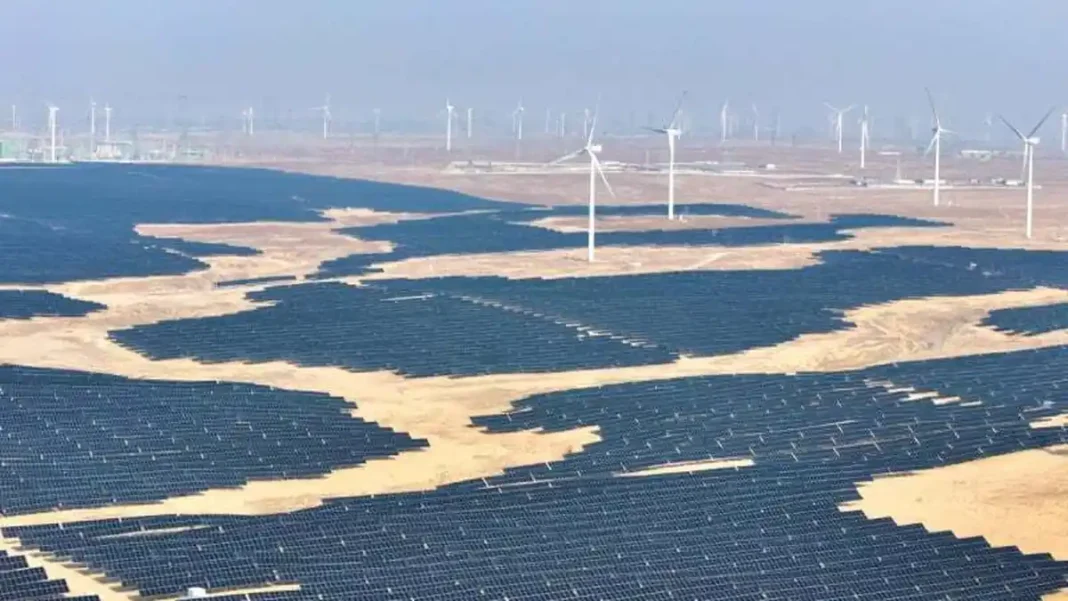
China Clean Tech Exports Hit $132bn for Developing World
China sent $132 billion in clean tech exports and investment to the developing world last year, a sum nearly as large as all the climate finance rich nations provided to poorer countries in 2024.
A Reuters analysis found that China’s green-manufacturing exports, built in part on heavy state subsidies, now rival the $137 billion in grants, loans and private finance that wealthy nations sent to poorer ones under their United Nations climate pledges.
The figures are not directly comparable: China’s total largely reflects commercial clean-energy transactions, while climate finance can also fund climate-resilient farming and repair after storms and floods. But the comparison shows the scale at which China’s factories now shape the energy transition in poorer countries.
What $132bn of clean tech avoids
The exports alone will help the Global South avoid 257 million tonnes of carbon dioxide a year once the equipment is in use, an amount equal to the annual emissions of France. That estimate comes from Lauri Myllyvirta, co-founder of the Helsinki-based Centre for Research on Energy and Clean Air.
This year’s exports from China are on track to avoid 337 million tonnes of carbon dioxide in the Global South, the analysis shows.
The $132 billion figure includes about $40 billion of Chinese foreign direct investment in clean-technology projects in developing countries, compiled by researchers at the London School of Economics. Nearly two thirds of China’s exports of solar panels, and the cells needed to make them, went to the developing world last year.
China clean tech exports and the Pakistan angle
Pakistan sits at the centre of this shift. The country imported 17 gigawatts worth of solar panels from China last year, according to data from Ember, roughly on par with Germany’s installations that year.
Those panels cut emissions, but for Pakistan the gain is more direct: cheap, reliable power, with solar spreading fast across rooftops, farms and small businesses as grid electricity became dearer and less reliable. The climate stakes are high: 2026 is most likely to rank as the second-hottest year on record, with global temperatures virtually certain to exceed 1.5 degrees Celsius above pre-industrial levels.
Chinese electric vehicles and buses are also entering the Pakistani market, with Ghandhara assembling Zhongtong buses locally, new models such as the Jaecoo J5 EV going on sale, and McDonald’s Pakistan adding StarCharge EV chargers.
Export giant, diplomatic mouse
Beijing has shown little interest so far in turning its commercial weight into leadership at global climate talks, even after President Donald Trump withdrew the United States from international climate cooperation in 2025. Its role is likely to take centre stage as nations gather this month for the UN’s COP31 climate conference in Antalya, Turkiye, but Beijing may be unwilling to move alone without Washington at the table.
Beijing may also worry that a bold stance on cutting carbon would bring pressure to give more climate aid or cut its own fossil-fuel emissions. China emits about a third of all carbon dioxide and still burns coal for more than half of its power.
Li Shuo, who heads the China Climate Hub at the Asia Society Policy Institute, said China’s manufacturing boom offered another path: driving down the price of clean technology until developing countries adopt it for economic reasons.
“You can align it to your economic agenda,” he said.
Why the shift matters
China’s manufacturing boom has made renewable energy more affordable across the developing world. When Ethiopia banned combustion-engine car imports in 2024, it was the first country to take such a step, driven less by emissions than by cutting its fuel import bill.
The picture differs in wealthy countries, which have imposed tariffs and other curbs on Chinese clean technology to protect their own manufacturers. The United States, for example, imposes tariffs above 100 per cent on Chinese electric vehicles.
How much clean tech did China send to the developing world?
China sent $132 billion in clean technology and investment last year, according to a Reuters analysis, nearly matching the $137 billion in climate finance from rich nations in 2024.
What does it mean for Pakistan?
Pakistan imported 17 gigawatts of solar panels from China last year, roughly on par with Germany’s installations, bringing cheaper power to homes, farms and businesses.
Is China still the biggest emitter?
Yes. China emits about a third of all carbon dioxide and still burns coal for more than half of its power, even as its clean-tech exports cut emissions elsewhere.