Quick Facts
- Location: In the Walled City of Lahore, Punjab, Pakistan — on the Shahi Guzargah (Royal Passage), opening onto Wazir Khan Chowk between the Wazir Khan Mosque and the Shahi Hammam.
- Altitude: Around 217 metres (about 712 feet) above sea level — Lahore’s old-city plain.
- Famous For: Being Lahore’s original Delhi Gate and main Mughal-era entry point; its white lime-plastered facade (“Chitta” means white); its position on the Royal Trail between Lahore Fort and Delhi Gate.
- Nearest City: It is inside Lahore itself — Pakistan’s second-largest city.
- Accessibility: Extremely easy — in the heart of the Walled City, reachable by rickshaw, taxi or on foot from Delhi Gate; best explored as part of a guided Walled City walk.
- Known Landmarks: Wazir Khan Mosque, Shahi Hammam, Delhi Gate, Well of Dina Nath, shrine of Syed Suf, Sonehri Mosque.
- Best For: History lovers, photographers, culture travelers, and anyone visiting Lahore who wants to walk the same royal road the Mughal emperors used.
Why Visit Chitta Gate
Most visitors to Lahore walk straight past it without realizing what they are looking at — and that is exactly why Chitta Gate deserves your attention. This modest, white-plastered gateway on the Royal Passage was once the main entrance to one of the greatest cities of the Mughal Empire. Before the grand Delhi Gate you see today was built about a hundred metres to the east, this was the Delhi Gate: the door through which emperors, armies, merchants and travelers entered Lahore, its doors shut every evening against the night.
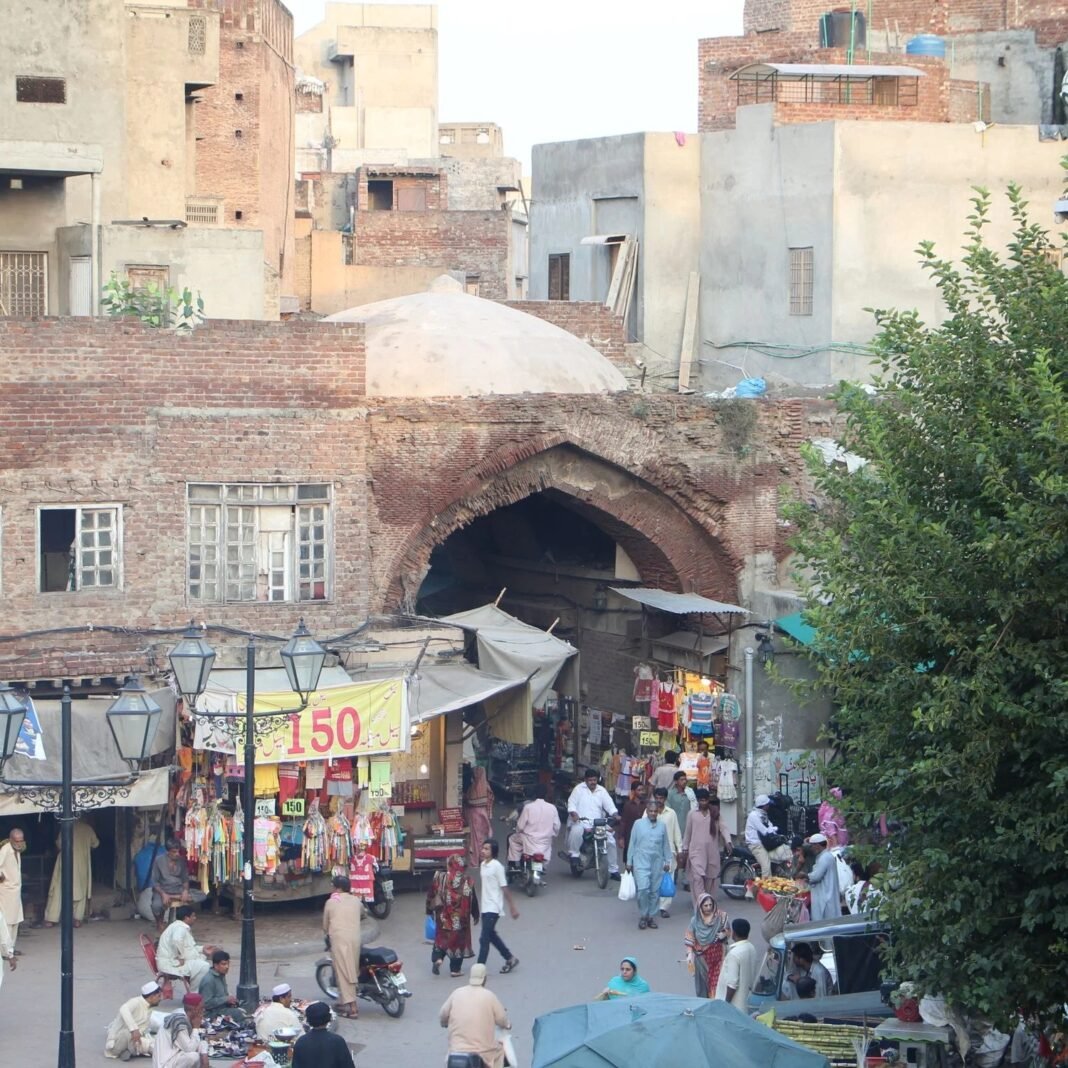
What makes the gate special today is not size but position. It stands on the Shahi Guzargah — the Royal Passage — the historic route connecting Lahore Fort to Delhi Gate, and it opens directly onto Wazir Khan Chowk, framed by two of the Walled City’s greatest monuments: the dazzling Wazir Khan Mosque on one side and the Shahi Hammam (royal bathhouse) on the other. Stand in the gate’s small inner chamber, look through its arch at the mosque’s minarets, and you are standing in a 375-year-old postcard.
Chitta Gate is also the perfect excuse to explore the Walled City properly. The bazaars spilling out around it — Delhi Gate Bazaar, Kashmiri Bazaar, the food lanes — are living museums of craft, food and everyday Lahori life. If your Pakistan travels have taken you to mountain valleys like Hunza or Malam Jabba, this chitta gate travel guide offers the essential counterpoint: the imperial, urban, Mughal soul of the country, all within a single walkable morning.
History of Chitta Gate
Chitta Gate was built in 1650, during the reign of the Mughal Emperor Shah Jahan — the builder of the Taj Mahal and, in Lahore, of much of the fort’s greatest architecture. In its original role it served as Lahore’s Delhi Gate: the city’s main eastern entry, named for the road that led toward Delhi, the Mughal capital. During the Mughal era it was the principal gateway of Lahore, and its doors were closed every evening.
The gate gets its current name from its appearance: “Chitta” means white in Punjabi, and the gateway was finished in a distinctive white glazed lime plaster that made it gleam — visible from a distance, a landmark for travelers approaching the city. Some accounts associate its construction with the era of the Wazir Khan Mosque (1634–35), suggesting it may have formed part of the mosque’s outer precinct planning; the widely cited completion date remains 1650.
Over time, a newer, grander Delhi Gate was built about 100 metres to the east, and the old gate settled into its second life as the “White Gate” on the Royal Passage. The Walled City of Lahore Authority has restored it in recent years as part of the Shahi Guzargah heritage trail, and today it stands — between mosque, bathhouse, old well and shrine — as one of the most atmospheric corners of old Lahore.
Top Things to Do in Chitta Gate
Stand in the Gate and Frame the Mosque
The classic Chitta Gate moment: position yourself in or just behind the gateway and look through its arch toward the Wazir Khan Mosque. The contrast — the plain white gate framing one of the most elaborately decorated mosques in the Islamic world — is the photograph that defines this corner of Lahore. Early morning light is kindest.
Walk the Shahi Guzargah (Royal Passage)
From Chitta Gate, walk the Royal Trail in either direction. Toward the east lies Delhi Gate and its bazaar; toward the west, the trail threads past the Shahi Hammam, Sonehri Mosque and old havelis toward Lahore Fort. This is the route Mughal emperors traveled between Delhi and Lahore — walking it is the closest you can come to time travel in the Walled City.
Visit the Wazir Khan Mosque
Steps from the gate stands the Wazir Khan Mosque (built 1634–35), a masterpiece of Mughal tilework and fresco — often called the most ornately decorated mosque of the Mughal era. Its faience tile mosaics, Persian-style frescoes and soaring minarets reward at least an hour. Non-Muslim visitors are welcome outside prayer times; dress modestly and remove shoes.
Explore the Shahi Hammam
On the other side of the gate, the Shahi Hammam — the royal Turkish-style bathhouse built by Wazir Khan in 1633 — has been beautifully restored. Its domed chambers, frescoed ceilings and ingenious water-heating system (hot water, steam rooms and marble pools) show the luxurious private world of the Mughal elite. Guided tours explain how the whole complex worked.
Find the Well of Dina Nath and the Shrine of Syed Suf
Immediately adjacent to the gate are two quieter landmarks: the historic Well of Dina Nath and the small shrine of Syed Suf. They are easy to miss and worth seeking out — they anchor the gate in the everyday spiritual life of the old neighborhood, beyond the grand monuments.
Browse Delhi Gate Bazaar
The 383-metre commercial spine of Delhi Gate Bazaar runs from outside Delhi Gate past Chitta Gate to Wazir Khan Chowk — a “city within a city” of spice sellers, cloth merchants, crockery shops and tea houses, developed in the era of Emperor Akbar. Come to browse, to haggle gently, and to drink chai while the old city flows past.
Famous Places In and Around Chitta Gate
- Wazir Khan Mosque — the tile-and-fresco masterpiece, steps from the gate.
- Shahi Hammam — the restored 1633 royal bathhouse.
- Delhi Gate — the grand replacement gate, about 100 metres east.
- Sonehri (Golden) Mosque — gleaming golden domes on the Royal Trail.
- Lahore Fort — the great citadel at the trail’s western end.
- Delhi Gate Bazaar & Akbari Mandi — historic markets along the trail.
- Kashmiri Bazaar & Kasera Bazaar — traditional craft and metalwork streets nearby.
- Fort Road Food Street — Lahore’s famous food street with fort views.
How to Reach Chitta Gate
Chitta Gate is in the Walled City of Lahore, one of the easiest heritage sites in Pakistan to reach. From within Lahore, take a rickshaw or taxi to Delhi Gate — the gate is a landmark every driver knows — then walk west along the Royal Trail past Delhi Gate Bazaar for about 100 metres to Chitta Gate and Wazir Khan Chowk. Ride-hailing apps work well for the approach; the last stretch is pedestrian lanes.
From Islamabad, Lahore is about 375 km via the M-2 motorway — roughly 4 to 5 hours by car or bus. From Karachi, fly to Lahore’s Allama Iqbal International Airport (about 1 hour 45 minutes) or take the train/bus (16+ hours). From elsewhere in Punjab, Lahore is the province’s hub — Daewoo and other bus services connect every major city.
The best way to experience the gate is as part of a Walled City guided walk: the Walled City of Lahore Authority and private operators run Royal Trail tours (Delhi Gate to Lahore Fort) that include Chitta Gate, the mosque, the hammam and the bazaars, often with breakfast or dinner options. Joining one solves navigation, unlocks the stories, and supports local guides.
Route Details
Step 1: Reach Lahore by motorway (M-2 from Islamabad), flight, or intercity bus.
Step 2: Take a rickshaw/taxi to Delhi Gate, the eastern entrance of the Walled City.
Step 3: Enter on foot and walk west along Delhi Gate Bazaar — the Royal Trail — for about 100 metres.
Step 4: You will reach Wazir Khan Chowk: Chitta Gate stands between the Wazir Khan Mosque and the Shahi Hammam. The whole walk from Delhi Gate takes under ten minutes.
Where to Stay in Chitta Gate
You will not sleep at the gate itself, but the Walled City and its surroundings offer atmospheric options. Inside and around the old city, family-run guesthouses and heritage-style lodgings put you steps from the Royal Trail — waking up to the call to prayer over the old city’s rooftops is an experience in itself. A few boutique properties in restored havelis offer real old-Lahore character.
Most visitors base themselves in modern Lahore — Gulberg, DHA and the Cantonment have the full range from luxury hotels to mid-range and budget options — and day-trip into the Walled City. This is the comfortable choice for families: modern amenities at night, the old city by day, with the drive to Delhi Gate taking 20 to 40 minutes depending on traffic. Whichever you choose, plan your Walled City visit for the morning, when the light is best and the bazaars are just waking up.
Where to Eat: Local Foods of Chitta Gate
The streets around Chitta Gate are some of the best eating streets in Lahore — and that is saying something. Start the day the Lahori way with a traditional breakfast: siri paye, nihari, halwa puri and lassi from the old city’s legendary breakfast shops. For lunch, the Delhi Gate food lanes serve kebabs, tikkas, daal and fresh naan from tandoors that have been running for generations.
In the evening, walk the Royal Trail toward Fort Road Food Street, where rooftop restaurants serve the full Lahori grill repertoire with the illuminated Lahore Fort as your backdrop. Do not miss the kulfi, falooda and Kashmiri chai from the old city’s dessert vendors. Prices in the Walled City are refreshingly down-to-earth — a full meal at a local eatery costs far less than the same food in modern Lahore’s restaurants. As with all street food, eat where the crowds are: high turnover means fresh food.
Weather in Chitta Gate
Lahore has a classic Punjab climate: pleasant winters, brutal summers and a short monsoon. The Walled City’s narrow lanes offer shade, but summer afternoons are still punishing — plan heritage walks for the cooler months or early mornings.
| Season | Temperature Range | Conditions |
|---|---|---|
| Winter (Dec–Feb) | 5°C to 20°C | The best season: crisp mornings, sunny days, perfect walking weather; occasional fog in January. |
| Spring (Mar–Apr) | 18°C to 35°C | Pleasant early, warming fast; good for morning walks before the heat builds. |
| Summer (May–Jul) | 30°C to 45°C | Extremely hot; avoid midday walks; monsoon rains arrive in July with humidity. |
| Autumn (Sep–Nov) | 20°C to 35°C | Cooling down; October and November are excellent for sightseeing. |
Language and Culture of Chitta Gate
The Walled City speaks Punjabi first — the earthy, warm Lahori Punjabi — with Urdu universal as the common language and English widely understood in shops and tour services. This is Androon Lahore (the inner city), the cultural heart of Punjab: famous for its hospitality, its food obsession, its music and its distinctive humor.
Visitors should dress modestly (covering shoulders and knees is respectful around mosques and shrines), remove shoes before entering the Wazir Khan Mosque, and ask before photographing people in the bazaars — most will happily agree, and many will pose with pride. Bargaining is expected in the bazaars but keep it friendly. If you are offered chai by a shopkeeper, accept: in the Walled City, tea is the beginning of every friendship.
Shopping in Chitta Gate
Skip the malls — the bazaars around Chitta Gate are the shopping. Delhi Gate Bazaar and Akbari Mandi sell spices, dry fruits and food grains in glorious, fragrant abundance. Kashmiri Bazaar is known for traditional goods, Kasera Bazaar for brass and metalwork, and Azam Cloth Market — one of Asia’s largest cloth markets — for fabrics at wholesale prices. Look for antique crockery, traditional furniture, embroidered textiles (phulkari), khussay (embroidered shoes) and Lahori handicrafts.
For souvenirs with a story, the WCLA craft shops near Delhi Gate sell artisan-made pieces that support local craftspeople. Prices are negotiable in the traditional bazaars — start at about two-thirds of the asking price and meet in the middle with a smile.
Travel Tips for Chitta Gate
Packing Essentials
Comfortable walking shoes (the Royal Trail is cobbled and uneven), a hat and water in warmer months, modest clothing for mosque visits, and a scarf for women entering religious sites. Bring small-denomination cash for the bazaars and a fully charged phone — you will take hundreds of photos.
Safety Tips
The Walled City is busy, crowded and generally safe for tourists, especially on guided walks. Keep valuables close in crowded bazaars, agree rickshaw fares before riding, and avoid the narrowest lanes after dark unless with a guide. The guided Royal Trail tours are the simplest way to see everything safely and with full context.
Money & Connectivity
Cash is king in the old bazaars — carry small notes, as change for large bills can be hard. ATMs are available on the main roads around the Walled City but not inside the lanes. Mobile signals from all major networks work well throughout the area.
Best Time to Visit Chitta Gate
Winter (November to February) — Perfect
Cool, sunny days made for walking; the Walled City at its most comfortable and photogenic. This is the prime season — plan your Lahore trip around it if you can.
Spring (March to April) — Lovely Mornings
Warm but manageable, especially for early-morning walks before the heat. The city’s gardens are in bloom.
Summer (May to August) — Avoid Midday
Lahore’s summer is fierce; if you must visit, explore at dawn, retreat to air conditioning by noon, and return for the illuminated monuments at night.
Autumn (September to October) — The Comeback
Temperatures fall, the monsoon clears, and October brings some of the year’s finest sightseeing weather.
Final Thoughts
Chitta Gate will never be the biggest monument in Lahore — the fort, the Badshahi Mosque and the Wazir Khan Mosque all outshine it in scale. But monuments are not only measured in size. This small white gate is where Lahore’s story as an imperial city begins: the original front door, the emperors’ road, the arch that frames the mosque. In a city of grand statements, it is the quiet first sentence.
Walk through it slowly, look back through the arch, and then let the Royal Trail carry you onward — to the hammam, the bazaars, the fort. Old Lahore rewards those who arrive on foot and in no hurry. For more of the country’s heritage, explore our Explore Pakistan collection.
FAQs
Where is Chitta Gate located?
In the Walled City of Lahore, on the Shahi Guzargah (Royal Passage) — opening onto Wazir Khan Chowk, between the Wazir Khan Mosque and the Shahi Hammam.
Why is it called Chitta Gate?
“Chitta” means white in Punjabi — the gate was finished in a distinctive white glazed lime plaster that made it gleam and visible from a distance.
When was Chitta Gate built?
In 1650, during the reign of Mughal Emperor Shah Jahan. It served as Lahore’s original Delhi Gate and main city entrance.
What is near Chitta Gate?
The Wazir Khan Mosque and Shahi Hammam (both steps away), Delhi Gate (about 100 metres east), Sonehri Mosque, Delhi Gate Bazaar, and Lahore Fort at the end of the Royal Trail.
What is the best time to visit Chitta Gate?
November to February offers the best weather for walking the Walled City. Avoid summer midday heat; mornings are best year-round.
How do I reach Chitta Gate?
Take a rickshaw or taxi to Delhi Gate in Lahore’s Walled City, then walk west along the Royal Trail for about 100 metres to Wazir Khan Chowk. Guided Walled City walks include it.
Is Chitta Gate good for families?
Yes — the Royal Trail walk is flat, short and packed with interest for all ages. Go in the morning, combine it with the mosque and hammam, and finish with lunch at Fort Road Food Street.
Is there an entry fee for Chitta Gate?
The gate itself is a public thoroughfare on the Royal Trail with no ticket. The nearby Shahi Hammam and guided tours may have small fees — confirm locally.